
























Opening
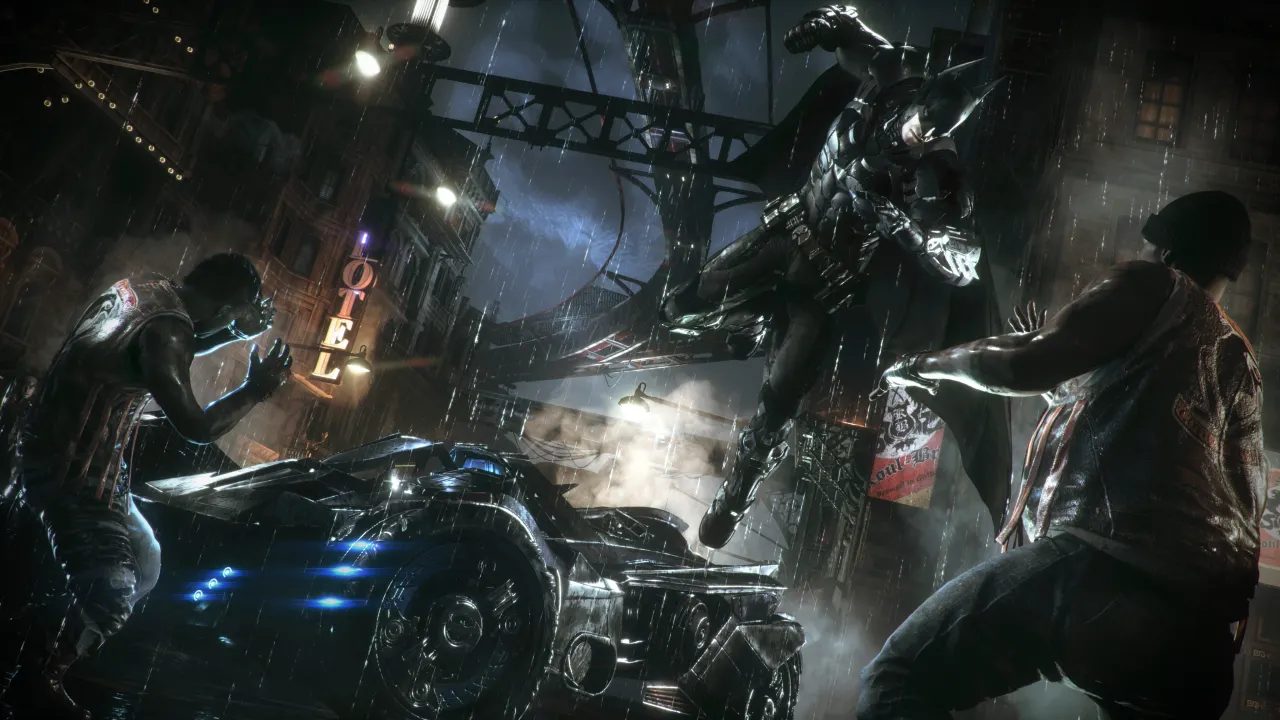
Rocksteady's Arkham trilogy redefined what a superhero game could be, and Batman: Arkham Knight is its grand, operatic finale — the night Gotham falls, and the last full performance of Kevin Conroy's Batman and Mark Hamill's Joker together. It is a game of soaring highs and one genuinely costly misstep, a near-masterpiece whose ambition occasionally outruns its judgment, and a fitting, flawed send-off to one of gaming's most influential series.
The setup is apocalyptic. On Halloween night, the villain Scarecrow threatens to blanket the city in a cloud of fear toxin, the civilians are evacuated, and Gotham is handed over to its criminals and to a mysterious, militarized new foe — the Arkham Knight — who knows Batman's every move. Across a Gotham roughly five times the size of Arkham City, you glide, fight, and detect your way through a single desperate night, while the ghost of the Joker whispers in Batman's fractured mind in some of the best-written scenes the genre has produced.
The combat is the fourth and most refined evolution of Rocksteady's FreeFlow system, now with seamless Dual Play tag-team takedowns, and the audiovisual craft — that rain-soaked Gotham, that voice cast — remains unmatched eleven years on. But the game also leans hard on a divisive new Batmobile and a wall of collectibles that drag its content score down. This review breaks down where the finale soars, where it stumbles, and who it is for.
Story | 9.2/10
ストーリー: 9.2/10The story is Arkham Knight at its very best — a dark, emotionally charged, superbly structured finale that brings Rocksteady's trilogy to a genuinely satisfying close. It treats Batman not as an invincible icon but as a man being slowly broken, and it uses the medium's interactivity to put you inside that unraveling in a way film never could. The high story score reflects a campaign that is one of the best-written in the superhero genre.
A City Falls in Five Acts
The narrative is structured with real craft, escalating across its acts as Gotham descends into chaos over a single night. Scarecrow's evacuation of the city gives the whole game a haunting, apocalyptic atmosphere — empty streets, abandoned homes, criminals roaming a metropolis given over to fear — and that emptiness is its own kind of storytelling, a Gotham hollowed out and waiting for its protector to fail. The pacing tightens as the stakes rise, each act stripping away more of Batman's certainty and support until he stands almost alone against a city turned against him.
This atmosphere is the foundation everything else builds on. The game understands that a superhero story works best when the hero is genuinely tested, and it spends its entire runtime testing Batman — physically, tactically, and psychologically. The result is a campaign with a constant sense of mounting dread, the feeling that this night could genuinely be the one where everything comes apart, and that tension gives even the spectacle real weight. The empty city is a masterstroke of restraint — by evacuating the civilians, the game frees itself to stage an apocalyptic war across Gotham while keeping the focus tight on Batman, his allies, and his enemies, so the scale never dilutes the intimacy of his personal crisis.
The Joker in Batman's Head
The masterstroke of the writing is the Joker. Though dead, he lingers as a hallucination in Batman's mind throughout the game, a manifestation of the hero's deepest fear that he might become like his greatest enemy. Mark Hamill's performance is extraordinary, by turns hilarious, menacing, and genuinely unsettling, and the scenes where the Joker taunts, narrates, and slowly tries to take over Batman's psyche are the best-scripted moments in the entire series. It is a bold, psychological approach to a villain everyone assumed was finished, and it pays off as one of the most memorable antagonist treatments in any game.
These hallucination sequences are where the game's writing reaches its peak, blending dark comedy with real horror as Batman fights to hold onto himself. They externalize the central theme — the thin line between the hero and the monster — and give Hamill a final showcase that stands as a fitting capstone to one of the medium's great vocal performances. For longtime fans, it is an unforgettable send-off, and it transforms what could have been a generic villain-of-the-week plot into a genuine character study of Batman himself, asking the most interesting question the series ever posed: what is left of the man when his greatest enemy lives on inside his own head.
Gordon, the Knight, and a Worthy Send-Off
The supporting cast anchors the human stakes, with Jonathan Banks lending Commissioner Gordon a weary gravity and John Noble's Scarecrow carrying the menace of the Gotham-falls arc, while the central mystery of the Arkham Knight's identity threads tension through the whole campaign. The reveal of who the Arkham Knight truly is lands as an emotional gut-punch tied directly to Batman's past, recontextualizing the antagonist from a faceless military threat into a personal tragedy, and it is the kind of twist that deepens rather than cheapens the story.
It all builds to the Knightfall Protocol, the elaborate closing sequence that serves as the trilogy's final ritual — a deliberate, ceremonial ending that asks you to have truly finished Batman's work before it grants its full conclusion. The voice ensemble across the whole game is a genuine masterclass, still cited eleven years later, and together with the writing it elevates the campaign well above the genre's usual fare. The honest note is that the story is occasionally interrupted by the gameplay's weaker elements, but the narrative itself is exceptional, and the score reflects superhero storytelling at the top of its form. It is the rare licensed game whose story would stand proudly on its own merits, independent of the brand, and that is the highest compliment a campaign like this can earn.
Audio | 9.4/10
サウンド: 9.4/10The audio of Arkham Knight is one of its crowning achievements, and arguably the single element that has aged the least. Between a legendary voice cast delivering career-defining performances, a sweeping orchestral score, and sound design that makes Gotham feel alive and Batman feel powerful, the game's audio is a bar the genre still measures itself against. The near-top score is fully earned.

A Voice Cast for the Ages
The voice acting is the heart of the audio and the heart of the game. Kevin Conroy and Mark Hamill deliver their final full performances together as Batman and the Joker, and the weight of that finality is felt in every line — Conroy's Batman is granite resolve cracking under pressure, Hamill's Joker a gleeful, malevolent presence that steals every scene he haunts. Their duet is the emotional and dramatic core of the experience, and it is impossible to overstate how much these two performances elevate the material. For a generation of fans, these are the definitive voices of these characters, and hearing them share the screen one last time is genuinely moving.
The supporting ensemble is just as strong. John Noble brings a chilling theatricality to Scarecrow, making him a credibly terrifying architect of Gotham's downfall, while Jonathan Banks lends Commissioner Gordon a grounded, world-weary humanity that anchors the human stakes. The entire cast performs at a level rarely seen in games, and the result is a voice ensemble still held up as a textbook example of the craft more than a decade later. The dialogue is delivered with such conviction that even the game's most melodramatic beats land with real force.
Score, Soundscape, and the Roar of the Batmobile
The musical score perfectly complements the dark, epic tone, swelling with orchestral grandeur during the game's biggest moments and dropping to tense, brooding atmosphere as Batman stalks through the shadows. The music understands when to soar and when to recede, amplifying the spectacle of a glide across the skyline or the dread of a Scarecrow sequence without ever overwhelming them. It is film-grade scoring that gives the whole game a cinematic sweep.
The sound design seals the immersion. The constant patter of rain on Gotham's streets, the ambient menace of a city given over to criminals, and the meaty, satisfying impact of every punch and counter in combat all combine to make the world feel tangible and Batman feel like an unstoppable force. The Batmobile, whatever one thinks of its gameplay, sounds magnificent — the throaty roar of its engine and the concussive force of its impacts giving it real presence and power. Across platforms the audio carries over faithfully, preserving the performances and the mix, and on a good sound system the rainy, orchestral, perfectly-voiced Gotham is an enveloping experience. It is audio craft at the highest level, and it is exactly what earns this dimension its near-perfect mark — the rare game where you could close your eyes and still feel the full weight of its world through sound alone.
Visuals | 9.0/10
グラフィック: 9/10Arkham Knight is a visual landmark, and its rain-soaked Gotham remains one of the most atmospheric cityscapes ever rendered — eleven years on, few open-world games have surpassed it. The strong score reflects a presentation of extraordinary artistry and technical ambition, tempered only by the notorious state of its original PC release. As a piece of art direction, it is close to untouchable.

The Rainy Gotham That Nobody Has Matched
The defining visual achievement is the city itself. Gotham at night, perpetually slicked with rain, is a triumph of mood and craft, and the secret is in the surfaces. Rocksteady developed bespoke rendering techniques for wet asphalt — custom surface normals and delayed reflections that make every street glisten with neon light, every puddle mirror the city above it. The effect is hypnotic, a noir metropolis that feels drenched, moody, and alive, and it is a large part of why the game's atmosphere is so overwhelming. This is not just a technically impressive city but an artistically perfect one, the visual embodiment of everything Batman's Gotham should be.
What makes it endure is that the artistry was never dependent on raw horsepower alone. The lighting, the reflections, the constant motion of rain and the play of neon on wet stone create a coherent, deliberate aesthetic that does not date the way pure fidelity does. Glide above the skyline and look down at the shimmering streets, and you are seeing a vision of Gotham that the genre has spent over a decade failing to top.
A City of Scale and Detail
The sheer scale of this Gotham is the other half of the achievement. Spanning three islands at roughly five times the footprint of Arkham City, it is a dense, vertical, lovingly detailed metropolis built for traversal, and gliding and grappling across its rooftops is a constant visual pleasure. The city is packed with detail — crumbling facades, criminal-tagged walls, the eerie emptiness of an evacuated population — that rewards close attention and sells the fiction of a great city in its darkest night.
The character models match the environments. Batman himself, rendered in a damaged, battle-worn suit, is a marvel of detail, and the villains are brought to life with striking, expressive designs that make the cutscenes as visually arresting as the gameplay. The animation across both combat and story is fluid and weighty, giving Batman a tangible physical presence whether he is gliding through the rain or laying out a room of thugs. Every element of the visual presentation pulls toward the same goal of making you feel like the Dark Knight in his definitive city. The cutscene direction deserves special mention, framing its dramatic moments with a cinematic eye — dramatic angles, expressive lighting, and a restraint that lets the performances breathe — so the transitions between play and story never break the visual spell. It is a game that looks like a high-end Batman film in nearly every frame, whether you are in control or watching events unfold.
Weather, Atmosphere, and the PC Asterisk
The lighting and weather systems are the finishing touch, with the rain, the rolling fog, the glow of fires across a city in chaos, and the dynamic play of light all combining into an oppressive, cinematic atmosphere that few games achieve. The mood shifts as the night deepens and Gotham falls further, the visuals tracking the narrative's descent, so the look of the game is always reinforcing its story of a city on the brink.
The one genuine blemish is historical: the 2015 PC release was a notorious disaster, locked at thirty frames per second, plagued by crashes and missing textures, and pulled from sale for months while it was repaired. That launch left a legacy of negative reviews that still weighs on the game's score today, even though the PC version was eventually fixed into a solid, good-looking port. On console the game was always excellent, and on a patched PC it is excellent now. That asterisk aside, this is one of the finest-looking and most atmospheric open worlds ever made. The fact that its rainy Gotham still tops "best-looking cities in games" lists a decade later, against far newer and more powerful releases, is the clearest possible proof that great art direction outlasts raw technology — and the score reflects art direction of the very highest order.
Combat | 9.5/10
ゲーム性: 9.5/10The gameplay of Arkham Knight is where its highest highs and its one real weakness both live. The core of being Batman — the combat, the stealth, the traversal, the detective work — is the most refined the series ever achieved, a near-perfect expression of the power fantasy. But the heavy emphasis on the new Batmobile, and one mode in particular, introduces the friction that keeps this from a flawless score. It is brilliance with an asterisk.

FreeFlow Combat at Its Peak
The melee combat is the fourth and finest evolution of Rocksteady's FreeFlow system, the rhythmic, flowing brawling that the entire genre has spent a decade imitating. Striking, countering, dodging, and weaving environmental takedowns into one seamless ballet feels better here than ever, the animation and feedback so polished that a well-executed fight against a dozen enemies is pure, balletic satisfaction. The new Dual Play feature deepens it further, letting you seamlessly hot-swap mid-combat between Batman and an ally — Robin, Nightwing, or Catwoman — to chain dual takedowns, pushing the crowd-fight rhythm to the series' absolute peak. It is combat as expressive performance, accessible to learn and deep to master.
Alongside the brawling, the predator stealth sequences remain a tense, satisfying highlight. Perched in the rafters above a room of patrolling enemies, taking them out one by one with gadgets and fear takedowns while their panic mounts, is a power fantasy executed with real craft. The detective vision system ties it all together, letting you scan the environment, follow clues, and analyze enemy formations, so the game flows naturally between investigation, stealth, and combat in a way that consistently makes you feel like the world's greatest detective and its most dangerous fighter.
The Batmobile and the Tank-Battle Problem
The major new addition is the Batmobile, and it is a genuine double-edged sword. As a traversal tool it is a thrill — tearing through Gotham's streets at speed, launching off ramps, and grappling into a glide is exhilarating, and the car handles with a satisfying weight. The problem is its combat. The Batmobile transforms into a hovering Battle Mode tank to fight waves of unmanned drone tanks, and while the mechanic is competent in isolation, the campaign leans on it far too heavily, especially in its back half.
This is the game's one widely-agreed flaw, flagged by virtually every major outlet. The drone-tank ambushes pile up too thick and too often, repeatedly interrupting the superb on-foot gameplay to drop you into another loud vehicle skirmish, and the pacing suffers badly for it. A finale that should have built toward Batman's personal confrontations instead keeps detouring into tank battles, and the repetition saps the momentum just when the story is at its most urgent. It does not ruin the game — the Batmobile has genuine strengths — but its overuse is the clearest reason this dimension lands a notch below the series' best.
Gadgets, Stealth, and the Total Package
Beyond combat and the car, the deep toolkit of gadgets keeps the moment-to-moment play varied and inventive. Batarangs, the grapple, explosive gel, the line launcher, and a host of returning and new tools feed into combat, traversal, and the environmental puzzles scattered across the city, and mastering their use is a satisfying expression of Batman's resourcefulness. The world is dense with optional encounters and challenges that reward engaging with the full suite of abilities. Traversal itself is a joy worth dwelling on: the combination of gliding, grappling, and the Batmobile's grapple-boost lets you cross the enormous city with a fluid grace that never stops feeling good, so even simply getting from one objective to the next is a pleasure rather than a chore. Movement this satisfying is the connective tissue that makes the whole open world cohere.
Taken as a whole, the gameplay is a phenomenal realization of the Batman fantasy held back from perfection by a single overweighted system. When you are on foot — fighting, sneaking, gliding, detecting — it is the genre at its absolute best, fluid and empowering and endlessly satisfying. When the campaign forces you into yet another tank battle, it stumbles. That tension between brilliance and repetition is the honest story of the game's play, and it is exactly what this score reflects.
Content | 6.5/10
ボリューム: 6.5/10Content is Arkham Knight's lowest score, and the reason is specific and well-earned: not a lack of content, but content padded out in a way that actively works against the player. The campaign and its world are substantial, but the game gates its true ending behind an exhausting wall of collectibles, and the legacy of its broken launch compounds the problem. The score reflects a great game undermined by how it asks you to spend your time.

A Substantial Core, Then the Padding Begins
On the surface, there is plenty here. The main story runs a solid length through Gotham's worst night, and it is surrounded by the Most Wanted side missions — a series of villain-focused storylines that let you hunt down Gotham's rogues' gallery, each with its own arc and encounters. These side stories are genuinely good, expanding the world and giving the supporting villains room to breathe, and engaging with them is a worthwhile extension of the campaign. For a player content to play the main story and dip into the best side content, there is a rich, generous game here.
The trouble starts when the game asks for completion. The path to one hundred percent, and to the game's true and complete ending, is gated behind an enormous and tedious volume of collectibles — most infamously the 243 Riddler puzzles and trophies, plus the demand to three-star all nine Batmobile race tracks. This is padding in the purest sense, busywork stretched across the entire city that has little to do with the campaign's strengths, and it turns the pursuit of the real conclusion into a chore rather than a reward.
The Knightfall Wall
The specific design decision that draws the most criticism is tying the full Knightfall Protocol ending to total completion. After investing in a gripping, emotional campaign, players who want to see how the story truly ends are told they must first collect every last one of the 315 Riddler items and conquer every race challenge — a requirement that can add many hours of repetitive, low-engagement activity on top of the campaign. For the player invested in the narrative but uninterested in exhaustive collection, this is a genuine wall, a demand for grinding that feels disrespectful of their time and sours the conclusion of an otherwise superb story.
It is a self-inflicted wound, because the underlying content is not bad so much as overused and badly gated. The Riddler challenges in small doses are a fine diversion; demanded in their entirety as the price of the ending, they become the single most criticized aspect of the game. The result is a strange situation where the game has a great deal of content, but the way it forces that content on the player is precisely what lowers its value, and the score reflects that the quantity here works against the experience rather than for it.
DLC, Versions, and Honest Standing
The post-launch support added a Season Pass with a range of story missions, villain-focused chapters, race tracks, and cosmetic skins, broadening the package considerably, and the complete editions that bundle all of this — the various Game of the Year and Premium collections — are the clear way to buy the game today, offering the fullest version at a reasonable price. For a buyer in the present, the content proposition is much better than it was at a launch fragmented by separately-sold extras, since a single purchase now delivers the campaign, every side story, and all the DLC chapters together for the price the base game once commanded alone.
The lingering shadow is the 2015 PC release, a notorious technical disaster that was pulled from sale and left a legacy of negative reviews that still suppresses the game's standing today, even though it was eventually patched into a solid port. Set against its open-world peers, Arkham Knight is not short on things to do — it is, if anything, too eager to fill your time — but the quality and pacing of that content, and the punishing completion requirements, keep this dimension well below the game's exceptional combat and story. It is the one area where the finale clearly stumbles, and the score names it honestly.





コメント 0
ご意見をお聞かせください
このゲームについての感想や評価をお寄せください。
まだコメントはありません。このレビューへの感想をぜひどうぞ。