

























Opening
Strip a man down to a ragged pair of trousers, drop him into a mining valley sealed off by a wall of magic, and hand him nothing — not even a map; he'll have to buy one. The first person who talks to you isn't there to help. He's there to size you up and work out whether you're worth robbing. That is the welcome mat Gothic 1 Remake lays out. It won't hold your hand, won't stamp a quest marker over anyone's head, won't sprinkle yellow dots across a minimap to tell you where to go. It just drops you into a valley where everyone is hungry and watches, coldly, to see how you survive.

This is a ground-up remake of the 2001 cult RPG that an entire generation of European players still talks about in reverent tones — the granddaddy of the no-handholding open world. Alkimia Interactive rebuilt the whole valley in Unreal Engine 5, and original composer Kai Rosenkranz is back too. It moved 500,000 copies in its first week and sits at 86% Very Positive on Steam, yet the critical verdict splits clean down the middle, from 90s to 50s — German outlets adore it, console reviewers want to throw the controller.
The honest question this review wants to answer isn't "is it good." It's "are you the kind of player who will fall for it."
Because Gothic has never been a game for everyone. It's a game the right person plays until 3am, and the wrong person quits inside two hours. Which one you are is worth knowing before you spend a cent, because no review score in the world can decide it for you. So let's get into it, and by the end you should know exactly which side of that line you fall on.
Story | 9.0/10
ストーリー: 9/10A barrier built to cage prisoners — and the order that rotted behind it
The premise is the kind of clean idea most modern RPGs would kill for. The kingdom of Myrtana is at war with the orcs and desperate for magical ore to harden its weapons, so it herds every convict in the realm into one valley and has its mages raise a vast magical barrier over the whole thing. Mine the ore, rot in there, problem solved.
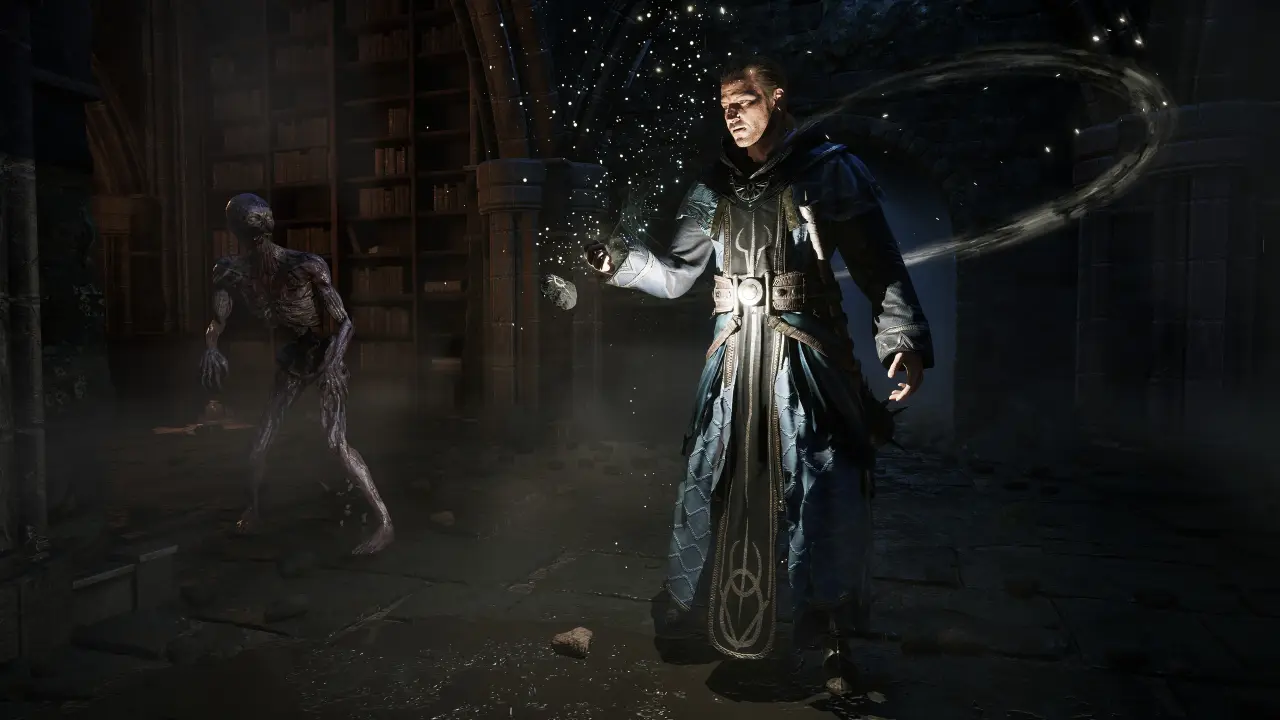
The spell misfired. The barrier ballooned far past its intended size and trapped the king's own guards inside alongside the men they were meant to watch. With no blade left at their throats, the prisoners flipped the board overnight, organized themselves into camps along lines of belief and self-interest, and seized the mines and the guards for themselves. You arrive as the newest body tossed through the wall, with nothing, and you have to claw a life out of a pecking order that was settled long before you got here. What makes it sing is how much it explains in one stroke: nobody here is a good person because this is a prison, not a village. Every grasping, suspicious, opportunistic soul you meet makes sense the instant you grasp the setup — the writing never has to apologize for its world being cruel, because cruelty is the premise. That economy of motivation is something a lot of bigger-budget RPGs, with their reams of lore dumps, never manage to land half as cleanly.
Three camps that play like a prison drama, and you only get to pick one
The valley is carved up between three powers, and the remake writes them like an HBO lockup series. The Old Camp is the ancien régime — Ore Barons hoarding the ore trade, swearing loyalty to a distant king, keeping a stable of heavy-armored mercenaries. The New Camp mines on the surface but secretly brews a concoction that disrupts the barrier's magic, plotting a mass escape, and it welcomes mages and thieves. The Swamp Camp is a cult of swampweed-smoking acolytes who worship a slumbering demon they call the Sleeper, convinced that waking it is salvation.

Choosing a side is not a cosmetic swap. The moment you pledge to a camp in Chapter 1, your armor tier, your trainers, your available guild quests, and your magic ceiling are effectively locked for the rest of the run. This isn't the open-world fantasy where you can court every faction at once and lose nothing; it's a road you can't reverse down once you've taken it. Which is exactly why all three are worth a full replay — it's the most compelling, most un-assembly-line thing about how Gothic tells a story.
Every line of dialogue is a wager — the world never lets you off the hook
What truly hooks you is Gothic's stubborn insistence that talking has consequences. Almost everyone in the Colony sees you as someone to use, con, or rob. A guard will openly demand protection money; you can pay, or you can refuse and make the first move — win, and you walk away with his stuff; lose, and that's on you. Crack a joke to a guard about torching his camp and he may simply draw steel and answer it.
That barbed, transactional texture turns every conversation into a small gamble and gives the world a lived-in friction few games can fake. Set it against its most direct rival, the modern open-world benchmark The Witcher 3: Wild Hunt, and the contrast is stark: Witcher 3's narrative density comes from the brilliant set-piece writing Geralt walks into, with the road paved ahead of him. Gothic's density comes from your own predicament — from having to read every face in the room. It doesn't perform for you; it makes you live there. The cost of that purity is real, though. The remake is faithful to a fault, preserving the original's creaky quest logic so completely that grabbing a key item too early, or doing steps out of the intended order, can soft-lock entire side quests. It's the cruelest irony of the whole package: a world this alive, hamstrung by a 2001 quest script.
Audio | 6.0/10
サウンド: 6/10Kai Rosenkranz is back, and so is that bleak Gothic mood
The best news on the audio front is that original composer Kai Rosenkranz returned to score it. The themes he wrote two decades ago are muscle memory for a whole generation of fans — the kind of melody you can hum with your eyes shut. His rearranged work here still grabs Gothic by its bleak, dangerous, faintly lonely collar. Walk a mountain path alone at night, a distant campfire flickering across the valley, and when that low string line swells underneath you, the mood snaps into place instantly.

That atmospheric fidelity is the one thing nearly every reviewer nods along to. The ambient design serves the same end without ever showing off: by day the camps are a din of voices and clanging smithies; by night it all drops away to the growl of wildlife and your own footsteps, while the mines swallow sound into a hollow echo. It doesn't win on layered sound effects. It wins by quietly, honestly reminding you that you are inside a dangerous prison. Stand still in a camp long enough and you start to read the place through your ears alone — where the work is, where the trouble is, who's drunk and who's dangerous — without a single marker telling you so.
A pile of audio bugs that shred the very mood it builds
The trouble isn't the craft — it's the engineering. The launch build ships with audio bugs frequent enough to wreck the experience. The signature offender is overlapping dialogue: two or more NPCs fire their lines at once, voices stacked on top of one another, and you can't make out who's saying what. A scene that should pull you in turns to noise.

Worse, the background music simply vanishes at random, dropping the whole world into an eerie silence — and there's no graceful fix. Reviewers across the board report that the only reliable way to coax the music back is to close the game entirely and relaunch. These faults hit harder on PS5 than on PC, where the console's already-strained performance leaves the audio system more prone to choking. It's precisely these glaring engineering lapses that drag a score that should have been a highlight down toward a passing grade. A composer this good and a mood this right deserve a launch that doesn't keep tripping over its own sound. Patch these out and this category climbs a long way, fast.
Voice work and localization: German grit, and a heads-up for non-English players
Gothic is a German game at heart, and the voice work wears that on its sleeve — coarse, blunt, unpolished. The mercenaries and miners around the camps open their mouths and out comes the gravel of men at the bottom of society, a world away from the crisp, theatrical diction of the big fantasy productions. If that's your thing, it feels exactly right; this is a prison, not a court. If it isn't, the delivery can read as a little stiff at first, and a couple of performances land flatter than the writing deserves.

There's a practical caveat worth flagging too. The game ships text in English, German, simplified and traditional Chinese, Japanese and more, but the spoken audio is essentially German and English — there's no dub for most other languages. Given that Gothic leans so hard on grinding dialogue out of NPCs to figure out who to trust and where to go, subtitle quality matters more here than in almost any other genre. The good news is the localization broadly nails the register, carrying across that everyone's-got-an-angle tone. The bad news is that when the overlapping-dialogue bug fires, the subtitles can scramble along with it — which loops you right back to the engineering problem that haunts this whole category.
Visuals | 7.5/10
グラフィック: 7.5/10A valley rebuilt in Unreal Engine 5 — a world away from 2001
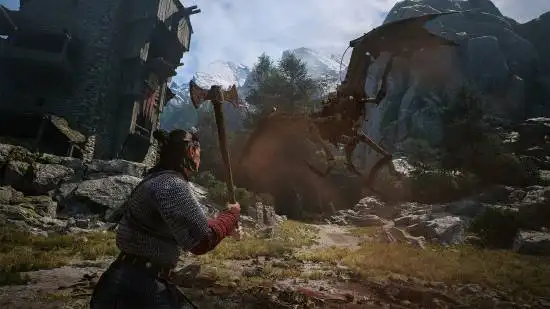
The visuals are the most immediate upgrade. Alkimia rebuilt the entire Colony from the ground up in Unreal Engine 5, and the lighting, the foliage, the rock faces, the grubby detail of each camp — set any of it beside the blocky 2001 original and you're looking at two different eras. The way sunlight filters down through that translucent barrier overhead, the firelight licking across a mercenary's plate at night: it has genuine texture.
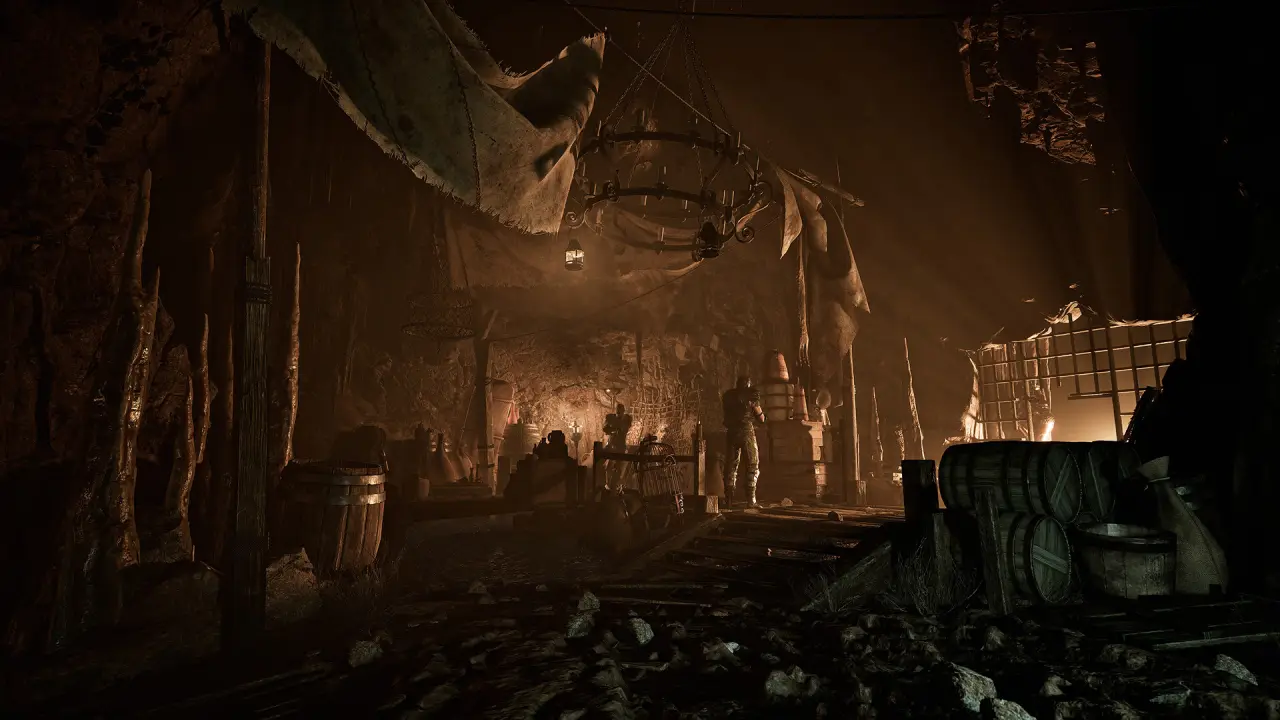
Crucially, the art direction never chases the glossy, crowd-pleasing fantasy look. It clamps down on the original's grimy, dangerous, miserable register. This place is supposed to look like somewhere people eat each other: muddy camps, rusted blades, prisoners in rags. That high-recognition filth is what separates it from a parade of slick open worlds, and it's the most faithful thing it could have done to the name on the box. There's an artistry to how cohesive the grime is — nothing here looks borrowed from a brighter game and dragged into the mud. The whole valley reads as one coherent, miserable place, which is harder to pull off than a thousand glittering particle effects, and far rarer.
The PS5 build is the weak spot: locked 30, single-digit dips, hard crashes
The good impression curdles fast once technical reality intrudes, and on console it intrudes hard. The PS5 version is the agreed-upon disaster zone: the game is locked to a 30fps ceiling, with no performance mode offered even on PS5 Pro — something more than one outlet flatly called near-fatal in 2026. And it can't reliably hold even those 30 frames. In NPC-dense spots like the Old Camp, the frame rate face-plants into single digits and stutters like a slideshow, punctuated by repeated freezes and outright crashes.

Textures occasionally read as PS4-era work, shadows and materials pop in constantly, and NPCs and enemies periodically drop through the floor or wink out of existence entirely. The PC build is markedly steadier, which is the plain reason it's the platform to play this on if you're committed. There's also a subtler side effect worth flagging: the sharper visuals actually spotlight the dated design underneath. When everything looks this modern, the old-school quest snags and stiff cutscenes stick out all the more — a handsome shell that keeps reminding you the skeleton inside is past twenty.
That mismatch is, in truth, the most telling trade-off in the whole remake. The budget clearly went into faithful reconstruction rather than blanket modernization: you can feel that every cliff and every camp was hand-placed with care, and the valley's verticality and stacked warren of caves look terrific under Unreal Engine 5's lighting. But the more production-hungry corners — facial animation, the camera language of cutscenes — land squarely at mid-budget quality. This isn't a triple-A spectacle out to stun you with fidelity; it's a middleweight built to spend its money on atmosphere, on the parts that matter. Read it that way and your expectations for the visuals snap into the right place. Judge it against The Witcher 3: Wild Hunt's cinematic polish and it loses; judge it on whether the valley feels like a place worth getting lost in, and it wins handily. The remake knew which fight to pick, and it picked the one that matters most for a game like this. Atmosphere ages slower than polygon counts, and a decade from now it's the mood of this valley people will remember, not its frame pacing.
Combat | 7.0/10
ゲーム性: 7/10No markers, no minimap, and you pay cash for the map
The soul of Gothic's design is an anti-convenience philosophy. There are no quest markers, no minimap, and not even a full map until you track down a merchant and buy one in-game. No string of yellow dots floats at the edge of your screen. Every scrap of direction has to come from talking to NPCs, from memorizing the roads, from getting lost in the valley over and over until you finally know it.

In a 2026 padded wall-to-wall with convenience systems, that reads as defiantly strange — and the payoff is a real thrill of discovery. Nearly every reviewer concedes the same thing: the Colony rewards aimless wandering. A hidden cave, a weapon you reach earlier than you should have, a quest that only fires if you bother to strike up a conversation. Finding the map is itself a pleasure; CGMagazine called piecing the place together yourself a real high point. The price is a tax on your sense of direction — the Swamp Camp's maze of a layout got branded "an absolute nightmare," and they weren't joking.
You start out useless — and that's the whole point
The most divisive, most signature trait is its brutally steep growth curve. You open the game pathetically weak: a single stray molerat can end you, two swings leave you gasping, one counter and you're on the floor. This isn't broken balance. It's deliberate. You have to seek out trainers and spend learning points before the hero unlocks combos, critical hits, parries, and real damage — and the feel of combat genuinely transforms as you do.

That arc — start as a nobody, grind your way into a threat — is the heritage Gothic carries from the original, and the satisfaction of crossing from prey to predator after the punishing first hours is something paved-road games can't replicate. It's also a hard fork in the audience: the people who can stomach it get addicted, and the people who can't shut the game off at that first molerat.
What makes it cleverer than a flat power curve is how tightly that growth binds to your camp. Pledge to the Old Camp and the armor track marches toward heavy melee, with trainers teaching you to hold a blade steadier. Throw in with the New Camp and the resources tilt toward spellcraft and stealth — you learn to win with your head and your footwork instead of brute force. Sign on with the Swamp Camp and you reach the off-kilter path of Sleeper magic earlier than anyone else. Getting stronger in Gothic isn't a linear climb up a stat bar; it's a string of choices wrapped around the question of who you want to be in this valley. You're not filling in a tech tree. You're deciding how to live.
The combat itself, honestly, is clunky
If a bucket of cold water is owed anywhere, it's the combat. The remake reworks the original's directional attacks, ditches the traditional stamina bar and the light-heavy split, and leans on positioning and timing instead, with magic cast through three rune schools that freeze enemies or summon skeletons. On paper, fine. In the hand, more than one reviewer described it as swinging through molasses: every strike carries heavy startup, hit feedback lacks crunch, and the worst sin is inconsistent enemy stagger — the same blow sometimes knocks a foe back, sometimes leaves them unflinching and swinging back, which makes fights feel arbitrary. That imbalance never fully washes out, even late. Stack it against a fellow hardcore Euro-RPG like Kingdom Come: Deliverance, or against the road-paved modern benchmark The Witcher 3: Wild Hunt, and the priorities are clear: Gothic puts figuring-it-out first and feels-good combat dead last. You don't come here for the swordplay. Be clear-eyed about that.
Content | 7.5/10
ボリューム: 7.5/10Fifty hours to start, and three camps to start over with
Gothic is generous on bulk. The official line is a 50-hour-plus campaign; outlets who actually clocked it land somewhere around 38 to 58 hours, depending on how deep into the corners you crawl. Given that there are no quest markers at all and a chunk of your time goes to getting lost, trial and error, and squeezing NPCs for directions, that runtime is genuinely played, not padded laps around an empty map.

What actually carries the replay value is the three-camp structure. Old Camp, New Camp, and Swamp Camp each bring their own guild quests, gear tracks, and magic systems; the main story converges on the same ending no matter what, but the playstyle along the way, the skills you can learn, and whose side you watch the prison politics from add up to three distinct runs. Want to see the whole world? You're replaying it at least twice, probably three times. That's the root of how Gothic stays fresh.
A third bigger than the original — but don't wait on a season pass
This is more than a reskin of the 2001 game. The team expanded the content across the original's chapters two through five, fleshed out the quest lines, and even brought in linguists to build out a proper orc language, leaving the world roughly 10 to 30 percent larger than before. For returning veterans, that means familiar ground hides a real amount of new material to dig up — corners you blew past two decades ago are worth a second survey now. And for anyone who never touched the original, this is simply the most complete, most modern doorway into a legendary IP that exists.

As for post-launch plans, things look restrained for now. The Digital Deluxe edition bundles the soundtrack and a digital art book and the like, but there's no announced roadmap for a season pass or major story DLC. Given the pile of launch bugs and performance work waiting in the queue, the studio's energy for the foreseeable future will almost certainly go into patches and rescuing the console experience rather than rushing to sell new content — which, frankly, is the better outcome for players. Worth adding: Gothic's whole notion of "content" runs counter to the fashionable map-of-question-marks checklist. Its explorable material wins on density and surprise, not volume — stumbling on a weapon far above your level deep in some nondescript cave, or catching two NPCs fall out over money and picking up a quest that otherwise wouldn't exist. For players who love being fed slowly by a hand-built world, that restraint is a luxury; for anyone chasing ten icons an hour, it'll feel slow and stingy. In the end Gothic's bulk was never a numbers game — it's a question of whether you'll pay for surprises you dug up yourself rather than ones a map handed you. Measured that way, there's more here than the runtime alone suggests, and a second camp run reveals corners the first one never touched. Few open worlds this size make wandering off the beaten path feel quite so consistently rewarded, and that, more than any hour count, is the real measure of its content. The flip side is that there's no checklist to chase to completion, no map slowly bleaching from icons to emptiness — so players who measure progress by boxes ticked will feel adrift. Gothic asks you to measure it differently: not by how much you've cleared, but by how much of the valley has stopped being a mystery. By that yardstick, even a single full run leaves plenty unsolved.




コメント 0
ご意見をお聞かせください
コメント欄へようこそ。このゲームの感想を聞かせてください。一番乗りにはうれしいことがあるかも。
まだコメントはありません。このレビューへの感想をぜひどうぞ。