




















Opening
Some games are defined by their loudest moment. Metro Exodus is defined by its quietest.
It is the lull on the Aurora, the steam locomotive that doubles as a moving home for a band of survivors who have just fled the Moscow tunnels. Anna leans by a window watching the thaw roll past; Colonel Miller cleans his kit at the far end; the squad's tinkerer fusses over another contraption in the corner. Outside, the first spring melt is breaking up the ice on the Volga. What lodges in the memory is never the intensity of a single skirmish — it is the lived-in truth of a dozen people crammed into a home on rails, dragging it east across an entire ruined continent.
This is 4A Games closing out the Metro trilogy, and it is the series' boldest pivot. The first two games locked you in the claustrophobic dark of the metro; this one drives the train up into daylight for the first time. Underground to surface, linear to semi-open, one tunnel to a year-long journey spanning the Volga, the Caspian, the Taiga and the Dead City — every design trade-off in the game flows from that single turn. It earned a Strong tier at OpenCritic on an 83, the Enhanced Edition pushed Metacritic to 85, and the game has sold past ten million copies. But those numbers hide a clean split: the atmosphere, the visuals and the storytelling were showered with praise, while the raw moment-to-moment combat remained the sticking point. This review sets out to map both poles — where it soars, where it stumbles, and whether you are the player it is looking for. Because for the right player, this is a journey that lodges in the memory for years; for the wrong one, it is a slow march whose moment-to-moment action never quite feels good. Knowing which you are is most of the decision.
Story | 9.0/10
ストーリー: 9/10The whole journey runs on a single emotional current: a group of people trying to stay alive together.
A home that travels

The setup is plain enough. Artyom and the Spartan Rangers stumble onto proof that the world beyond Moscow was never fully swallowed by radiation — there are living people out there. So they commandeer a steam locomotive named the Aurora and, with Artyom's wife Anna, Colonel Miller and a knot of comrades aboard, follow the dead railways east in search of a rumoured place fit to live. The arc covers a full calendar year, opening on the spring floodplains of the Volga, baking through the dried-out summer seabed of the Caspian, drifting into the autumn Taiga, and closing in the deep-winter ruin of the Dead City.
What makes that spine so clever is the way it makes "home" a literal thing you can walk through. Clear a region and you return to the Aurora, and the carriage has quietly changed — someone has joined, someone has gone, someone is nursing a wound. You are not ticking off waypoints; you are shepherding a trainload of people forward, and every stop down the line thickens the bonds and frictions between them. That moving-home structure is something almost none of the era's apocalypse games can offer.
The campfire crew outshines the quest log

The cast is what truly props up the trip. Anna is Artyom's wife and the squad's finest marksman; Miller is its moral spine; then there is the taciturn Damir, the gadget-mad tinkerer of the crew, the old hand Stepan. None of them stand on a marker handing out tasks. They bicker and reminisce around the fire when you climb back aboard, and they genuinely sag when one of their own falls.
The writer is Dmitry Glukhovsky, author of the Metro novels, and that pedigree shows in the texture of it all. Each season is effectively its own short story: on the Volga you pull people out of a cult's grip; on the Caspian you hunt water for the train and weigh whether to take Damir along; in the Taiga you are pulled into the fate of children held by bandits. Distinct in mood, every one of them still feeds the larger task of getting this family to the end of the line alive.
The craft is in the small beats more than the big ones. A companion will mention something offhand at one fire and pay it off three regions later; a romance, a grudge, a flicker of doubt about Miller's leadership all develop in the gaps between missions rather than in scripted set-pieces. By the time the train rolls into its final stop, you know these people not because the game sat you down and explained them, but because you overheard them becoming who they are.
A ledger nobody reads aloud
The choice system is the smartest stroke in the narrative. It refuses the dialogue wheel that so many choice-driven role-playing games of its day lean on. Instead it buries judgement inside your behaviour — whether you stay your hand against someone who has dropped their guard, whether you help a stranger met on the road, whether a stealth approach ends in a knockout rather than something final. Those acts tally, silently, into a meter you never see.
Come the finale, that hidden ledger settles all at once: it decides which companions live, and whether Artyom earns the good ending, with Anna's survival the rawest stake of all. A system that says nothing and accumulates everything outclasses any either-or prompt, because it makes you act on instinct without ever flagging which moments mattered.
There are soft spots, to be fair. The ending lands gentle and never quite repays the year of build-up the journey spends on you, and a perpetually silent Artyom — voiced only in loading narration — leaves some players an arm's length from him.
Still, the emotional arithmetic works because it never lectures. Set beside Fallout 4, which offers a wilder, looser, more sprawling wasteland, Exodus trades breadth for a tighter, far more affecting run of feeling. You leave the train not with a head full of lore dumps but with the dull ache of having watched a handful of people endure a year you would not wish on anyone. That is the part nobody has managed to copy.
Audio | 9.0/10
サウンド: 9/10The sound design is where the game's obsession with atmosphere is wound tightest.
A score that knows when to shut up

The music comes from Ukrainian composer Alexey Omelchuk, who has scored the entire Metro series across more than twenty years. His approach here runs against instinct: rather than smother the screen in orchestral swell, he leaves vast stretches empty. You will trek across open country with nothing in your ears but wind and your own footfalls, the music holding back — and when it finally arrives it is usually a lone folk guitar or a thread of Eastern European melody, and the loneliness lands like a weight.
That restraint is the mark of a confident hand. The genre's easiest mistake is to have music shout "this is dangerous" or "this is moving" until the emotion turns cheap. Omelchuk does the opposite. He teaches the score to keep quiet and hands the stage to the environment, touching the keys only at the beats that have earned it. Around the campfire the music shades itself to the companions' talk, the hush and the swell trading off, always serving the story's breathing rather than a quick jolt to the senses.
The environment is the lead instrument

If the score plays a supporting part, the ambient audio is the lead. Boots crunch differently on slush, sand and packed snow; the carriage clatters along its rails; something mutated growls in the middle distance; a filter ticking toward empty plants a knot in your chest. Together they weave the trademark pressure of the series. You are not hearing a backing track — you are confirming, by ear, exactly how dangerous this world is.
The masterstroke is the gas mask. Every time Artyom pulls it on to head outside, the world's audio drops behind a muffling layer and all that is left is his own ragged, hurrying breath, with the occasional spatter of water across the lens. The trick funnels survival pressure straight into your ears: you can hear how long you have left, hear the filter draining minute by minute. Against the era's stealth-narrative rivals, which manufacture tension by piling the music on, Exodus does it with negative space — and pulls you under deeper for it.
Where the mix earns its keep, and where it slips
The honest blemish is the voice acting. The English performances are solid, but a few of the Russian-accented turns read flat, short on emotional range, and Artyom's permanent silence strands any player hoping for a closer bond with him. For a game that puts mood first, though, it is a scratch the overall sound work easily outshines.
It helps that the mix is built to reward attention. Threats announce themselves through the audio before you ever see them — a distant shuffle, a wet snarl, the chitter of something circling in the dark — so the soundscape doubles as an early-warning system that keeps you reading the space with your ears. On the Aurora, the register softens: rain on the carriage roof, the hum of the engine, a half-heard song from someone two compartments down. The game is forever using sound to tell you whether you are safe or hunted, and it almost never lies to you. That consistency is why the audio carries a 9.0 even with the voice work dragging slightly behind the rest.
Visuals | 9.5/10
グラフィック: 9.5/10If one word has to carry the visuals, make it believable.
The credibility of a single beam of light

The 2021 Enhanced Edition is where the look graduates to landmark. 4A Games rebuilt the entire ray-traced global illumination pipeline: every shadow-casting source in a scene — sun, moon, sky, every scrap of man-made light — now feeds the lighting solve, brightening interiors, exteriors, characters and the kit in your hands. The Enhanced build also folds in up to 256 analytical light sources, each carrying its own shadow map.
The real coup, though, is DDGI — dynamic diffuse global illumination. Built on NVIDIA's RTXGI, it upgrades single-bounce lighting into a multi-bounce solution. When a shaft of sun breaks through a smashed window into a derelict room, the light now ricochets across walls, floor and furniture, lifting the whole space with a soft, plausible glow and easing the shadow transitions. For a game spent largely in gloomy interiors lit by a torch and the odd flame, that solve is tailor-made — the more credible that one beam of light, the sharper the dread it casts. GameSpot ran a piece calling it the most convincing case for ray tracing yet, and the Enhanced Edition landed in OpenCritic's Mighty tier on its own.
Four seasons, four worlds

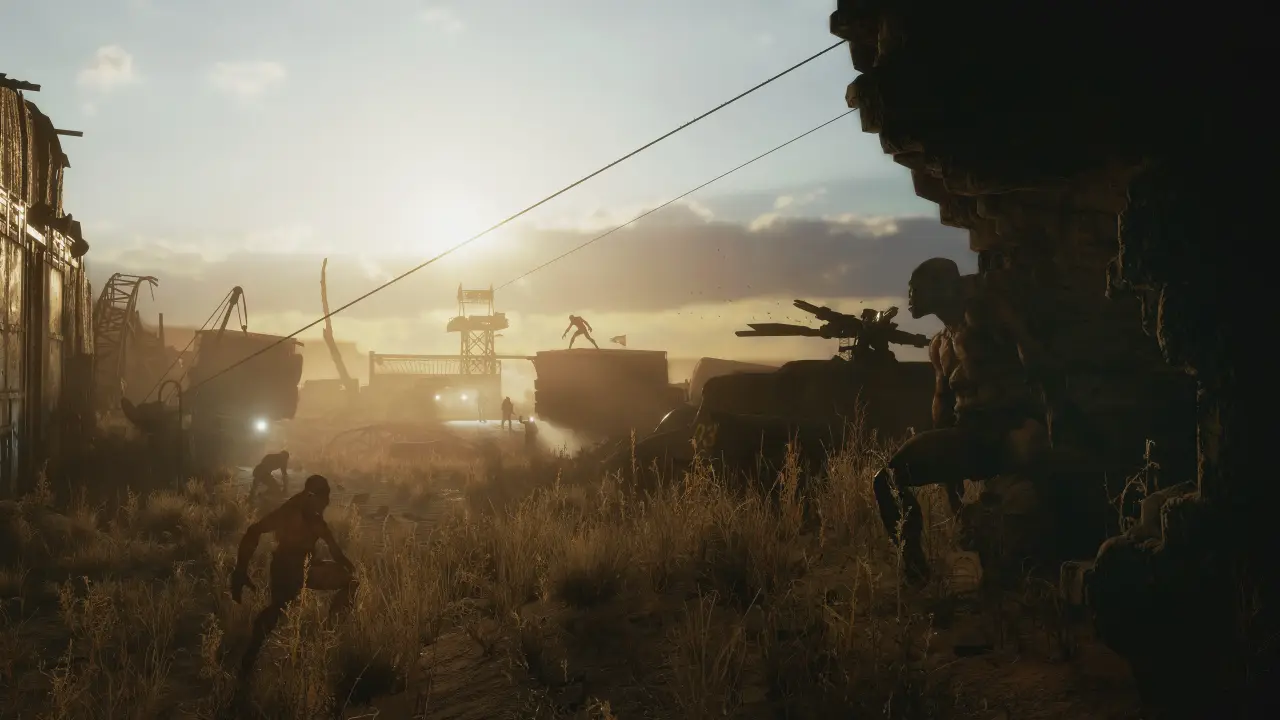
Much of the art's identity comes from the seasons. Four regions, four seasons, four utterly different landscapes: the Volga is a misty spring floodplain dotted with drifting ice; the Caspian is a sun-scorched summer seabed choked by sandstorms; the Taiga is a deep-autumn conifer forest carpeted in gold; the Dead City is a winter ruin where snow blankets the radiation. One-level-per-season keeps the visual rhythm forever shifting, and fatigue never sets in.
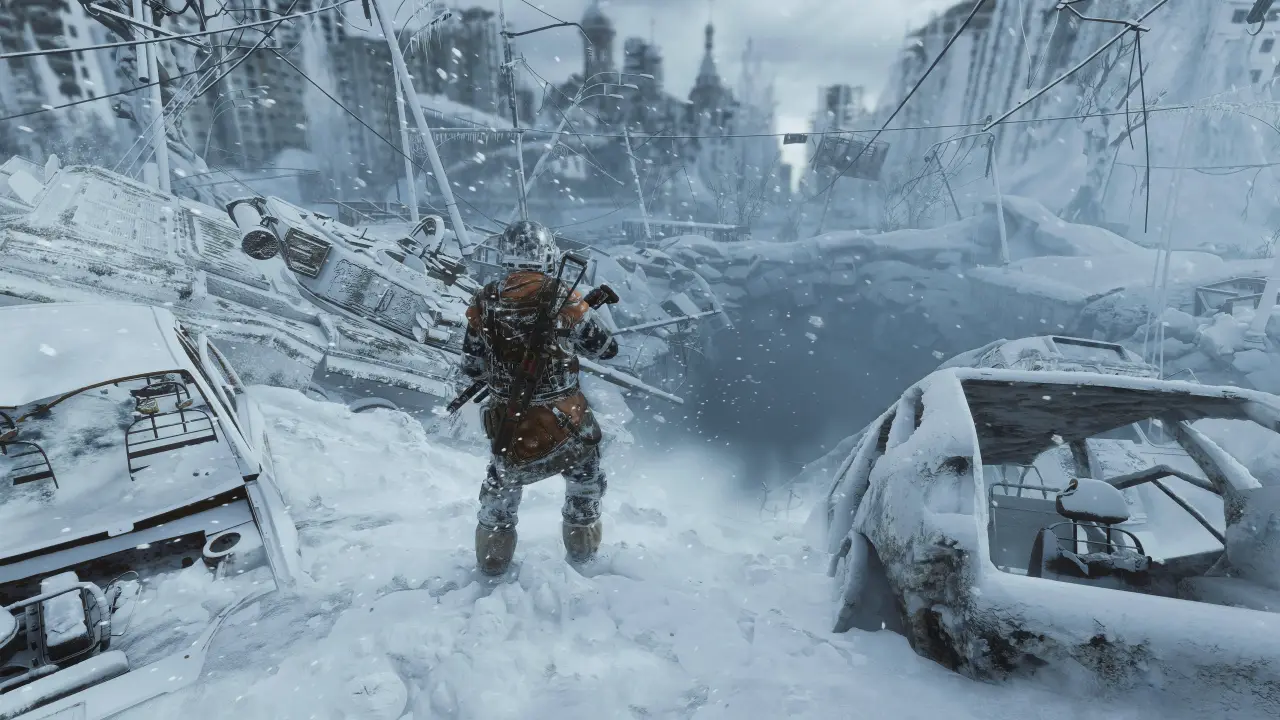
And the seasons are no reskin. Summer on the Caspian has you minding heat and water, visibility collapsing when a sandstorm rolls in so that you grope forward half-blind; winter in the Dead City runs the radiation so high you can barely lift the mask, every step shadowed by a filter counting down. The visual turn of the season and the survival squeeze are one and the same, which hands each region a sharp personality and makes the journey's progress something you feel in the body. By the time the Aurora reaches the snow, the warm green of that first spring on the Volga feels like a memory from another life — and that emotional distance is something the art direction earns purely through the changing light and palette.
Underneath it sits the in-house 4A Engine — Direct3D 12 Ultimate, NVIDIA PhysX, hardware ray tracing — the technical bedrock of the whole presentation. This is no off-the-shelf middleware but a bespoke tool the studio has honed over more than a decade, and it is especially deft with the volumetric light, smoke and particle work that the post-collapse setting leans on hardest. Watch dust motes hang in a shaft of window light, or fog roll low across the floodplain at dawn, and you are seeing years of focused engine work paying off in exactly the places this world needs it most.
The version you pick matters
Platform differences decide which game you actually see. The PC Enhanced Edition is the ceiling, at the cost of demanding a hardware ray-tracing card to run at all; on consoles, the PS5 and Xbox Series X/S Enhanced builds bring ray tracing and higher frame rates and are the best way to play there. The original PS4 and Xbox One versions ride traditional rasterisation, no ray tracing.
So if you are on current-gen hardware or a ray-tracing PC, take the Enhanced Edition without a second thought — it is a free upgrade and the leap is generational, not a couple of resolution notches but the light of the entire space resculpted. Even players who finished the original have reason to walk it again, the same rooms reading wholly differently under the new lighting. The strength was never raw polygon counts or texture resolution; it is the unity and credibility of the whole, light and fog and snow and dust conspiring into a ruined world you are willing to believe in. Years on, the game still trades blows with any first-person benchmark of its generation, and that presentation in service of mood is what earned it the 9.5.
Combat | 6.5/10
ゲーム性: 6.5/10The systems here put survival first, and confrontation is only one strand of it — and not the strongest.
The workbench and a currency-free economy

The load-bearing loop is scavenging. There is no money anywhere in the game; every supply is clawed out of the world piece by piece, with components and chemicals as the only real currency. Bank enough parts and you can deeply rework your gear at a full workbench — swap barrels, sights, magazines, fit a suppressor, even reshape its whole role. On the move, the backpack lets you bodge quick mods and craft consumables, medkits, filters and throwables.
That gather-modify-decide loop sutures survival pressure to preparation. With no shop and no coin, every round and every filter on your person was bled for, which forces you to weigh each encounter before it starts: is this fight worth it, or do I slip past. Gear fouls and needs cleaning, too, hammering home the sense that everything is consumable. Resource management stops being a spreadsheet and becomes a wellspring of tension in its own right.
The mod system also rewards forethought in a way the genre rarely bothers with. A loadout tuned for the Caspian's wide-open daylight is the wrong loadout for the Dead City's cramped winter interiors, so you find yourself rebuilding your kit at each new region to suit the terrain and the threats. Crafting two extra filters might mean going without the parts for a scope, and that scarcity makes the bench feel less like a menu and more like a quartermaster's gamble — you are always spending something to gain something else.
Day, night and the smarter road through

The cleverest design hands confrontation a second exit: stealth. Enemies see well by day and poorly by night, so you can kill the lights, slip past, knock out a straggler, or skirt a whole zone. Paired with the abundance of alternate routes threaded through each level, the game fully supports a no-takedown run from start to finish.
That path is more than an option — it wires straight into the morality system, where a lighter touch buys a better ending. And because the route is always there as a backstop, the thinness of the raw confrontation is largely diluted; if head-on play leaves you cold, you can ghost through nearly every hard stretch.
The environment is a tool too. Cut the power to an outpost and drown it in dark before picking it apart, or play the mutants and human foes off each other and let them tangle while you slip through the gap. There is a quiet thrill in clearing a whole camp without a soul ever knowing you were there, and the game is generous with the routes, vents and shadows that make it possible. Stealth here is no crouch-and-creep filler but a full discipline of watching, planning and improvising, far deeper than first impressions suggest.
Confrontation, honestly, is the weak link

Now the part that needs candour. On the pure thrill of a stand-up fight, the game falls short of its era's front rank. The feedback on ranged exchanges reads blunt, recoil and impact are unremarkable, enemy reactions once spotted are no great shakes, and a slow-moving Artyom caps it all — a head-on scrap is functional, never thrilling. PC Gamer's 78 named it outright, "let down by some uninspiring combat," and that is the core of the 6.5 the gameplay pulls.
Then again, drop that blunt, heavy feel back into the survival-stealth-story frame and it coheres. The game was never chasing power-fantasy mowing; it wants every exchange to wind you tight enough to count your bullets. A jam at the wrong moment, a filter ticking out mid-encounter, a magazine you cannot afford to empty — the friction is the point, and a slicker, snappier feel would actually undercut the desperation the rest of the game works so hard to build. Against the post-nuclear sprawl of Fallout 4, Exodus runs tighter and stakes its survival pressure more concretely — Fallout sells you a bigger, messier wasteland of freedom, Metro a locked-in loop that makes you account for everything. Which one fits comes down to whether you are after openness or immersion.
Content | 8.0/10
ボリューム: 8/10As a package, this is a tight journey with two side trips of very different weight bolted on.
The base game: a dozen-plus hours stitched by seasons

The main campaign runs around 16 hours by HowLongToBeat's count, nearer 40 if you mop up every side strand and point of interest. That is not a colossal figure, but the strength is density. It refuses the open-world habit of padding with mountains of repeat busywork, compressing everything into four seasonal regions plus the Aurora's interludes, each with its own cadence and feeling.
The side content is restrained in the same spirit. Most of it hangs in the semi-open zones and clusters around rescue, search and exploration: hunting water for the train on the Caspian, getting tangled in the fate of caged children in the Taiga. These are not checklist errands but small stories in their own right, and finishing one deepens your read on the region and the crew. There is no map littered with a hundred icons demanding to be hoovered up; what optional content exists is there because it has something to say, and the restraint is itself a statement of confidence. Better still, many of them loop back to influence the moral ledger and the ending — saving someone, lending a hand, it is all noted quietly and cashed out in the finale. That less-but-better stance keeps the run taut, never deflating under filler, and lends every detour weight beyond its reward.
Two add-ons, one thin and one thick

Beyond the base game sit two pieces of downloadable content, and the gulf between them is wide. The Two Colonels runs about three hours, leans heavily on cutscenes, and is light on play — more a story coda filling in series backstory, worth it for the lore crowd but slim as an experience.
Sam's Story is the far meatier of the pair at roughly seven hours, built around play and exploration, and many reviewers reckoned it "does almost everything The Two Colonels failed to." It inherits the base game's semi-open scavenging core, with a fresh map and a new playable lead that make picking it up feel new again. Its flaw is a glut of boss fights with bloated health pools and summoned minions that drag stretches longer than they should, the pacing never as poised as the main game. Together the two add roughly ten hours; if you own the season-pass edition both are worth a run — one feeds the story, the other the play.
Versions and a market verdict
There is a versioning story worth flagging. The game opened as a year-long Epic Store exclusive, only reaching Steam in February 2020, where it cleared 200,000 copies in two days; then 2021 brought the free Enhanced Edition that lifted the visuals to a new bar. That exclusive-to-Steam-to-free-upgrade path kept the player base snowballing, and the fact that the most ambitious visual version arrived as a no-cost gift to existing owners says a great deal about how the studio valued the work over the quick sale.
The market is the bluntest endorsement of the content's worth. By its fifth anniversary in 2024 the game had passed ten million copies, holding a 90% positive rating on Steam across more than 110,000 reviews. A linear-leaning work that stands on quality and atmosphere rather than padding, pulling those numbers, speaks for itself — and it does so despite a gameplay feel widely judged to have a soft spot. Players voted with their wallets for the atmosphere, the story and the exploration.
It is worth sitting with how unusual that is. The prevailing wisdom of the era held that a single-player game needed eighty hours of map markers to justify its price, and Exodus quietly argued the opposite: that a leaner, hand-built run could earn more devotion than a bloated one. The replay value is real, too — the hidden morality system and the branching of who lives means a second run played differently genuinely lands a different ending, which is more than most narrative games can claim. The content's value was never about bulk; it was about a journey affecting enough that you finish it gladly, however long it runs, and carry it with you after.





コメント 0
ご意見をお聞かせください
このゲームについての感想や評価をお寄せください。
まだコメントはありません。このレビューへの感想をぜひどうぞ。