





















Opening
Here is the strange part nobody warns you about: Path of Exile 2 is not finished, and it might be the best action-RPG you can play right now anyway. It is parked in Early Access at version 0.x, the story cuts off mid-sentence, only half the classes exist, and there is no firm date for 1.0. None of that stopped 578,569 people from logging in at once in December 2024, making it the 15th most-concurrent game in Steam's entire history, ahead of finished hits like Valheim and Fallout 4.

Sit with that for a second. A game that cannot even tell you how its own story ends had hundreds of thousands of players queuing to get in, and GGG had to warn them about server lines because demand blew past the million-player capacity they had prepared. The reason is not complicated. Grinding Gear Games did the thing nobody else dared to try: they took the read-the-attack, eat-the-hit, try-again rhythm of a Souls game and bolted it onto a looter, a genre that used to be all about clicking the floor until things died. That single act raised the ceiling for the whole category, and the rest of this review is really one long answer to why that gamble paid off.
Worth saying out loud, too: a half-built game earning this kind of devotion is genuinely rare in the Early Access lane. Most games wearing that tag are either thin on content or quietly abandoned, and the ones that manage to spike both their reputation and their player count before launch can be counted on one hand. Path of Exile 2 is the clearest example of the breed, which is exactly why it is worth pulling apart properly — where it dazzles, where it stings, and which kind of player should pull the trigger today versus wait. I will walk it dimension by dimension: story, sound, looks, the moment-to-moment play, and the sheer volume of content. The short version is up top: the build depth is already best-in-class, while the completeness, the performance, and the welcome mat for newcomers all sit in a place that asks for patience. That tug-of-war is the whole review.
Story | 6.5/10
ストーリー: 6.5/10A campaign that stops mid-breath — three acts, then a cliff
Let me get the ugly truth out first. Right now the main story only runs through three acts, with the fourth, the Karui Archipelago, arriving in the August 2025 patch 0.3, "The Third Edict." You fight your way out from a rotting plague-soaked coast, the tension finally starts to build, and then the narrative just hangs there in mid-air. The rest of it is still sitting on GGG's hard drives, unmade.
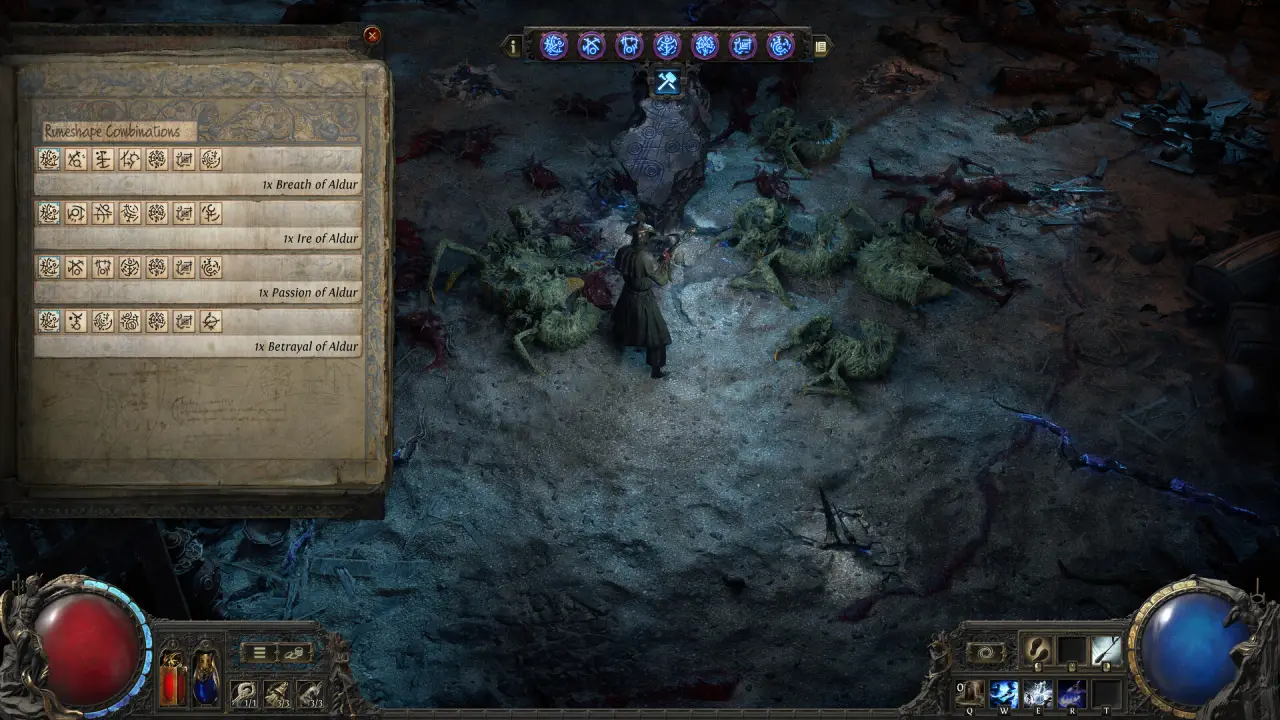
This is not me nitpicking. It is the blunt reality of Early Access. GGG has openly said the content will roughly double before launch, including three more campaign acts. So what you are playing is a novel serialized halfway. If you come for the plot, accept that going in: you are not buying an ending, you are buying a world that is still being written, one patch at a time.
The story exists to get out of the gameplay's way
Now the honest part. Even the chapters that do exist are not where Path of Exile 2 shines. The plot works more like a conveyor belt moving you from one pack of monsters to the next. The atmosphere is convincingly grim and the world is plenty dark, but the character arcs and the turns you actually remember are nowhere near as sturdy as the combat underneath them.
That is exactly why story is the one number I dropped to 6.5 in a game that earns an 88 on OpenCritic and a 9.5 from me on gameplay. Narrative is the dimension being openly sacrificed so the loop can take center stage. Patch 0.3 did add three Interlude chapters that bridge the campaign and the endgame with three side stories, but those read like dessert handed to veterans rather than the main course holding the whole thing up, and they will not change anyone's mind about the writing.
There is one clever wrinkle worth a mention. The Karui Archipelago is the first non-linear region in the game, eight islands you can tackle in any order you like. Handing that choice back to the player keeps the replay grind a little fresher, but notice what it is really serving: the loop, not the story. It is a structural trick borrowed in service of replayability, not a branching narrative with real consequences.
To be fair to it, the raw world-building is not the problem. A fallen pantheon, a spreading plague, exiles cast out to the edge of a dying world — the dark-fantasy bones are heavy and the atmosphere lands. The failure is in the telling. The strongest setting in the world still needs characters and turns to carry it, and that scaffolding is the thing this game has not built yet. Patch the later acts in, smooth the translation out, and this dimension might climb. As it stands, do not walk in expecting a story you will turn over in your head weeks later.
Localization bugs and mistranslated text still pull you out of the fiction here and there too. In a game that leaned on its plot to keep you, that would be fatal. Here it barely registers, because the plot was never the hook in the first place. If you are the kind of RPG player who values narrative density over the thrill of combat, Path of Exile 2 is probably not your game this year. Its ambition was never to tell a great story. It was to make you grind the same combat system, over and over, for hundreds of hours, with the plot riding along as an afterthought rather than the reason you stay.
Audio | 7.5/10
サウンド: 7.5/10Low strings and dead air — the score sets the mood, not the playlist
Put on headphones and the first thing that hits you is the gloom. Path of Exile 2 builds its score out of low strings and a bed of ambient noise, with none of those instantly hummable hero themes. Instead it slowly presses you down into a lonely, end-of-the-world place. That choice rhymes with the dark, realist art direction: the music never grabs the spotlight, it tunes the whole world to one bleak key.
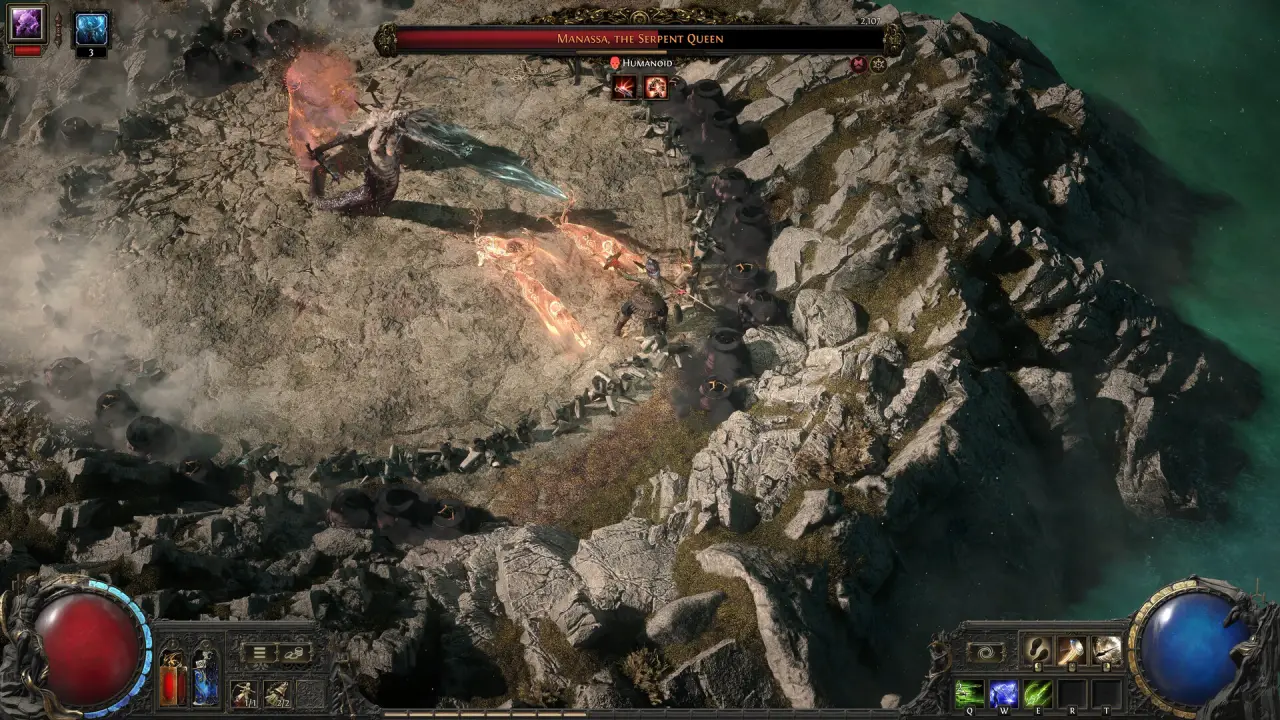
The upside is real. Every step you take through a corrupted town comes wrapped in oppressive strings that keep reminding you this is not a world built for your comfort.
The cost is just as plain. The soundtrack is functional first and memorable second; finish the campaign and you probably cannot whistle a single bar of it. Stacked against the Diablo series, whose themes became calling cards, this score is the quieter, less distinctive cousin, and that is the main reason audio lands at 7.5 rather than higher.
In a screen full of effects, your ears keep you alive
Where the sound design actually earns its keep is not the music — it is the combat feedback. Once you decide to make fights about reading and dodging, the audio has to carry weight. The dull thud of a successful block, the sharp crack of a critical hit, the music lurching as a boss flips into its next phase: in practice those cues genuinely save your life.
Here is why that matters so much. The game has a chronic problem where several mechanics trigger at once and the screen drowns in particles, hiding the very attack tells you need to see. Your eyes simply cannot find the next swing. So your ears become the second pair. Experienced players often hear a boss wind up before they consciously see it, and that is what tells them which way to roll.
That gives me a split verdict on the sound. Judged purely as music you would put on to enjoy, this is middle-of-the-road stuff that would vanish on any blockbuster soundtrack list without leaving a trace.
Drop it back into the context of this fast, Souls-flavored combat, though, and it becomes load-bearing in a way a prettier, flashier score might not be. The distinct thud of each weapon class, the audio sting when a boss shifts phase, the way a parry sounds different from a clean dodge — these are not flourishes, they are information you act on. The score is not here to please your ears. It is here to keep you breathing, and on that job it quietly and reliably does its part, fight after fight, even when you never consciously notice it working.
Visuals | 8.0/10
グラフィック: 8/10From a plague coast to tropical islands — a dark-fantasy engine flexing
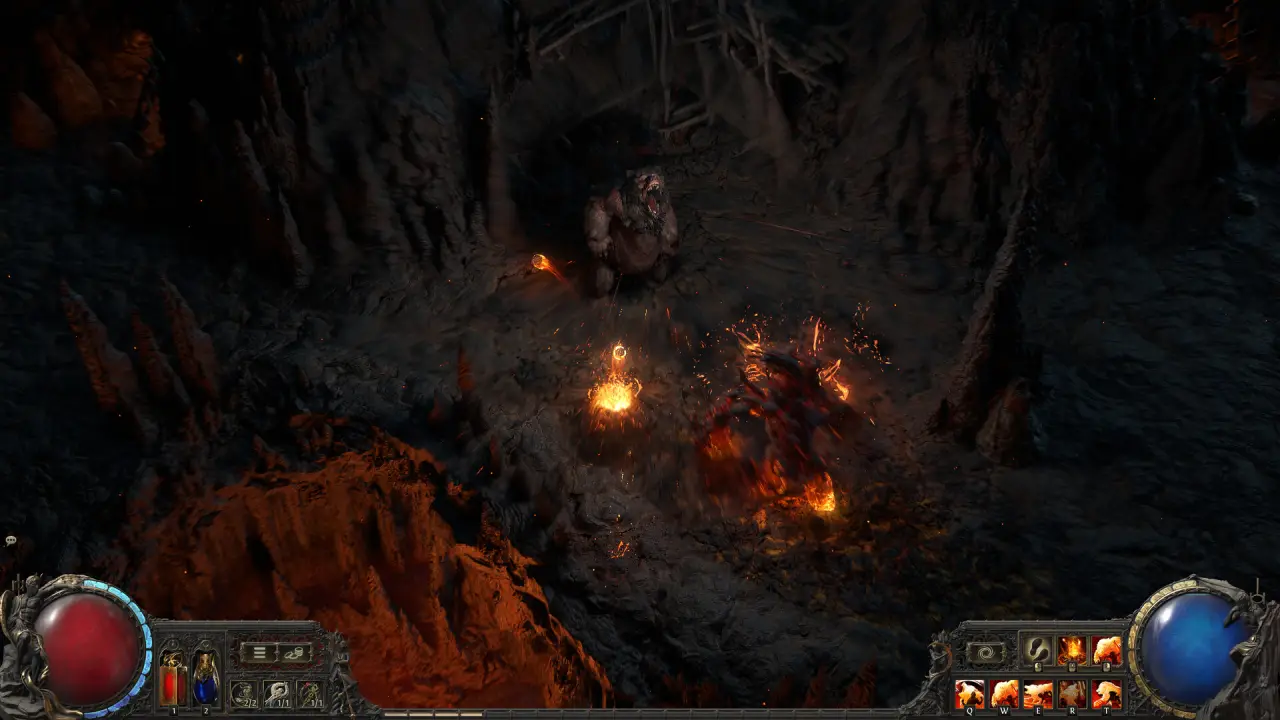
The visuals throw the first real punch. The dark, realist fantasy that GGG built on its in-house engine is a generational leap over the original from over a decade ago: lighting, materials, and monster models are all in a different class. You slog through the mud of a rotting plague coast, then patch 0.3 drops you into the tropical heat of the Karui Archipelago. One game holding regions with that much stylistic range, each instantly recognizable, is an ambition you rarely see in an action-RPG.
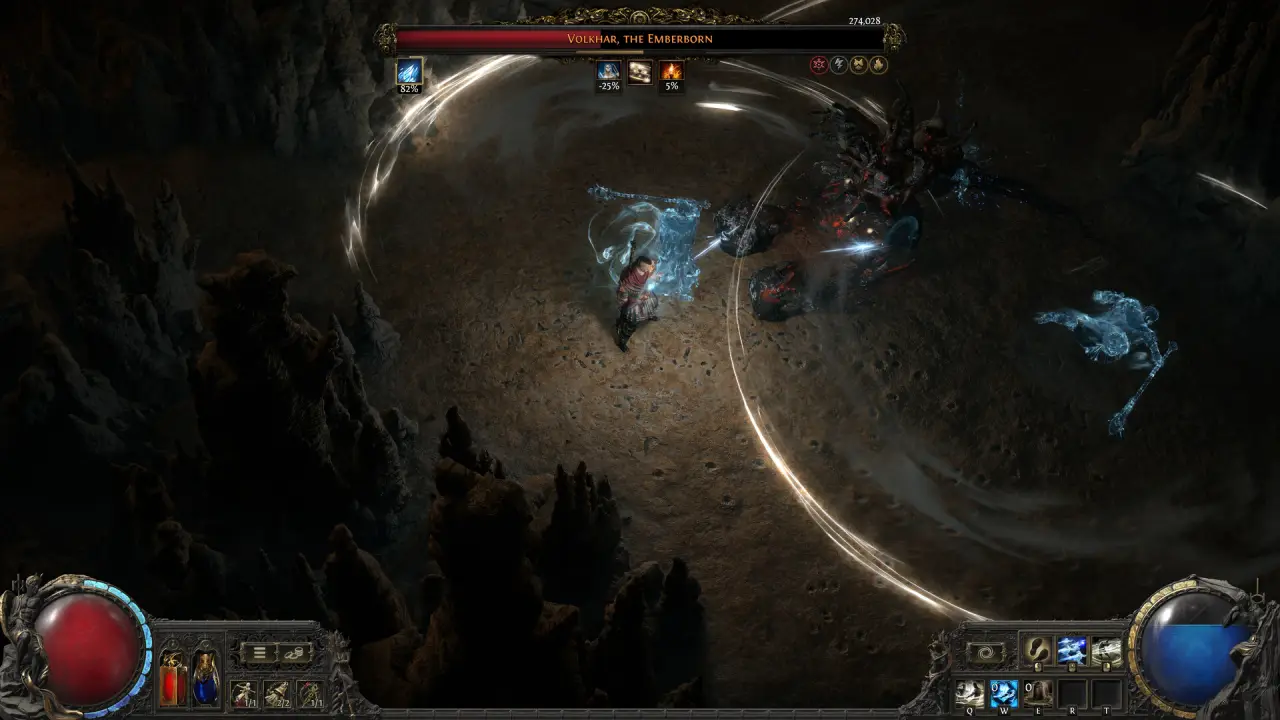
One trick deserves its own line. IGN China singled this out as the boldest, most inventive scene design they had seen in the genre — fighting on top of a wagon that is actually rolling forward, for one. Traditional ARPG maps are static chessboards. Path of Exile 2 insists the ground under your feet should move. That dynamism is not just pretty; it forces you to rethink your footwork, stitching the visuals and the play together.
The monster and boss design pulls the same weight. Across more than a hundred unique bosses, it is not just the move sets that differ — silhouettes and entrance staging are distinct too, none of that lazy recolor-and-resize routine. Paired with the grim, realist palette, plenty of bosses land a genuine jolt the first time they appear; you read "this one is trouble" straight off its size and the way it coils before it strikes. Tying visual presence to combat threat like that is one of the most quietly impressive things the art team did, and it is a big part of why the world feels dangerous rather than decorative.
Gorgeous, yes — and it stutters, yes: optimization is the soft spot
Hold off before you sprint to buy, though. The biggest visual problem here is not how it looks but whether it runs. Optimization is a genuine weak spot: stutter, frame drops, and outright crashes show up on both PC and PS5, and the framerate buckles hardest in heavy effect-laden fights. That is the direct reason I pinned graphics at 8.0 — the raw craft is worth a 9, and performance dragged it down.
What makes it worse is how the stutter tangles with the play itself. As the audio section flagged, a screen crowded with effects can swallow the attack tells, and in a game this demanding, not seeing where the next hit lands ends your run outright. So the visual issues do more than dent the spectacle; they bleed straight into your combat performance.
That distinction matters when you weigh the score. Plenty of games stutter without it ruining anything but the screenshots. Here, a dropped frame at the wrong instant is the difference between rolling clear of a one-shot and eating it, which is why I cannot wave the performance away as a cosmetic gripe. It is a playability problem wearing a visual costume, and it is the single biggest thing standing between this art direction and a higher mark.
There is a real tension worth naming between that visual ambition and the optimization. GGG clearly wants every frame to stagger you, so it piles on spell particles, lavish skill effects, and complex lighting. Pretty, until the hardware cannot keep up and stutter becomes the inevitable byproduct. It chose impact over stability, and right now you live with the consequences of that trade.
On platforms, the game spans PC, PS5, Xbox Series X/S, and the Epic Store, but the console experience trails PC noticeably. Inventory management on a controller is a genuine slog, nudging a stick across a dense grid one cell at a time until you want to put the pad down. For the steadiest frames and the smoothest controls, PC with a keyboard and mouse is still the safer bet today, and there is no shame in waiting for the full release to smooth the performance out before you try it on a console at all.
Combat | 9.5/10
ゲーム性: 9.5/10The moment you press dodge — a looter that finally feels like Souls
If you only learn one thing about Path of Exile 2, make it this: it shoved Souls-style combat into a loot game, and it actually pulled it off. You get a dodge roll with no cooldown, paired with WASD movement, and for the first time you have to read enemy windups and time your escapes the way you would in an action game. Shield classes can raise a guard and block on command, leaning even harder toward the Souls end of the dial.

How big a shift is that? Combat in a traditional ARPG is, bluntly, standing still and clicking the floor until your stats win. Path of Exile 2 refuses. It has more than 100 distinct bosses, each with its own move set and mechanical damage, and plenty of attacks will one-shot you flat if you do not roll or block. That pressure is sharpest on your first run through, when the game forces you to learn each boss's rhythm rather than tank it with gear. This is why outlets keep calling it the Dark Souls of hack-and-slash.
It comes wrapped in a checkpoint design that is pure Souls, too. When your character dies, the monsters in the area respawn as if you had rested at a bonfire, and every area is dotted with three or four resurrection points, with a save always sitting at a boss's door. The smart part is the math: it lowers the cost of throwing yourself at a boss again, no long run back, while still chopping your progress into bite-sized Souls-style trial and error.
What surprised me most is how this rhythm reshapes the way you actually think mid-fight. In the old click-the-floor school, you barely registered individual enemies; here you are tracking a single boss's tells, husbanding your flask charges, picking the half-second when it is safe to commit to a big attack. The game has quietly turned a genre that used to reward reflexless number-stacking into one that rewards attention and patience. That shift will not be for everyone — some players genuinely just want to vaporize screens of monsters — but for the crowd it is aimed at, it is intoxicating, and it is the single clearest reason this is the highest score in the review.
Pull skills off your gear — build freedom is its real ace
Action alone would not be enough. What actually keeps people grinding for hundreds of hours is the bottomless build system, and the heart of that overhaul is a fully independent skill-gem screen.
Let me put that in plain terms. In a lot of looters, the skills you can run depend on whether your gear has sockets in the right colors, which boxes you in at every turn.
Path of Exile 2 simply cut that chain. Skills no longer live in your equipment sockets; they have their own screen, every active skill carries its own support-gem slots, and you can bolt on more with crafting. Building a character stops being about matching socket colors and becomes purely about chasing the playstyle you want, freedom cranked all the way up.
The Ascendancy layer deserves one more line. An Ascendancy is essentially a sub-class: clear its trial and you unlock a specialization plus the points to push it, the Shaman pumping your elemental damage, the Oracle opening burst windows through foresight mechanics. Crucially, every class can wield every weapon and every skill, with no hard class walls fencing you in, which means the same starting character can branch into two completely different experiences depending on the Ascendancy and tree path you chase. That "everything is open, you pick the direction" philosophy is where the build depth actually comes from, not from a long list of locked archetypes.
Stack the beefed-up passive tree on top, plus the planned 12 base classes and 36 Ascendancies for the full release, and you can picture the sheer number of builds this thing can spit out. That is the confidence behind handing gameplay the highest score in the whole review, a 9.5. Line it up against its most direct rival, Diablo IV: Diablo is friendlier and warmer to newcomers, no argument, but on build depth and endgame staying power it gets left in the dust. One has you brushing the ceiling in thirty hours; the other has you three hundred hours deep and still testing new builds. That gap is the whole story.
Content | 8.5/10
ボリューム: 8.5/10A 38-hour campaign is the appetizer — the Atlas is what keeps you
Talk about content and you have to look at two ends. On the campaign end, Path of Exile 2 runs roughly 38 hours through its current story, which is no small slab for a game still in Early Access. But what turns this into a long-term home for loot players was never the campaign. It is the interlocking endgame map waiting on the far side of it.

The Atlas of Worlds works like this. You crack open one region challenge after another with Waystones, which climb in tiers from T1 all the way to T15, the difficulty ratcheting up step by step. Bolted into those maps are stackable random mechanics like Breach, Expedition, and Abyss, plus a separate endgame passive tree you invest into on purpose.
The campaign teaches you how to play; the endgame is the part that genuinely will not let you stop, and its staying power is close to limitless. That is the core of the 8.5 content score, and it is the reason veterans measure their time here in hundreds of hours rather than a single playthrough.
A half-built game that patches like crazy — seasons are the engine
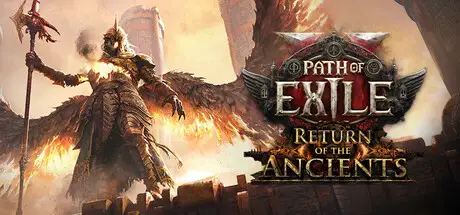
Here is something Path of Exile 2 does harder than nearly any Early Access game alive: it updates relentlessly. Most games go quiet for ages once they hit Early Access. Not this one. Patch 0.3 in August 2025 cut the much-hated Cruel difficulty, added the fourth act and three Interludes, and squeezed in a Sprint mechanic, holding the roll button to move faster and kill dead travel time. December 2025 brought 0.4 to expand the endgame; May 29, 2026 launched the Runes of Aldur league; and 0.5, "Echoes of the Ancients," overhauled the endgame again.
That cadence of resetting the economy and dropping new mechanics every few months is GGG's signature carried over from the original, and it is the real reason a half-built game holds tens of thousands of concurrent players and a rating that has climbed to Very Positive.
Patch 0.3 in particular deserves a callout for sheer heft. This was not a round of bug-fixes — cutting Cruel difficulty solved the single loudest veteran complaint, the old grind where reaching the endgame meant replaying the entire campaign on a harder setting, tedious enough to drive people off. The Third Edict tore that wall down, then used the fourth act and three Interludes to re-pace the whole run, and folded in Sprint so travel stopped being a chore. One update lifting the experience a full tier is exactly what separates this from the Early Access games that ship and rot. For a game still growing, whether the studio keeps investing and actually delivers on its promises often matters more than its current state — and GGG's credibility on that front is one of its most valuable assets.
The business model earns a nod too. The game itself is free, selling only cosmetics and stash conveniences, never power. The $30 Early Access pack even hands you the full $30 back as in-game currency, so the entry fee turns straight into spendable credit. There is a quiet upside to free-plus-seasons: it crushes the cost of trying it. You do not drop sixty dollars up front and gamble on whether you like it; you just play, then spend on looks once it clicks, and walk away free if it does not. For a game still in Early Access and liable to rework core systems at any moment, that low bar to entry is genuinely friendly, and it lets you sample the loop on your own terms before committing a cent.
Just keep the asterisk in view: the content is still half-baked. GGG plans to double the size before release, adding roughly 50 bosses, three campaign acts, and six classes. What you play now is not even half the finished game, which cuts both ways — frustrating if you wanted a complete package, exciting if you realize how much is still on the way. Step in now and you are not buying a finished product. You are signing on to grow up alongside it, and whether that reads as a pro or a con comes down entirely to the kind of player you are.




コメント 0
ご意見をお聞かせください
このゲームについての感想や評価をお寄せください。
まだコメントはありません。このレビューへの感想をぜひどうぞ。