






















Opening
One person made a game that 41 million people use to log off from their lives.
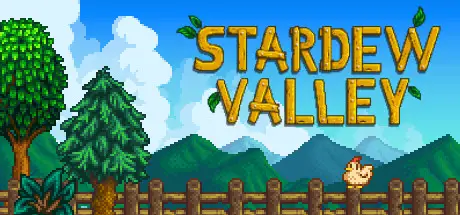
The numbers are absurd before you've watched the first sunrise. Eric Barone — pixel artist, composer, programmer, designer, occasional plumbing-fixer — shipped Stardew Valley in February 2016 after four-and-a-half years of solo work while his wife paid the bills as a nurse. Lifetime sales now run to forty-one million copies, gross revenue past five hundred and eighty million dollars, his personal net somewhere north of a hundred and seventy. No co-founders, no funding round, no acquisition. The credits crawl is twelve seconds long and most of those seconds are blank.
But the sales aren't really what this review is about. Ten years on, every farming sim with a Kickstarter has been measured against Stardew — Animal Crossing: New Horizons, Coral Island, Disney Dreamlight Valley, Story of Seasons: Pioneers of Olive Town, Mistria — and none of them have moved the line. Stardew sits at ninety-six percent positive on Steam across eight hundred and sixty thousand reviews, holds a permanent Top 200 slot a decade after launch, and climbed back into the Top 20 the week 1.6 dropped in March 2024. The interesting question isn't why it sold; it's why a decade of well-funded, well-staffed, well-IP'd successors couldn't take its market share.
The short answer is the lattice. Most of Stardew's competitors built two systems and called it a life sim — farming plus relationships, or building plus fishing. Stardew runs five at once on the same save: the farm, the town's social graph, the procedural mine, the fishing minigame, the Community Center bundle quest. A first-time player picks one, finds it deep enough to carry a whole indie game, and then discovers the next layer four hours later. That arithmetic — five layers, one designer, one save — is hard to replicate at any budget. The rest of this review unpacks how the writing carries the social layer, why eighty hand-written tracks turn into the second-most-important script of the game, how 16-bit tile art stays sharp on 4K, what the five-system stack actually means in play, why $14.99 of content has somehow scaled to 300 hours, and where Stardew sits on the indie shelf a decade in. Pour a coffee. The dive is long.
Story | 9.2/10
ストーリー: 9.2/10No one walks into Stardew Valley for the writing, and yet the writing is the reason the BAFTA jury walked past every triple-A nominee and put it on a 2017 nomination ballot for Game Design.
The main quest is a single sentence: your grandfather left you a farm, go take care of it. That's the entire forward push. Everything else — every line of dialogue, every revealed inner life, every quiet collapse and quieter rebuild — is staged so it only happens if you choose to walk into it. The game never tells you that Pam drinks. It never tells you Shane is depressed. It never tells you Penny and her mother are below the poverty line, or that Sebastian is suffocating under a stepfather, or that Linus voluntarily lives in a hilltop tent because he is done with the indignities of low-wage town life. You find out by showing up and paying attention, and that's the move the game makes — it treats your time as a writing variable that other games refuse to admit exists.
A town under glass — every resident is writing waiting to happen

Pelican Town has thirty-plus residents and most of them carry a private interior life that the script will quietly reveal if you cross enough thresholds with them. Eurogamer's Christian Donlan compared the writing style to George Saunders — "a quiet desperation under the town" — and the comparison earns itself the first time you stumble onto someone's eight-heart event and realize the game has been holding a hand out for thirty hours waiting for you to take it. There is no quest pointer on these moments. There is no audio sting. The screen does not freeze the action. They happen and resolve and then the day continues, the way real conversations end.
The hardest-cited example is Shane. His eight-heart sequence is staged across four discrete events, each separated by weeks of in-game time and only triggered by sustained friendship — you can't speedrun your way into them. You first meet Shane at the Joja loading dock with a beer at six in the morning; eight months of game time later you find him at the lakeside, joining a sobriety meeting and trying. The arc never claims he's fixed; the writing trusts you to read the difference between attendance and recovery. AAA productions with full voice direction, hundred-million budgets, and writers' rooms have failed at this exact maneuver for twenty years. A solo developer landed it in 2016 with typewriter text and ambient music.
The smaller arc that converted the Chinese-language audience, and that still gets quoted in fan essays a decade later, is Linus's leek. On the first morning of spring you can forage a wild leek by the bus stop, walk it up the hill, and give it to a man who lives in a tent and whom the town politely ignores. There is no quest for it. There is no flag for it. He says thank you in three sentences that read like every adult who has ever been told they are not contributing. The game's reputation in Asia got built on that thirty-second event, not on the farming.
Two endings inside the same questline — Joja Mart against the Junimo

The structural idea most pirated by Stardew's successors is the Community Center fork. The same questline — restore six rooms of Community Center bundles to bring the Junimo spirits back — can be answered with capitulation to the Joja Mart corporate membership instead, and the game refuses to tell you either path is wrong. The Joja ending isn't a punishment route; the writing actually earns it. Pam keeps her bus driver job at the JojaMart-funded bus repair. The town isn't ruined. It's just slightly more depressed in a way the writing leaves you to feel rather than name. The Junimo ending isn't a victory either; the spirits leave, the town gets shinier, and one of the most ambiguous final scenes in indie games suggests the Wizard knew what he was trading. Disney Dreamlight Valley tried to copy this fork in 2023 and ended up making one of the two endings clearly the right answer. Stardew makes both endings sting in different places.
Marriage sits inside the writing budget rather than beside it. Twelve candidates, fourteen-heart progression past the wedding, post-marriage stardrops, children with their own dialogue trees. Sebastian's post-marriage line about his stepfather is forty-eight words long and lands harder than most AAA cutscenes. The game's relationship system is the only one in the genre where the relationship continues to be written after the engagement ring.
Where the writing flickers is localization. Simplified and Traditional Chinese subtitles are clean and consistent — that's why the Linus leek scene crossed over — but Korean and Japanese full voice tracks are absent for the Sea-of-Spirits-equivalent priest figures, and there is no voice work at all in English. The compensating decision is honest: the absence of voice protects the localization budget and preserves the music as the emotional channel. It is not a flaw; it is a trade-off the game owns.
Audio | 9.5/10
サウンド: 9.5/10If the writing is the secret second screenplay, the music is the secret first. Eric Barone wrote all eighty-plus tracks on the soundtrack himself, across folk, Celtic, and 16-bit chiptune lineages, while also writing the code and painting the pixels. That is one human handling composition, arrangement, and final mix on a project the size of a triple-A's narrative budget. The closest peer in indie history is Toby Fox on Undertale, and Fox didn't ship the engine and the art.
Eighty tracks, one composer, two hundred listens

The signature melodies anchor themselves to places and seasons. Spring (Outside the World) is the music you hear most often in the first thirty hours of any save, and it is the song that gets cited in the "I open the game just to listen to this" Steam reviews. Fall (Ghost Synth) replaces it the moment the first leaf turns and recalibrates the whole emotional weather of the farm — the same screen now reads as a place where the year is ending. Winter (Nocturne of Ice) leans into a quieter, lower-register cold and is, for many players, the first time they realize the soundtrack has been writing a year-long emotional arc beneath their attention. The Stardrop Saloon theme runs the social hub at night. Cloud Country, the tiny hilltop motif for Linus, is two minutes long and reorients every player's relationship with the character it plays under.
The technical bar is loop length against playthrough length. Each track runs roughly four minutes; the average engaged save crosses two hundred hours; that is more than a thousand repeats of every theme. Music written under those conditions has to survive saturation. ConcernedApe's compositional restraint is what does it — most themes use a small ensemble (acoustic guitar, marimba, soft synth pad, one melodic lead) and reserve the larger textures for seasonal transitions, weather changes, and special events. The mix is deliberately under-produced for indie standards; that's the point. A denser mix would have collapsed at the four-hundred-hour mark.
Time-of-day binding — thirty-two moods per year cycle
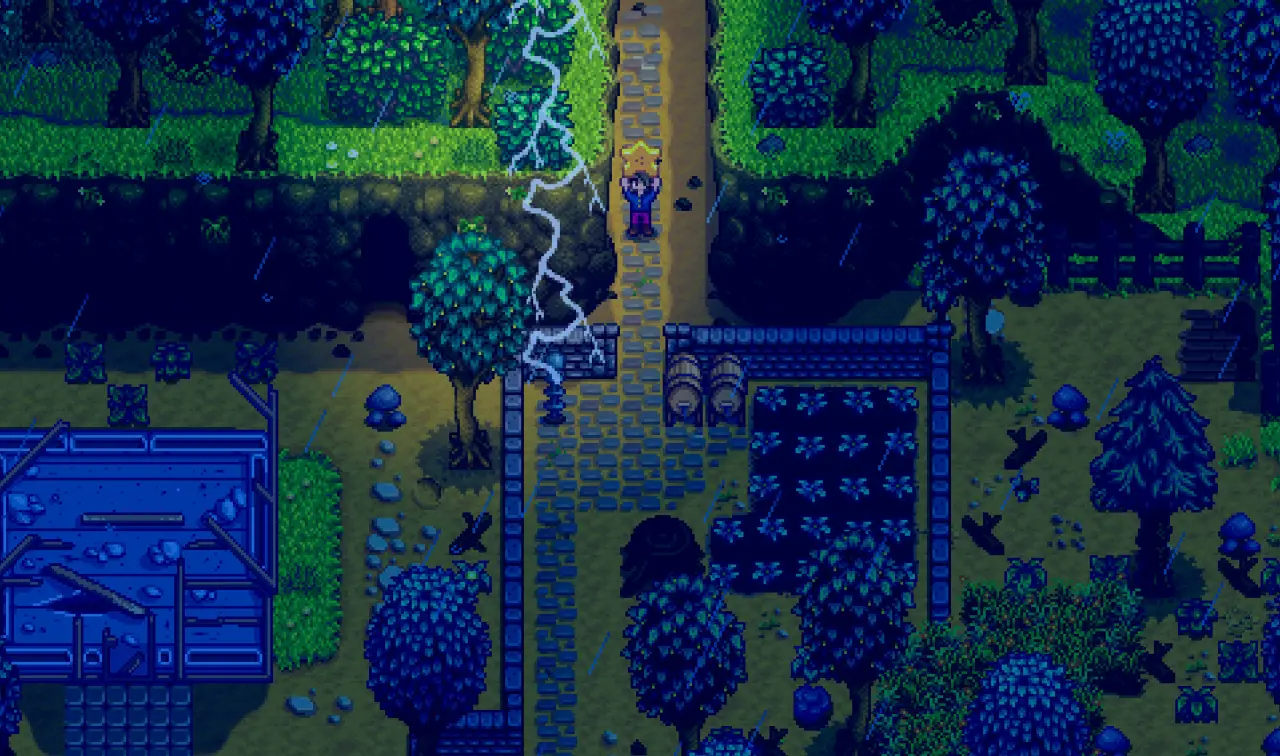
Music binds not only to season but to time of day inside each season. There is a separate spring-day theme, a spring-rain theme, a spring-evening theme, and a spring-festival theme; multiply that across four seasons and you get roughly thirty-two distinct musical moods inside the calendar year, before you count special-zone tracks for the mine, the Skull Cavern descent, Ginger Island, the wizard's tower, and JojaMart. No other game in the "cozy" category attempts this resolution of binding.
The sound design behind the music does work most reviews skip. Footsteps change tonal weight on dew-wet grass versus dust path versus wood porch versus stone floor. The fishing-rod reel has friction. The ax against oak sounds different from the ax against pine. The pop of a refrigerator opening is sampled, not stock. Eight years of patches have kept this layer alive — the 1.6 update added new foley for the meadowlands farm grass tiles, which most players will never consciously notice, which is the point.
The single missing layer is voice. Every NPC speaks in typewriter text against ambient music — a choice that protects the localization budget and preserves the music as the emotional channel. The trade-off is honest and the game owns it; players who arrived from voice-acted indie peers (Disco Elysium, Pentiment) sometimes call it dated, but the alternative was either a thinner localization or a worse OST. Stardew chose music, and the choice has held for a decade.
If you have a decent headset, the Stardrop Saloon scene at eleven at night with the crowd noise mixed under the saloon theme is the single best advertisement for the audio team-of-one. The crowd is sampled, the room ambience has dimension, and the music sits in the center channel exactly where it should. It is the kind of mix that makes you check the credits and then check them again because surely there is a sound designer somewhere on this list. There is not.
Visuals | 9.0/10
グラフィック: 9/10Pixel art ages two ways. Most of it gets blurry the moment you plug a 4K monitor into a 2016 game and watch bilinear interpolation smudge every sprite into a sad cloud. The rest of it stays crisp, and Stardew Valley is the textbook example of why.
The single technical decision that explains the whole look
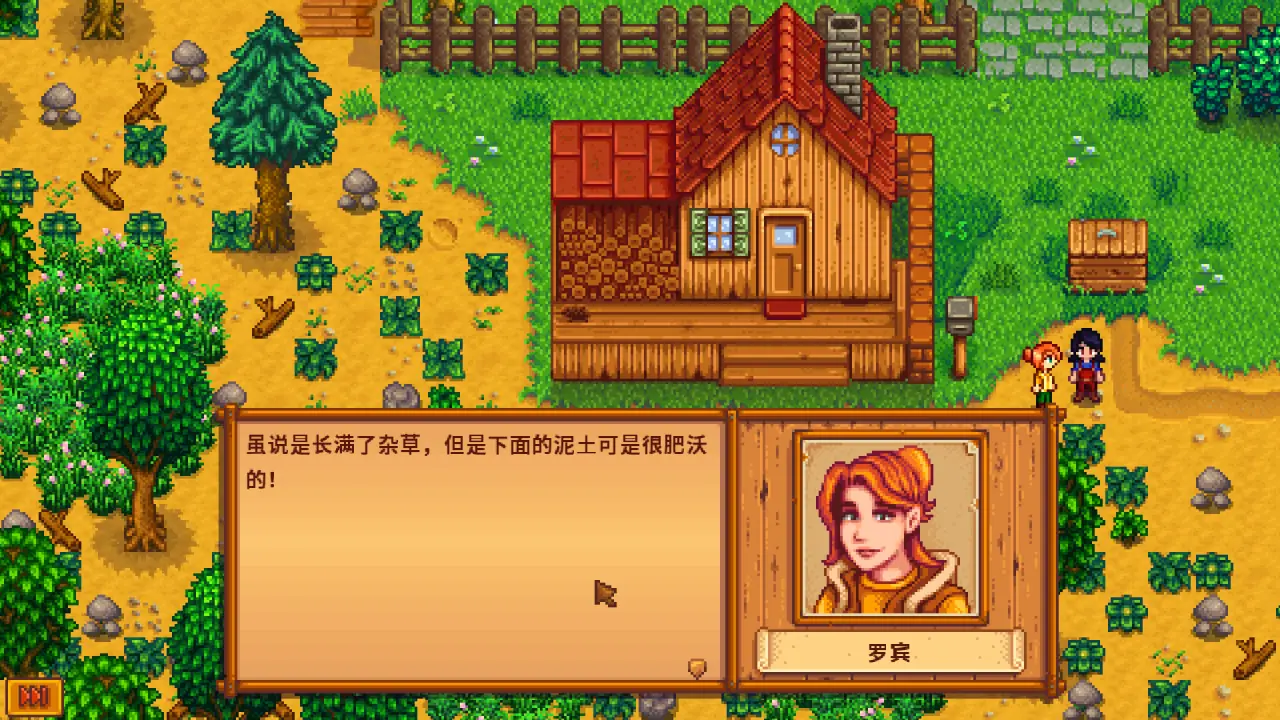
Every tile in the game is rendered from a 16x16 base resolution at hard integer-multiple scaling — 2x, 3x, 4x, 5x — never fractional, never bilinear-smoothed, never re-sampled. The result is that every pixel on a 4K monitor is still a perfectly square block of color, the way pixel art was meant to be read. It is a one-line graphics-pipeline decision the developer made early and never reversed, and it is the single largest reason the art does not look like a 2016 indie when you load it on a 2026 monitor. Most contemporaries chose smoothing. Eastward (2021) is the cautionary case — beautifully composed pixel work, fuzzy as a sweater on any screen above 1080p. Hyper Light Drifter and Celeste sit closer to Stardew's discipline. The reference points the developer cites publicly are Final Fantasy VI (1994) and Super Metroid (1991), and the resolution-independence is more thorough than either ancestor managed.
The art volume behind the technical discipline is what makes the decade-long longevity legible. Roughly five thousand hand-drawn pixel sprites across four-and-a-half years of solo work — character portraits, tile sets, animation frames, item icons, weather overlays, the entire UI font. Every NPC has a full expression set; every farm animal has idle, eat, sleep, and weather-reaction frames; every crop has six growth stages plus a withered variant. The audit reveals an asset density that small studios with art departments don't ship.
Seasonal repainting — four maps inside one map

Pelican Town isn't one map. It's four, repainted to the tile for spring, summer, fall, and winter, with weather-state overlays for rain and snow on top. The river runs differently in winter ice and spring melt. The bus stop bench has a different shadow in summer haze. The general store's window catches different light. These are not switchable filters; they are hand-painted alternate tilesets for the entire town, all by one person, all in the same pixel grammar. It is the kind of work that looks invisible because it is so consistent that the player never realizes how much painting hit the floor.
The 1.6 update in March 2024 is the demonstration that the art budget has stayed live for a decade. Twelve marriage candidates got new outfit and expression sets — same pixel resolution, same color palette discipline, ten years on. There is no studio in the industry where a single artist has shipped consistent design language for a decade without team handoff. ConcernedApe did, and the result is that 1.6 content does not look like a graft.
There are limits. Character portraits use a deliberately limited expression set — neutral, happy, surprised, sad, blushing — and intimate-relationship scenes lean on text rather than facial nuance, which a player coming from Persona 5 will notice immediately. The combat sprites for cave enemies sit at a lower animation budget than the town residents, which is the game's quiet acknowledgement that fighting is not where the art investment lives. The mine procedural tilesets are clean but repetitive enough that long Skull Cavern runs start to feel visually flat by floor 80.
What the art ultimately does is anchor the game's central claim — that pixel work, done with discipline, ages slower than 3D work done with shortcuts. Plenty of 2016 indies that chose 3D look worse in 2026 than Stardew does. The technical floor for "still looks good ten years later" turned out to be lower than the AAA pixel-vs-polygon arguments of the time suggested, and Stardew is the proof.
Weather, lighting, and the small visual systems that hold the world together

Past the headline tilesets, the small visual systems are where the art budget shows its discipline, and where the decade-of-solo-work claim earns the most credibility. Lightning during a storm forks across the screen with a real frame budget, not a single-flash cheat. Rain has three intensities, each with its own raindrop sprite sheet, and the puddle accumulation on dirt paths is a separate animated layer. Fog rolls in for the Ginger Island volcano route as a soft alpha overlay that subtly shifts the palette. The festival sets — the Egg Hunt, the Stardew Valley Fair, the Spirit's Eve maze, the Night Market — each have their own bespoke tilesets used for one in-game day per year, which is the kind of asset allocation that small studios with art departments openly refuse. Even the Stardew Valley title screen has had four full repaints across the 1.0 to 1.6 update arc, every one in the same color discipline as the original. That continuity of style across a decade of work, executed by one person, is the visual signature the imitators cannot bottle.
Combat | 7.5/10
ゲーム性: 7.5/10A decade of would-be successors arrived, built the farm and the relationships, called it a life sim, and shipped. Stardew built five independent systems on the same save and let the player decide which one was the real game. That arithmetic is the moat.
Five systems running in parallel — pick any one and find it deep enough

Game Informer's 2016 review introduced the phrase "secondary economy" to describe the farming-to-cooking-to-gifting loop, and the framing has aged into the right lens for the whole game. There are five independent economies running on one save: agriculture, social relationships, mine descent, fishing, and the Community Center bundle quest. Each one is engineered to a depth that would carry its own indie game if you stripped the others away.
The empirical proof is in the player-behavior data. Roughly one hundred percent of players farm (it's the default verb). About seventy percent build out the NPC relationship graph. About fifty percent take the mines seriously. About forty percent invest in fishing. And about eighty percent complete the Community Center. The average engaged player runs three or four systems through to depth, and almost no two saves do it the same way. The systems are not gated dependencies — you don't have to farm to mine, you don't have to mine to fish, the Community Center bundles let you trade your way through with whichever loop you preferred. That is the structural choice every successor missed.
The systems share one resource — stamina — which is the design key that ties them together without forcing them together. Most mistakes cost time, not progress. Forget to water the crops one rainy morning? The rain waters them. Pass out at one in the morning chasing a sturgeon? Wake up at six the next day with half a wallet and most of your dignity. The absence of failure states is what makes the systems forgiving enough for casual players and dense enough for spreadsheet players to live in the same game without one mode trampling the other.
The 28-day month is a compound-interest planning game

Farming inside Stardew works on a 28-day month and a four-season cycle. Crops have maturity timers tied to that calendar; ancient fruit takes 28 days; cranberries take seven, but you only have fall to plant them. Late-season decisions are pre-season decisions. A new player picking parsnips on day one is, without realizing it, sketching out their entire first summer income. The mechanic-as-pacing trick is rare in life sims and is the reason farming carries weight in Stardew despite using only four verbs (till, plant, water, harvest).
The 14-heart NPC relationship system is the second compound-interest layer. Gifts have weekly caps. Birthdays multiply gift effect by eight. Friendship decay sets in if you ignore someone past a month. You cannot grind your way to a marriage; the system forces you to budget your attention. That is exactly the kind of design discipline triple-A relationship systems abandoned a decade ago. The third compound layer sits inside the Community Center bundles, where pre-bundle planning forces players to think across seasons — the spring bundle needs a salmonberry that only forages in summer, the artisan bundle needs goat cheese that only exists after you've raised a goat past its first month. Every "completion list" hides a calendar planning exercise. That is the lattice in motion: every system tightens the others.
Skull Cavern, fishing, and where combat falls short

Skull Cavern is the procedural action-game grafted onto the farming sim, and on its own it would have been a respectable rogue-lite indie release. Stamina math, iridium drops, luck mechanics, food buffs, weapon scaling — the same player who calls Stardew "the cozy game" can spend an entire Friday night on Skull Cavern descents trying to hit floor 100 and find it deep enough. The fishing minigame is the most divisive system; rod-control physics frustrate handheld players, and the 1.6 training rod helps but doesn't fix the curve. Game Informer's 2016 verdict that combat is the weak pillar still holds — enemy AI is thin, weapon variety doesn't scale beyond raw damage numbers, and a decade of patches has barely moved it. The 7.5 score on gameplay is the honest accounting of that gap.
The 1.6 update's biggest design intervention is eight-player co-op. The previous 1.3 ceiling was four. Eight players changes the pacing entirely — chore-divided mornings, shared marriage politics, parallel mine descents — and effectively turns Stardew into a friendship sim. The multiplayer audience is now a distinct population from the singleplayer audience, and Mintrocket-style live-ops attention to that audience is the reason the game is climbing Steam Top 20 again in 2024.
If your reference point is Hades or Sekiro, Stardew's breadth will read as scattered and its boss fights will read as soft. That is a true read and the game owns it. If your reference point is "I want one game I can open every evening for the next ten years," the five-system stack is built exactly for you.
Content | 9.8/10
ボリューム: 9.8/10Fourteen dollars and ninety-nine cents. That's the price the game has held across every platform for the last decade.
Time-on-game arithmetic — 53 hours minimum, 300 hours typical

HowLongToBeat tracks Stardew Valley main story at 53 hours, main-plus-extras at 95, completionist at 175. Those are the published numbers. The honest player number — the one collected from save files in the Stardew Valley subreddit — is closer to 300 hours by year three, because the game keeps inventing new reasons to log in long after the Community Center is restored. Year-three stardrops, year-five grandfather evaluations, year-eight perfection rewards. There are rewards in this game pacing past most players' real-life rate of getting older. The breakdown across content stages settles into a recognizable rhythm: year one is the Community Center grind that ends around hour fifty; year two is the marriage and child arc that fills another sixty; year three onward is the layered endgame where Ginger Island, Skull Cavern descent records, and perfection rewards each carry their own seventy- to hundred-hour subgame. A typical Reddit save thread will track players landing on the 300-hour mark somewhere in the middle of year four. AAA titles with five-times the budget rarely hold an engaged save past the year-one equivalent.
The cost-per-hour math is the cleanest in indie gaming. $14.99 divided by 300 hours is five cents an hour. A typical AAA release at $69.99 played for forty hours is one dollar and seventy-five cents an hour. Stardew is one thirty-fifth the per-hour cost of the typical triple-A purchase. If you have a budget concern, this is the single most defensible buy in the past decade of indie storefront pricing.
Eight years of free content — 1.0 to 1.6 as a continuous expansion
Every major update has shipped at zero additional cost. 1.1 in October 2016 added farm building automation and Krobus as a non-romantic housemate. 1.3 in August 2018 took multiplayer from one-player only to four-player co-op. 1.4 in November 2019 brought the fish pond, new fruit trees, and the Joja-route alternate endgame. 1.5 in December 2020 was the largest single drop — Ginger Island, the beach farm map, the entire endgame zone with parrot upgrades, walnuts, and the jungle questline. 1.6 in March 2024 added the meadowlands farm, nineteen power books, eight-player co-op, and over a hundred new pieces of late-game content. The Steam Awards 2022 "Labor of Love" award was earned on this content cadence, not branded onto it.
The three optional content pools that extend the post-completion ceiling are Ginger Island (the resort endgame with its own farming subsystem and walnut puzzles), Skull Cavern (the endless procedural descent for action-game players), and the Joja-versus-Community-Center fork (which effectively gives every player a New Game Plus by routing them through the opposite ending). Each pool adds roughly a hundred hours to a save that exhausts the core systems.
The third leg — the mod ecosystem

The single layer that most reviews skip is the mod scene. SMAPI, the unofficial Stardew Modding API, has carried roughly fourteen thousand mods on NexusMods over a decade, and the developer's public stance on the modding community is one of the warmest in the industry. Stardew Valley Expanded alone adds thirty-plus NPCs, new map areas, fully voiced events, and a roughly two-hundred-hour expansion experience that effectively functions as a fan-made sequel. Ridgeside Village, the East Scarpe expansion, the various overhaul mods — they sit alongside the official game as a content multiplier that no single-platform reviewer ever sees because Switch, console, and mobile players can't access them. That said, PC players who finish the base game and want a second loop have one of the most generous fan-content libraries in modern gaming waiting for them at no cost.
The one honest friction is cross-save. PC, Switch, mobile, PS, and Xbox saves are siloed; if you started on Switch you can't open the same farm on PC. That's the only meaningful content limitation in the package, and it has been the same limitation for ten years.
1.6 is the closing argument

ConcernedApe has publicly confirmed that 1.6 is the last non-port major update before his attention shifts to Haunted Chocolatier. That is good news for the buying decision: the product is now fixed. You are not buying into an open-ended live service that could change shape under you. The price is locked, the content is locked, the mod community is mature, and any future patches will be ports and stability fixes only. Whatever you pay for the game this week is what the game will be in 2030. Compare that to a typical AAA live-service title where the year-three content roadmap is uncertain and the year-five servers might be off; Stardew has the opposite problem, where the content ceiling is now stable and the only forward question is which platform port lands next. The Switch 2 release window is the only outstanding platform decision, and the gameplay's frame-rate-insensitive pacing means any future port is an equipment swap, not a redesign.
A decade of free expansion, half-a-billion in revenue, and a closing-of-the-book in 2024 — there is no other indie of the last fifteen years that has shipped this volume of content at this consistency at this price.





コメント 0
ご意見をお聞かせください
このゲームについての感想や評価をお寄せください。
まだコメントはありません。このレビューへの感想をぜひどうぞ。