























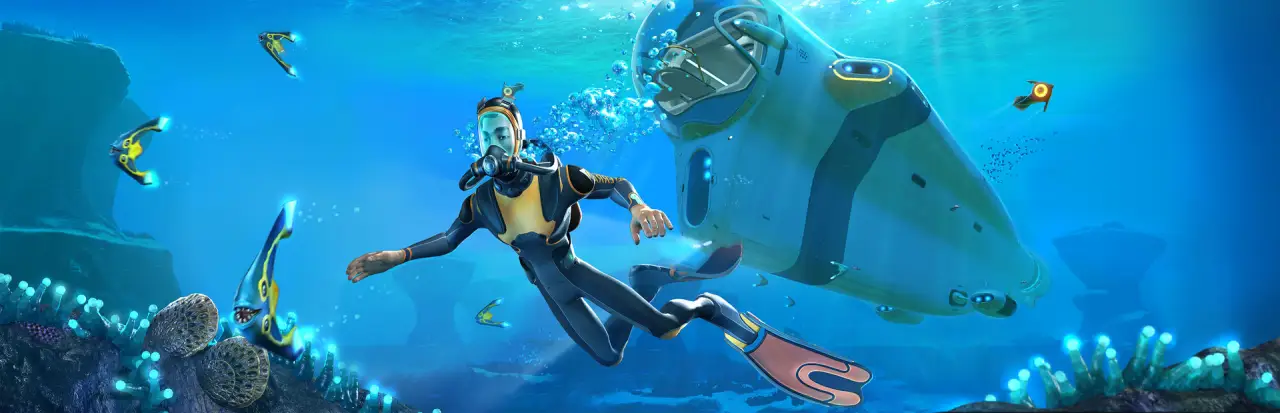
Opening
Officially released in January 2018, this title still ranks in Steam's top 5 by positive rating for the survival category as of May 2026 — Subnautica is one of the most immersive representatives in the PC survival genre. The San Francisco indie studio Unknown Worlds Entertainment, with a long-running team of about 30 people and a deeply customized underwater lighting system on the Unity engine, reached Steam 91% positive, around 8 million cumulative sales, IGN 91/100, PC Gamer 89/100, and OpenCritic 87/100 — a steady "small-studio classic" representative of PC gaming. In May 2026, the sequel Subnautica 2 launched into early access and sold 4 million copies in five days, validating the global reach of the series.
The game is set on the fictional alien planet 4546B — a world almost entirely covered by ocean. The player takes the role of Ryley Robinson, sole survivor of the Alterra company starship "Aurora," which was shot down by a mysterious giant weapon. Ryley's escape pod lands on the ocean surface and begins a journey of underwater survival and exploration, gradually discovering the ruins of an advanced alien civilization called the "Architects" from a thousand years ago — they built research facilities on the planet specifically to search for a cure to the deadly Kharaa Bacterium plague. On the surface this is underwater survival, but at heart it is a sci-fi mystery puzzle, one of the strongest narrative entries in the PC survival genre.
This is not a routine recommendation for players seeking combat thrills. The keywords here are underwater exploration, sci-fi mystery, deep-sea pressure feel, and the founding father of PC's "peaceful school" of survival. If you accept "almost no traditional combat weapons" plus "moments of deep-sea fear," the 60-hour mainline will be your most memorable sci-fi adventure of 2018-2026. If you fear deep water or want instant satisfaction, the first 10 hours of deep diving will make you genuinely uncomfortable — the game demands to be played on its own pace and makes no attempt to please players seeking a quick rush.
Story | 9.5/10
ストーリー: 9.5/10Main Story Architecture: The Aurora Crash and 4546B Exploration
The mainline narrative is one of the strongest in the PC survival genre — on the surface underwater survival, at heart sci-fi mystery puzzle. The player takes the role of Ryley Robinson, sole survivor of the Alterra company starship "Aurora," which was shot down by a mysterious giant weapon high above the alien planet 4546B (a world almost entirely covered by ocean). His escape pod lands on the surface, beginning a journey of survival and exploration in waters never before charted by humans on this world.
The mainline splits into five stages: Survival Adaptation (the first 10 hours learning oxygen management, base building, basic vehicles); Ship Exploration (finding the crashed Aurora itself, obtaining key story clues); Going Deeper (exploring the Lost River and ancient ruins, encountering Leviathan-class creatures for the first time); Story Turn (the Sunbeam rescue ship gets shot down, hope shatters, the Kharaa Bacterium plague is uncovered); Endgame Escape (locate the Sea Emperor Leviathan to obtain the cure, assemble the Neptune Escape Rocket and leave 4546B forever). The entire mainline has zero NPC guidance — the player discovers all plot through pure exploration of the world.
The Architects: Environmental Storytelling as Sci-Fi Mystery
As exploration deepens, Ryley discovers ancient alien ruins on planet 4546B — the "Architects" race (also called the "Precursors" by the player community). The Architects are a highly advanced cybernetic life form race that arrived on 4546B about a thousand years before Ryley's crash. They built research facilities, quarantine bases, and massive weapon installations on the planet (the giant weapon that shot down the Aurora was one of them) — all to find a cure for the deadly Kharaa Bacterium plague. The entire planet is, in essence, an "Architect disease research station."
This sci-fi setting unfolds fully through environmental storytelling — players scan stone tablets in ruins, read Architect-left PDA data, and piece together the full picture of Architect civilization themselves. There are no forced cutscenes and no NPC quest-giver characters; the entire story is found by the player. This "environmental narrative" style places Subnautica alongside Elden Ring and The Witcher 3: Wild Hunt as one of the "PC environmental storytelling ceiling" titles — a design victory for the small-studio classic at its 2018 launch, and one that later independent studios have studied repeatedly as a reference sample.
Choice System: Exploration Path As Player Personality
There is no traditional dialogue choice system, but players make decisions every moment in the game: take the risk and dive deep for rare resources or stay shallow and play safe; build a large permanent base or stay mobile with small vehicles; push the mainline first or explore the full map first; approach Leviathans closely or detour far around them. Every choice has no correct answer, but cumulatively they define your "underwater exploration personality" — the bold type, the cautious type, the completionist type, the speed-runner, the photographer type.
A deeper layer of choice is "how you handle deep-sea fear." The game deliberately designed "deep-sea pressure" — the environmental audio in Leviathan zones, the extremely poor visibility of deep water, the tense atmosphere around Aurora wreckage. Many players genuinely get goose bumps in the deep ocean, a rare "psychological immersion" representative in the PC survival genre. Chinese community consensus: Subnautica is one of the few games that make players genuinely think "I dare not dive" — this immersion is something the "violent school" survival games of DayZ and Project Zomboid cannot deliver in the same pure deep-sea form.
Character Writing: Ryley and the Sea Emperor Leviathan Double Track
The game has zero NPC companions — Ryley spends the entire game alone on 4546B. But the studio shapes character through two delicate threads. The first is Ryley himself — players progress from panicked newcomer at launch to seasoned explorer who can dive into the Sea Emperor nursery by endgame. This character arc forms entirely through the player's own exploration experience, a design victory by the studio for "creating emotional memory without any NPCs at all."
The second thread is the Sea Emperor Leviathan — the only intelligent character in the game. This is the largest intelligent creature on 4546B, the only non-aggressive Leviathan, a sentient and telepathic gentle giant. In the endgame mission the player conducts telepathic conversation with the Sea Emperor — the Emperor shares the tragic history of its species and the truth about the Kharaa Bacterium. This story beat is widely regarded as one of the "tearjerker game moments" of 2018-2020 in the Chinese-language community, with many players moved to tears by the Emperor's loneliness and gentleness, and remains the high point of the title's character writing across the entire game.


Audio | 9.0/10
サウンド: 9/10Soundtrack Themes: Environmental Atmosphere and Emotional Moments
The soundtrack is composed by an independent team including Simon Chylinski and Ben Prunty — overall running "environmental atmosphere plus emotional moments" dual tracks. Most of the time there is no background music — only underwater environmental audio; music only rises during plot beats (finding the Aurora, the Sunbeam getting shot down, entering the Lost Island, the Sea Emperor Leviathan conversation, the final escape). This "subtractive aesthetic" has been the design principle for eight years, giving the real cues unmatched emotional impact at the moments that truly matter most in the entire experience.
The most praised is the "Sea Emperor Leviathan conversation theme" — a slow ethereal string and female-choral piece that plays during the telepathic exchange. The track has accumulated over 100 million views on Bilibili, and many players use it as background music for meditation or sleep after finishing the game. Another is the "Sunbeam shot down" tragic strings — at the moment hope shatters, the strong contrast in scoring makes the loneliness and despair of being stranded on 4546B land with full emotional weight on every player who reaches that point in the campaign.
Environmental Audio Design: The Ceiling of Underwater Soundscape Immersion
The environmental audio design is the ceiling of underwater immersion in the PC survival genre. There is no guiding music and no UI prompt sounds — all sounds the player hears are real "underwater information": waves slapping the escape pod hull, the faint water sounds of fish schools swimming past, distant low-frequency growls of large creatures, the oxygen tank countdown prompt, the metallic creak of ship wreckage, the low-frequency psychological pressure of deep-water pressure shifts.
Each biome carries its own independent soundscape — Safe Shallows bright fish calls plus sunlight-through-water tones; Mushroom Forest glowing fungus hum plus spore drift sounds; Blood Kelp Zone the low respiration of blood-red anemones; the Lost River the crisp tones of water flowing through a freshwater layer; the Lava Zone underwater volcanic rumble plus steam sizzle; the Sea Emperor nursery ancient stillness plus the Emperor's low-frequency telepathic echoes. Every map is a complete "underwater audio ecosystem" where players can identify which biome they are in with eyes closed even after only a few hours of total playtime in that area.
Leviathan Audio: The Core Source of Deep-Sea Fear
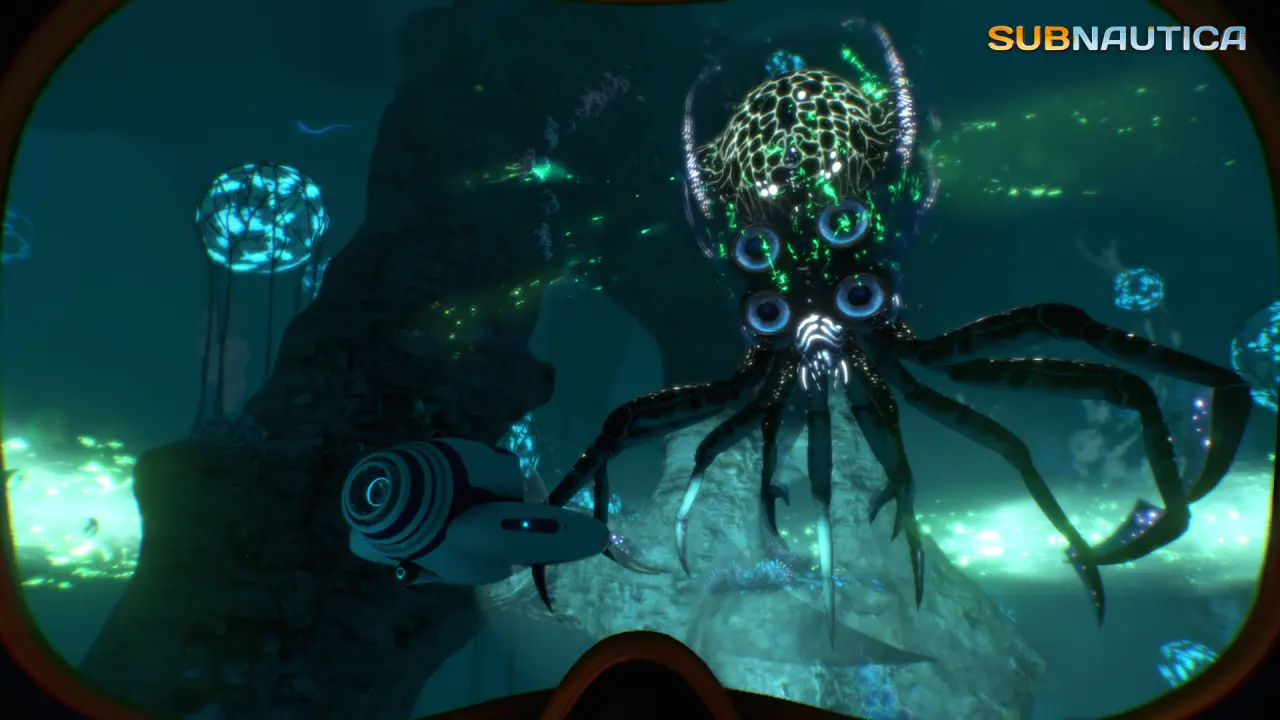
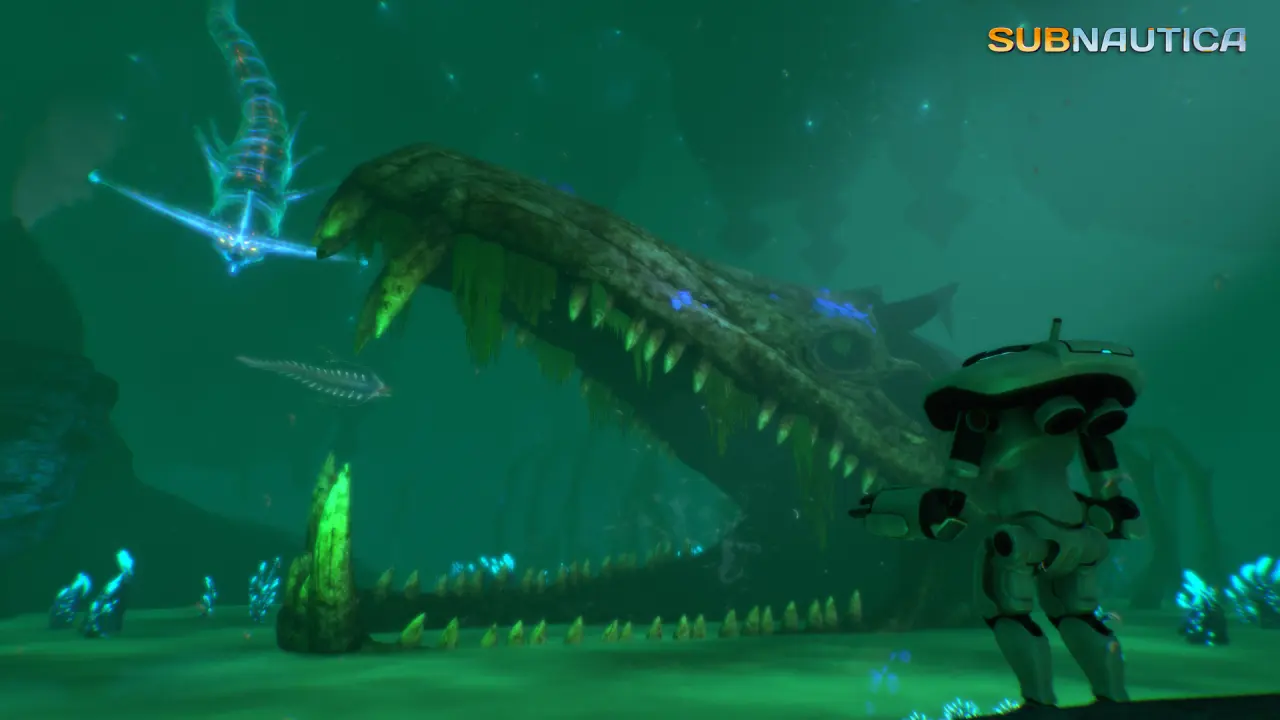
The "deep-sea fear" of the game comes mainly from the Leviathan audio design across every dangerous biome. Large Leviathans each have their own roars — the Reaper Leviathan's signature low growl tenses up players 200 meters away; the Ghost Leviathan's spiral charge is preceded by an echoing screech; the Sea Dragon Leviathan's fire-breathing attack has a heavy low charge-up tone. These sound effects calculate distance attenuation precisely across multiple scenarios — the same Leviathan at 50 meters, 200 meters, and 500 meters sounds entirely different, and veteran players can localize a Leviathan within roughly a hundred meters from distant roars alone after enough hours of dedicated listening practice.
The Chinese-language community talks most about "Reaper Leviathan auditory training" — many post-completion players can identify "which Leviathan, how far, in which direction" from a single distant roar. This "audio first" gameplay is unique in PC underwater survival, the most valuable hard skill veterans develop. Playing with headphones delivers more than ten times the immersion of desktop speakers — this is community consensus, and many veterans specifically buy high-end head-mounted audio gear just for this game.
Platform Audio and Peripheral Support
Platform audio: - PC (Steam): complete 7.1 surround plus Dolby Atmos plus HRTF headphone audio. - PlayStation 4 / 5: Dolby 5.1 plus system-layer Tempest 3D integration. - Xbox One / Series X|S: complete Dolby Atmos support. - Nintendo Switch: basic stereo (the port simplifies some features). - macOS: native support is no longer maintained, but the old version still runs.
VR mode: the game supports PlayStation VR and PC VR (OpenXR) — once you put on the head-mounted display, the underwater immersion enters "real diving" tier. Chinese community consensus: "Wearing VR while diving deep in this game is one of the most overwhelming immersive experiences in PC gaming, with many players genuinely holding their breath in VR or instinctively dodging virtual sea creatures." But beware — players with 3D motion sickness or deep-water phobia should approach with caution; the VR mode is so realistic that ordinary players can genuinely get goose bumps in many scenes. Unknown Worlds is exceptionally PC-peripheral-friendly, sitting alongside BeamNG and Bohemia as one of the "small studios with the most open peripheral support" in the PC scene, and one of the most-recommended "must-install" titles in the Chinese-language community.

Visuals | 9.2/10
グラフィック: 9.2/10Art Direction and Underwater Visuals: Sci-Fi Fantasy Polished Water World
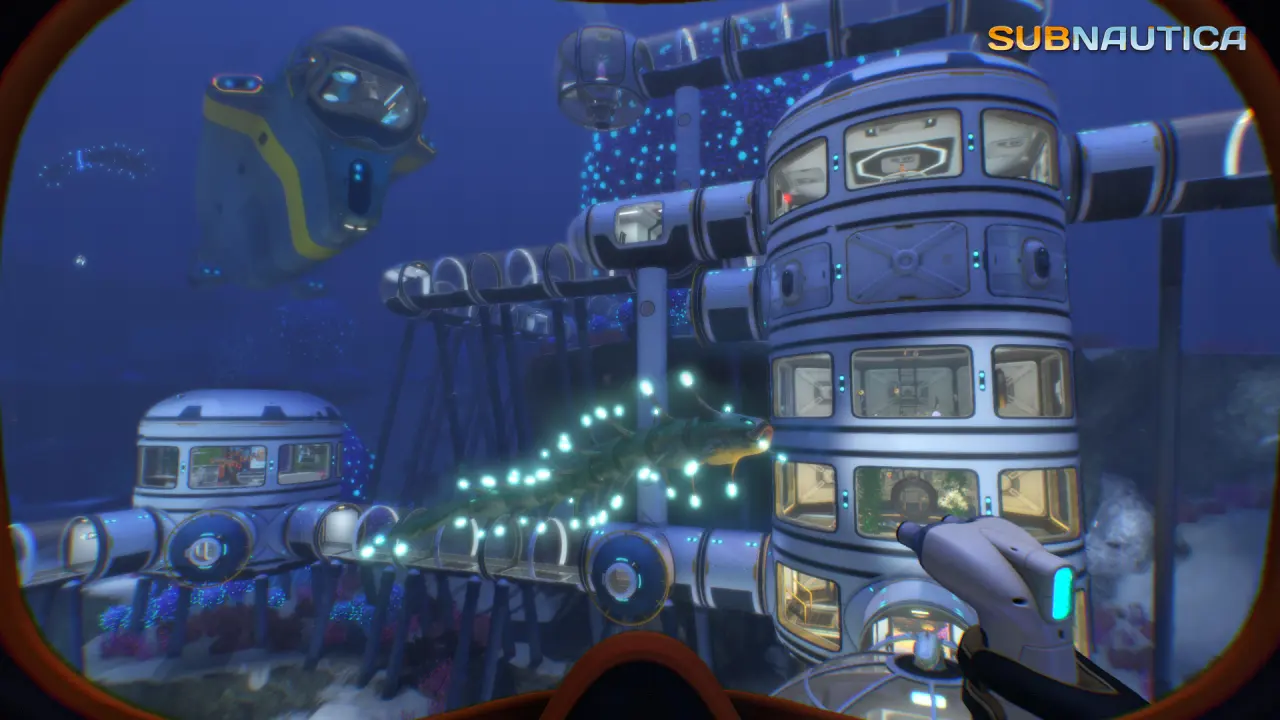
The art direction is polished sci-fi fantasy meets realism — every creature design is Japanese-anime plus PIXAR cartoon-style mashup, but the underwater environmental lighting is based on real ocean photography reference. The 4546B planet's underwater world covers 25+ biomes, and each has its own palette, visual style, and creature distribution:
- Safe Shallows: bright shallow blue, colorful fish schools, the entry visual benchmark. - Grassy Plateau: dark green underwater grassland with large kelp forests. - Mushroom Forest: forest of glowing large mushrooms, the most praised "fantasy wonder" of the game's art. - Grand Reef: highly saturated coral zone, visually stunning. - Lost River: freshwater currents inside saltwater — underwater "rivers," the pinnacle of terrain aesthetics. - Lava Zone: orange-red deep-sea volcanic hot spring area with visible water temperature differential effects. - Lost Island: underwater ancient civilization ruins, the core story area, blue-green tone mystery atmosphere. - Sea Emperor nursery: the most striking visual scene in the game, a massive underwater dome enclosing the Emperor and the eggs.
Each biome is a complete "underwater ecosystem painting," and players can identify which map they are on with eyes closed. The studio spent three years deeply customizing the underwater lighting system on Unity, reaching the ceiling of PC underwater visuals in the entire genre.
Unity Engine: Deeply Customized Underwater Lighting
The game runs on the Unity engine — long the studio's tech stack at Unknown Worlds over many years of product development. The team is about 30 people, a typical small-studio configuration in the PC survival genre. Unity's strengths: efficient cross-platform, large community resources, complete toolchain. Weaknesses: native underwater rendering requires deep studio customization — Unknown Worlds spent three years developing the game's underwater lighting system, getting sunlight scattering through water, depth perception, and bioluminescent creature visuals to the ceiling of PC underwater games at the time of launch.
Technical details include dynamic underwater lighting (sunlight depth attenuation plus scattering particle effects), independent biome palettes (every map has a completely different visual atmosphere), draw distance up to 500 meters (underwater visibility limited by real physics), volumetric fog (the obscuring depth feel of deep water), bioluminescence physics (deep-sea glowing fungi and anemones), water flow particle effects (water ripple textures while the player dives). Veteran consensus: "The game's underwater visuals are not 3A top-tier rendering, but the ultimate interpretation of underwater lighting science, and that is Unknown Worlds' real moat in the genre."
Platform and Version Differences: Small-Studio Full-Platform Coverage Model
This is one of the rare "full-platform coverage" representatives in the PC survival genre: - Windows PC (Steam): primary platform, all features fully supported, the version with the most active modding ecosystem. - macOS: native support no longer maintained, but the old version still plays. - PlayStation 4: launched in 2018 alongside PC. - PlayStation 5: runs via backward compatibility with faster load times. - Xbox One and Xbox Series X|S: launched alongside PlayStation versions, equivalent experience. - Nintendo Switch: ported in 2021, slightly simplified visuals but complete experience preserved.
Performance requirements are gentle: minimum i3 plus GTX 550 plus 4GB RAM; recommended i5 plus GTX 760 plus 8GB; high settings 4K 60 fps needs RTX 2060 plus 16GB. Older hardware also runs — just turn down underwater lighting and volumetric fog for smoother performance. Unity engine cross-platform strengths make this one of the rare "full-platform" survival games, covering PC, console, and handheld for the complete ecosystem, one of the few titles the Chinese-language community recommends for "whole-family co-play," and many veterans replaying on new devices still feel the same shock from their first deep dive years ago.
UI and Accessibility: Minimalist Design and Friendly Onboarding
The UI design is the "friendly school" representative in the PC survival genre — moving away from the complex menus of DayZ and Project Zomboid into a minimalist style. The main menu only has five options, the inventory categorization is clear, the crafting system groups by "tools plus vehicles plus base plus food" into four major groups. New players won't be scared off by information density on first open — this clearly reflects the studio's "peaceful school survival" positioning.
Accessibility-wise Unknown Worlds offers basic options — subtitles, UI scaling, color-blind mode, key remapping — but the suite trails first-party PlayStation titles by some margin in completeness. Chinese-language players widely rely on community-maintained "localization optimization packs" — official Chinese translation is decent, but community versions further polish slang, item names, and story translation across the entire game. Compared to the Below Zero expansion, the original Subnautica UI remains the most-praised "friendly balance point" of the series — preserving the complexity a survival game needs without immediately driving newcomers away in frustration during their very first session with the title.
Combat | 8.0/10
ゲーム性: 8/10Exploration System Layers: Underwater Survival Progressive Depth
The exploration system is the progressive-depth ceiling of the PC survival genre — players start in the shallow safety zone, and each dive unlocks new depths and new fears across hundreds of meters of vertical world. Exploration splits into four depth tiers:
- Shallow tier (0-50m): spawn area, plenty of oxygen, friendly creatures, basic resources. Suitable for the first 10 hours of mechanic learning. - Mid tier (50-200m): mid-sized creatures and rare resources begin to appear, oxygen requires breath cycles. Suitable for the mid 20-30 hours of play. - Deep tier (200-500m): the first Leviathan encounter, deep-sea pressure begins, vehicles and upgraded oxygen tanks required. Suitable for 30-60 hour mainline progression. - Extreme deep tier (500-1500m): the most dangerous and most mysterious area, where the story core and the Sea Emperor nursery sit. Requires top-tier vehicles and complete upgrades.
Each "depth breakthrough" is a sense-of-accomplishment moment for the player — from the early game's fear of diving only 100 meters to the endgame composure of piloting the Cyclops submarine down to 1700 meters. This "endless gradual" depth growth is the core psychological hook behind the title's eight-year evergreen long tail, studied alongside Elden Ring's "endless exploration" as a retention design sample for the genre.
Base Building System: The Cyber Romance of the Deep-Sea Villa
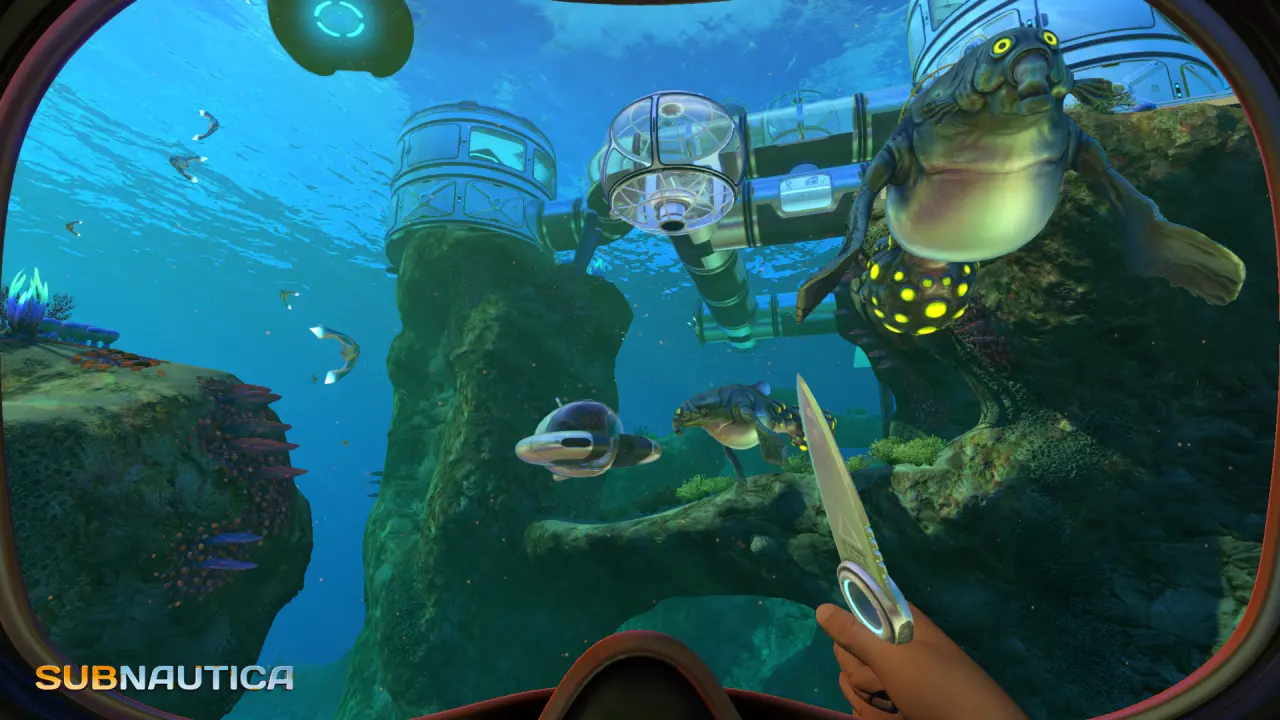
Players can build underwater bases at any location — this is the core gameplay of the title's "peaceful school" positioning. Basic modules include pipe connections, watertight chambers, and multipurpose rooms; life support includes oxygen cyclers, water purifiers, solar panels, nuclear reactors, and thermal generators; storage and crafting include storage lockers, fabricators, upgrade consoles, and mobile vehicle bays; the farm system includes underwater planting pools (for fish and plants) and indoor flora and fauna husbandry; decoration includes observation windows, interior decorations, glass floors, and glass corridors.
The Chinese-language community's favorite gameplay is "deep-sea villa" — building an entire base 200 meters underwater, opening windows to watch the colorful underwater wildlife. This is the most "cyber underwater romance" gameplay in the title, with related videos on Bilibili accumulating over 10 billion views across thousands of uploads. Many players spend 30-50 hours building a complete "deep-sea villa" — from exterior design to interior decoration to ecosystem farms, a rare "building aesthetics" representative in the PC survival genre, and the biggest victory of the studio's "peaceful school survival" positioning across the whole player base in the international community.
Vehicle System: Four Submersibles Each With Their Own Playstyle
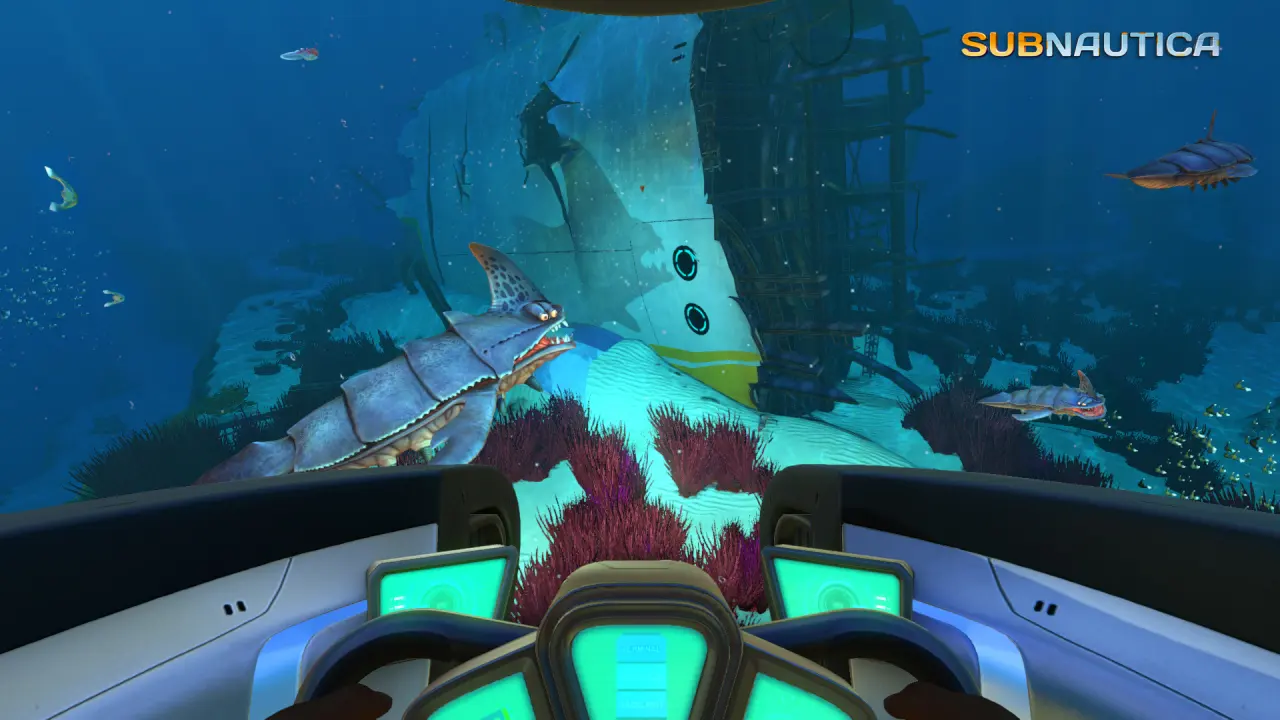
The underwater vehicles are the core innovation of the title — four major vehicles each have unique gameplay and serve different exploration purposes. The Seamoth is a small single-pilot submersible (max depth 900m), fast and agile, ideal for mid-to-shallow exploration during the early and middle phases of the campaign. The Cyclops is a large multi-pilot submarine (max depth 500m, 1700m after upgrades), with walkable interior space, capable of carrying multiple Seamoths inside its hull, serving as the endgame "mobile base" for extended deep-sea expeditions.
The Prawn Suit is a single-pilot heavy-armor mecha (max depth 900m, 1700m after upgrades), capable of walking and climbing on the seafloor, equipped with drill and grappling arm, the best choice for mining and close-quarters work. Player-crafted small vehicles are hand-assembled craft for specific tasks, the core template for community mod creation. Each vehicle can be equipped with upgrade modules — deeper diving, faster speed, perfect oxygen recycling, Leviathan defense. Chinese community consensus: the title's "building and upgrading" loop is one of the most satisfying in the PC survival genre, the core driver for newcomers to stably keep playing past the 20-hour mark into deeper exploration.
Story Puzzle and Scanner: Environmental Storytelling As Gameplay
The story puzzle mechanic is the environmental-storytelling benchmark of the PC survival genre — players use the scanner to scan new creatures, new ruins, and new blueprints to advance the plot. Every scan of a new object unlocks a PDA database entry — including creature behavior, historical background, and operating principles. Players piece together the full picture of Architect civilization themselves — no NPC quest-giver characters and no forced cutscenes anywhere in the runtime.
A deeper layer is "recordings and ruins" — players find various recording devices during underwater exploration (left behind by other expeditions that came to investigate 4546B). These recordings piece together the "Sunbeam shot down," the "Kharaa Bacterium plague," and the "tragic history of the Architect civilization" plot beats. This "environmental storytelling as gameplay" design is a win for the small-studio positioning — without a big-budget voice cast, the delicate scanner and recording system gives players a complete narrative experience, one of the ceiling representatives of PC survival story design. Many veterans read every PDA entry after the credits roll, and this is the favorite gameplay layer of the Chinese-language "sci-fi mystery party" community within the broader fanbase.

Content | 8.0/10
ボリューム: 8/10Mainline Length and Pacing: 60 Hours of Main Story Plus 200 Hours of Complete Exploration
Content length per official data: mainline runs about 60 hours (complete the main story, defeat the boss, hatch the Sea Emperor eggs, escape 4546B); complete exploration takes about 200 hours (including the Below Zero expansion, all biome exploration, complete base building, full PDA archive unlock). Steam average playtime sits at 100+ hours — placing the title in Steam's top 100 by total playtime worldwide. Top players reach 500-plus hours, mostly spent on base-building art and speedrun challenges across multiple replays of the same campaign.
Pacing follows a textbook "slow start to explosive finish" curve. The first 10 hours are the newcomer phase — learning oxygen management, base building, basic vehicles, and many players find "the game is too slow" during this stretch. Hours 10-30 enter the "expansion phase" — building a complete base, crafting the first Seamoth, the mainline beginning to advance. Hours 30-60 enter the "story climax phase" — the Sunbeam being shot down, Architect ruins exploration, discovering the Kharaa Bacterium plague. Past 60 hours enters the "perfectionist phase" — completing the base, unlocking all blueprints, telepathic conversation with the Sea Emperor, and the endgame escape. This progressive pacing makes retention player stickiness extremely high across the entire community.
Below Zero Expansion: Polar Visuals With a Different Experience
Subnautica: Below Zero is the most important content expansion — launched into early access in 2019 and fully released in 2021. Priced at 30 USD standalone, the same as the base game. Type: expansion of the original Subnautica, playable independently (does not require the base game). Setting: the story takes place after the original, with the player as new character planetary biologist Robin Ayou, investigating her sister's mysterious death in the Arctic region of 4546B.
Core differences: compared to the original's "unknown planet exploration" theme, the expansion leans into story-driven design plus icy polar visuals throughout the entire campaign. It introduces new icy biomes (glaciers, polar sea surface, sub-ice tunnels), new creatures (ice worms, Arctic penguin-like creatures, large under-ice Leviathans), new vehicles (snowmobile, sub-ice mecha), and new base decorations (snow greenhouse). Content scope is about 60 percent of the original. Steam positive rating sits at 78 percent, below the original's 91 percent — the main complaint being that the story is more refined but the gameplay feels repetitive, lacking the "unknown exploration" shock of the original entry. Chinese community consensus: the original Subnautica remains the most classic entry point of the series, with the expansion being optional for players who want more after finishing the base game.
Expansions and Business Model: Pure Premium Conscience Pricing
Unknown Worlds' monetization fits the small-studio identity tightly — pure premium, no pay-to-win microtransactions, no cosmetic skin shop. All equipment appearances are unlocked through player collection. The base game is 30 USD normally and 7.5 USD at the typical 75 percent discount — one of the cheapest hardcore PC survival games on Steam. The Below Zero expansion is 30 USD standalone and 15 USD at the typical 50 percent discount. No self-hosted servers needed (the game is single-player and does not have multiplayer server requirements).
This pure monetization model is exceptionally rare in 2026 PC gaming across the entire industry. Unknown Worlds sits alongside BeamNG, Bohemia, the Witcher studio, Larian, the Stardew Valley studio, Pocketpair, and The Indie Stone in the Chinese-language community's "indie conscience studios" list. Krafton acquired Unknown Worlds in 2021 but maintained the studio's independent operation — one of the Chinese community's favorite "acquired but kept its soul" reference cases in modern gaming history. The 2026 Subnautica 2 early access launched with a 4-million-copy sales burst within 5 days, validating the global pull of the independent studio across the wider market and confirming the strength of the brand even years after the original launch on Steam.
Mod Ecosystem: PC Version's Second Life
The true PC long tail is in mods. Nexus Mods has accumulated over 1,000 mods for the title, the backbone of the "infinitely playable" reputation. Unknown Worlds is friendly toward modding — single-player mods are fully open, one of the most stable mod ecosystems in the PC survival genre across the past decade of game releases.
Mainstream mod categories: visual enhancement mods include high-resolution textures plus more realistic underwater lighting plus creature model polish; base building expansion mods include more decorations, larger base space, custom modules, transparent glass corridors; new vehicle mods include community-created small submersibles and mechas; difficulty adjustment mods include hardcore survival, creative mode, custom parameters; story expansion mods include community-original extra plot lines (though not as good as the official) giving post-completion players new content; localization optimization packs polish slang, item names, and story translation. Chinese community favorite is "base building expansion packs" — letting "deep-sea villas" be built more grand and refined, the core content source of Bilibili showcase channels around the title. This mod ecosystem lifts the PC version's playable ceiling toward infinity, the "second-run essential" representative of the Chinese-language community.







コメント 0
ご意見をお聞かせください
このゲームについての感想や評価をお寄せください。
まだコメントはありません。このレビューへの感想をぜひどうぞ。