






















Opening
Afterthought launched The Isle into Steam Early Access on December 1, 2015. Ten years later it is still wearing the Early Access label, and yet roughly 98,000 reviews keep it parked at a 77% positive rating. In the narrow lane of dinosaur survival, The Isle is both the founder and the de facto benchmark. In 2020 the studio's lead, Dondi, became tangled in a long-running controversy, and that same year the project fractured into two parallel branches, Legacy and Evrima — a community rift that has never fully healed. Even after all of that, it remains the game you cannot route around if what you want is to "play as a dinosaur and stay alive."
Pull the ecosystem apart and its singularity comes down to three things. Permadeath stacked on a single character slot turns every encounter into a high-stakes gamble. The Evrima build renders 27 dinosaur models on Unreal Engine 4 at a level of detail that reaches BBC documentary fidelity. And a complete life cycle from hatchling to elder, fused with pack-shared vision and a courtship-and-breeding layer, produces a social system that genuinely exists nowhere else. Its most direct rival, Path of Titans, chose the opposite road — a stylized look, multiple character slots, quest-driven goals — but paid for that friendliness by surrendering the heart-in-your-throat tension that defines every Isle confrontation.
The six dimensions that follow keep circling two questions. Why has nobody, in ten years, managed to inherit this ecosystem? And if 2026 is the year you touch it for the first time, which onboarding path should you walk and which traps should you sidestep? We will be honest about the Dondi controversy, about the lived reality of the Legacy and Evrima split, and about whether a punishing permadeath curve is worth the hours it demands of you.
Story | 4.0/10
ストーリー: 4/10A Sandbox With No Script At All
On the story dimension, The Isle deliberately scrapes the floor of what a sandbox can offer, and it does so on purpose. There is no main questline, no dialogue, no cutscenes, no checklist of objectives waiting in a menu. You inhabit a dinosaur on Spiro Island, a volcanic landmass, and the entire premise is survival without narration. The only elements that carry even a faint narrative texture are the scattered ancient ruins and hidden fossil sites strewn across the map. Wander far enough and you can stumble onto weathered symbols, the skeletons of long-dead creatures, and the dark mouths of hidden caves. These provide the thinnest possible narrative hooks, little whispers of a world that existed before you, but they come nowhere close to sustaining a real story arc. This "zero-script" extremity is an explicit design choice from Afterthought, who hold that the essence of dinosaur survival is simply staying alive, and that any imposed plot would only interfere with that core. Whether you find that bracing or hollow depends entirely on why you arrived. If you came for authored drama, this island will feel like an empty stage; if you came to be a hunted animal, the absence of a script is itself the point.
What fills the official narrative vacuum is almost entirely player-generated story. The community has grown a surprisingly mature ecosystem of emergent fiction: courtship pairings, coordinated pack hunts, territorial disputes, multi-generational lineages, and even dedicated role-play servers where each participant commits to a specific dinosaur character and coordinates long-running plots through Discord. This player-authored layer genuinely patches over the missing official narrative, and on the right server it can become the most memorable thing about the game. But it leans entirely on player investment. The game itself does nothing to usher a newcomer into that storytelling layer — there is no signpost, no tutorial prompt, no nudge. For the solo player experiencing it alone, The Isle is a pure dinosaur survival battleground with no narrative thread to follow whatsoever, and that solitude can feel either meditative or barren depending on the temperament you bring to it.

The Meta-Narrative: Dondi and the Great Split
The story dimension carries a second, stranger layer that lives outside the game entirely: a meta-narrative the community tells about the game's own troubled history. Afterthought founder Donald "Dondi" Wittich has been a controversial figure for years. The broad accusations that surfaced in 2020 touched on team member misconduct, questions about financial management, and heavy criticism of Dondi's communication style toward customers, some of it captured on video. The fallout drove several original developers away. The controversy did not end development, but it visibly slowed the pace and eroded a portion of the community's trust in the studio. For a prospective buyer in 2026, understanding this backdrop matters more than fixating on any single number, because you are, in a small way, choosing whether to back a contested studio in its long march to completion.
Right on the heels of that came June 19, 2020, when Evrima opened through Steam's beta feature, and the game cleaved into two parallel branches. Legacy, the older version, stopped receiving development updates but kept running on community servers; Evrima became the actively developed build that the overwhelming majority of players now choose. This split history has itself become a core topic of the player meta-narrative — "is The Isle even still alive?" is a perennial forum thread, and people keep playing the thing they both love and resent. Set it beside its peers and the contrast is stark. Path of Titans offers quest-driven progression, base decoration, and a skill tree, an explicit "finish the task, earn the reward" hook that pulls casual players in effortlessly. Beasts of Bermuda, also PVP-leaning, at least ships a basic tutorial. Saurian builds a science-grounded evolutionary narrative. Against all of them The Isle is the weakest narrative offering in the lane, and that is the honest basis for a 4.0. Veterans split sharply on the matter: some insist this is exactly what a sandbox should be, with the game supplying only models and an ecosystem while the story is generated by the players themselves; others feel ten years was more than enough time to author a respectable main line, and the studio simply chose not to. A review cannot rule that choice good or bad, but the score must reflect the narrative volume the product itself delivers, not the extra content that role-play servers graft on after the fact.
Audio | 8.0/10
サウンド: 8/10Spatial Sound and the Language of Body Size
In the dinosaur survival lane, The Isle's audio design is the ceiling, and it earns that standing because sound here is not decoration but information. The 3D spatial audio lets a distant roar be localized — direction, rough distance, and even approximate body size can be read from it. Deep inside a dense rainforest you can judge where an enemy dinosaur sits, how far off it is, how large it likely is, and whether you are hearing a lone animal or a whole pack. That density of audio information vastly exceeds what an ordinary survival game offers, and it is one of the central sources of the tension that defines the whole experience. You learn to play with your ears before your eyes, and that shift is what separates a frightened newcomer from a composed veteran.
The single design worth dwelling on is how footstep sound expresses differences in body size. A tyrant-class predator's footfalls make nearby small dinosaurs feel the ground tremble; your screen picks up a faint shake, and the interface warns that a large creature is near. The bigger the animal, the lower the frequency of its steps and the wider its tremor radius; small dinosaurs are nearly inaudible underfoot, which turns the stealth of the small into an actual mechanic rather than a flavor note. This "sound as mechanic" idea is, frankly, unique among sandbox survival games. On top of that, all 27 dinosaurs carry independent sound libraries — each species has its own roar, alarm, courtship, pain, and death vocalizations. Pack species produce a chorus when they bellow together; a wounded animal's cries of pain draw other predators in; an adult in courtship season emits a low call that pulls same-species mates toward it. That breadth of coverage gives every dinosaur a distinct "vocal personality," and it is the core reason audio lands at 8.0.
Ambient Density Against Voice and Score Gaps
Environmental sound carries the other half of the rainforest immersion. The game layers four strata of ambience: wind moving through the canopy, rain striking different surfaces with different timbres, the echo of distant roars, and a dense backdrop of insects and birds. A storm, lightning, and a faraway tyrant's bellow stack into a composite soundscape that is The Isle's signature mood; walk through it for thirty seconds and you are fully submerged in a world of dinosaurs. It is the kind of audio that does immersion work no amount of visual fidelity could substitute for, and it is a large part of why long sessions feel like inhabiting a place rather than running a program.
But the audio dimension also carries obvious shortfalls. There is no human voice acting at all — you play a dinosaur, no dialogue needs performing, and every piece of information arrives through animal calls and interface cues. That "immersive, voiceless" approach is reasonable within the dinosaur survival framing, yet it means an entire slice of the audio dimension, vocal performance, is simply absent. The more conspicuous gap is the soundtrack. There is no official score release; the background music was written by independent musicians in a register that leans toward a documentary-style orchestral sound braided with modern electronic synthesis. Across ten years, though, The Isle has never produced a breakout signature theme, nothing of the "hear one bar and instantly think of the game" variety. Measured against the global recognition of a famous dinosaur film theme, The Isle's score lacks cultural identity, and that is the ceiling audio cannot climb past. The community has answered with fan-made score mods that swap the default music for that famous film soundtrack, which softens the awkwardness of the official music's low recognizability — but that is a community patch, not an achievement of the product itself.
Visuals | 8.5/10
グラフィック: 8.5/10UE4 Rainforest and Documentary-Grade Models
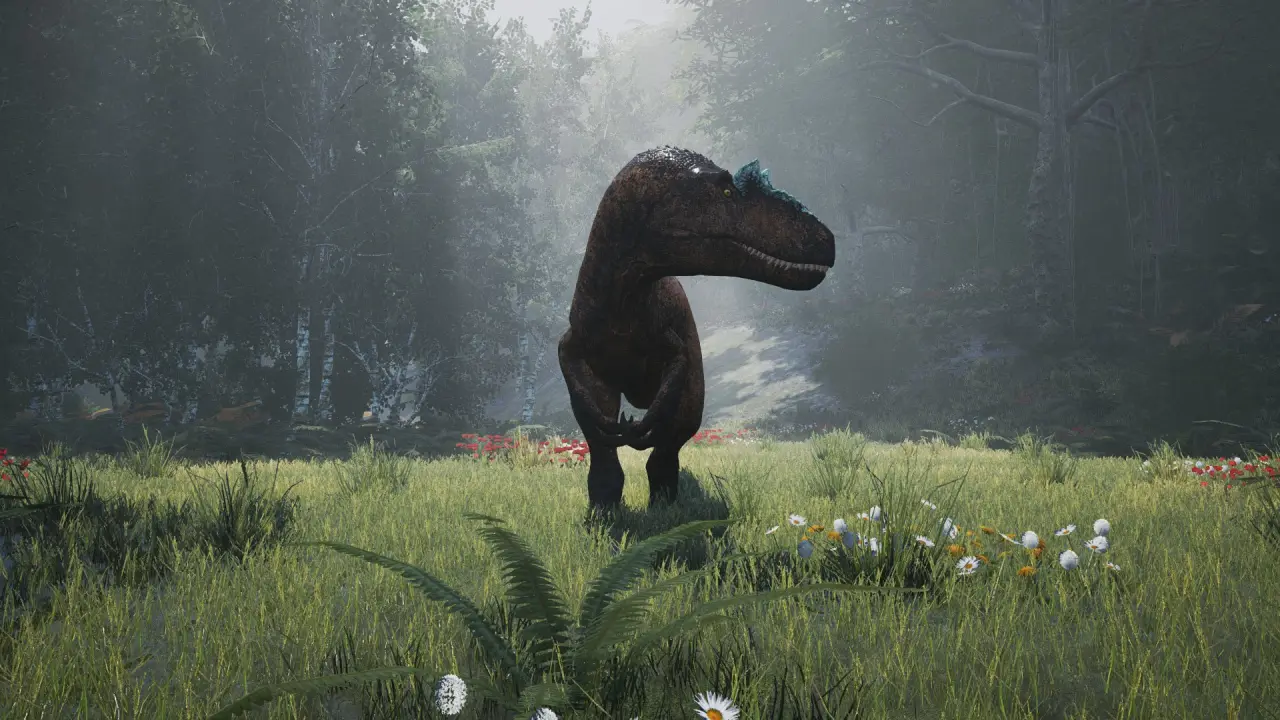
The Isle is built on Unreal Engine 4, and it is the strongest visual performer in the dinosaur survival lane by a comfortable margin. Its signature technical flex is high-density vegetation rendering — the plant density across tropical rainforest, redwood forest, and swampland is the highest in its class. Every leaf carries independent physical sway, rain runs realistically down individual blades, and sunlight filtering through the canopy produces shifting, dappled light. This "real rainforest" presentation gives Spiro Island a powerful sense of place, the conviction that "a dinosaur ought to live in exactly an environment like this." It is the rare survival game where standing still and simply looking around is its own reward, and that scenic confidence sets the tone for everything else the engine does.
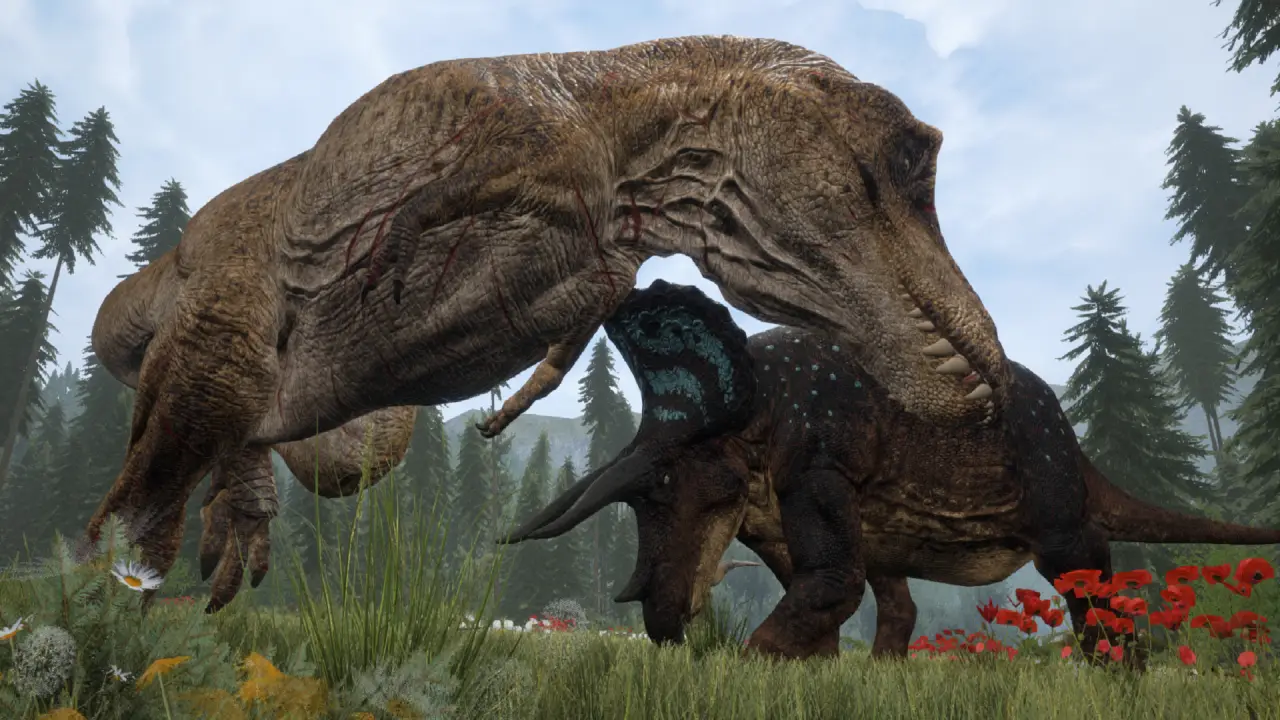
The fidelity of the 27 dinosaur models is the best in the industry. Each species has independent skeletal rigging, skin textures that closely follow paleontological reconstructions, and a randomized color-generation system that gives individuals of the same species visible variation — you will not bump into two identical tyrant-class predators on a server. The animation set includes distinct gait, attack, alert, courtship, and death loops, so each dinosaur's "personality" comes through in motion rather than just in its silhouette. Set against peers, Path of Titans skews stylized and cartoonish, Beasts of Bermuda runs comparatively simplified models, and The Isle sits closest to BBC documentary or National Geographic reconstruction standards. A rain-streak system means wet weather leaves real water trails running across dinosaur skin, and the voxel terrain can be locally reshaped by trampling and biting. These dynamic touches make the world feel alive rather than a static, pretty texture, and that liveness is half the reason the dimension holds an 8.5.
Habitat Variety Against Platform Limits
The Spiro Island map divides into four major habitats, and the division is functional rather than cosmetic. The tropical rainforest is a shadow-heavy vegetation layer suited to small dinosaurs hiding and to herding herbivores; the redwood forest is a region of tall, bare-trunked conifers where mid-sized dinosaurs do most of their living; the swampland is shallow water and reeds, the crossroads where waterside predators meet drinking herds; and the volcanic lava zone is a high-temperature danger area, a high-risk, high-reward stretch to explore. Different habitats suit different dinosaurs, so "choosing your habitat" becomes a piece of core play. Engine stability is another bright spot here: 50-plus players on screen without significant frame drops, with multi-LOD switching automatically simplifying distant models to hold the frame rate. For a PVP multiplayer game, that stability matters more than any single effect, and the night lighting — moonlit silhouettes on the grass, the red glow of the lava zone, lightning illuminating a herd during a storm — pushes the atmosphere to a level rival dinosaur games struggle to reach.
But platform coverage is the dimension's largest shortfall. Only native Windows is supported; there is no macOS, no Linux, no console, no VR, and Steam Deck carries no official compatibility marking. This "PC players only" strategy leaves console players with no way to touch the game at all, and it is the core deduction that holds graphics at 8.5 rather than higher. The interface is comparatively minimalist — the HUD shows only health, hunger, thirst, and body temperature, with no quest list, no minimap, no hotbar. You navigate by memory and by reading the environment. That spareness is a plus for immersion but a steep barrier for newcomers, who can feel lost within five minutes of a guidance-free UI. One frequently overlooked visual strength is the water rendering: surface reflections behave differently across weather, with real ripples and sun glints on clear days, dense rain pocking the surface in storms, and a silvery moonlit sheen at night. The shot of a dinosaur drinking or bathing at the water's edge is one of The Isle's most-shared screenshots, and that detail is why the dimension still earns a high mark even with consoles left out. This water detail is the mature payoff of Unreal Engine 4's scene rendering and a sign of real craft in the studio's visual engineering. Even looking back from 2026, no peer has surpassed this particular combination of water, rainforest, and dinosaur model — a visual package that has aged with unusual grace and still anchors the game's reputation as the prettiest survival simulation in its lane.
Combat | 8.5/10
ゲーム性: 8.5/10Permadeath and the Full Life Cycle
The ceiling of The Isle's gameplay comes from the chemistry of three things colliding: permadeath, a single character slot, and a complete life cycle. On any given server you hold exactly one character slot, and when that character dies all progress is wiped — you start over from a hatchling. This permadeath design turns every PVP encounter into a high-stakes gamble. You might spend four hours raising a tyrant-class predator to its elder stage, and a single misjudgment reduces every minute of that investment to zero. It is precisely this harshness that produces a tension far beyond an ordinary survival game, the specific feeling of having something real to lose every time another animal crosses your path. Nothing else in the genre asks you to weigh a fight against four hours of sunk effort the way this loop does.
The full life cycle gives the dimension genuine depth. You begin as a hatchling — for the first thirty minutes you are smallest and lowest on health, instantly finished by nearly any large dinosaur, forced to hide in dense forest or cling to a herd. The sub-adult stage, from thirty minutes to two hours, is where your size starts to carry threat; you can contend with same-size dinosaurs and the PVP tension begins to climb. The adult stage, two to four hours in, brings your size near its maximum and your attack power to the species ceiling, letting you trade blows with other adults. The elder stage, past four hours, is your largest and most complete form, with some species unlocking special abilities and carrying the heaviest loss on death. This curve, where investment and risk rise in lockstep, is the core of the game's depth. The survival pressures stacked on top are extraordinarily varied: hunger demands regular feeding, thirst demands clean water sources, untreated injuries fester into disease, repeated hits cause lingering internal damage, falls from height break bones and hamper movement, cold weather drains body heat, the dilophosaurus can spit toxin to sicken a target, and even a lone large dinosaur can be brought down by a coordinated pack of small ones. This web of overlapping pressure keeps you in a constant state of having to make decisions, with no moment of genuine rest.

Tactical Depth and Pack Sociality
PVP here is not a simple matter of one health bar grinding down another. Body-size differences mean large-versus-small plays out with entirely different tactics; terrain use gives open ground, dense forest, and shallow water each their own advantages; pack coordination lets herding dinosaurs collectively surround a lone individual; a bleed tactic lets you wound and then flee while the target loses health; a toxin tactic lets the dilophosaurus spit and wait for the opponent to weaken; an ambush tactic lets a fast dinosaur strike a large slow one; and there is even a "play dead" tactic where certain dinosaurs feign death to deceive a pursuer. These tactics push the PVP experience well past ordinary survival fare, and they are one of the core reasons the dimension lands at 8.5. Read carefully, the combat is closer to a positioning duel than a brawl, and that is exactly what keeps veterans engaged thousands of hours in.
Herding dinosaurs carry a distinct social mechanic: a pack can share vision, collective attacks gain a damage bonus, and a herding dinosaur left alone enters an "anxiety" state that lowers its survival ability. The courtship system lets adults interact with same-species mates, and the breeding system lets a successful pairing produce a new generation of hatchlings. This social layer lets multiplayer servers grow self-organizing dinosaur societies, an extra dimension no other dinosaur game offers. The learning curve, finally, is the dimension's largest double-edged influence. The first ten hours are mostly dying and restarting; ten to fifty hours teach basic survival; fifty to two hundred hours master the various dinosaurs; two hundred hours and beyond reach PVP-expert caliber. That steep curve drives off most casual players, but it also forges a fierce sense of identity in those who stay. Set against Path of Titans, which chose quest-driven progression, multiple characters, and a light death penalty — friendlier, but stripped of The Isle's tension — and against Beasts of Bermuda, whose serious PVP balance problems leave public servers full of veterans dominating newcomers, the conclusion holds: for the hardcore dinosaur player, The Isle remains the only mature, hardcore, simulation-grade dinosaur survival sandbox going. There is also the night survival mechanic worth naming directly — restricted night vision is a hidden source of depth, since small dinosaurs are nearly blind in the dark while some large predators retain decent night sight, making "two different games across day and night" a real design, and learning to find a safe hiding spot before dark is a mandatory first lesson.
Content | 7.5/10
ボリューム: 7.5/10The Playtime Curve and a 27-Dinosaur Roster
The Isle's playtime curve offers players three tiers. Running one complete loop from hatchling to elder — living to a natural death or being taken down — takes roughly 50 hours to reach a working familiarity with the basic dinosaurs. A "complete" playthrough that includes PVP-expert competence runs around 400 hours. And genuinely mastering the extreme tactics of all 27 dinosaurs makes a 1,000-hour solo investment unremarkable. Compared with a building sandbox capped around 200 hours or a space engineering game near 500, The Isle's content depth actually stretches longer precisely because of permadeath — every death means re-raising a character, and the playtime curve is naturally extended. That is a strange virtue: the cruelty that frustrates newcomers is the same mechanism that gives the long-term player a near-bottomless well of hours.
The Evrima 27-dinosaur roster is the core of the content dimension's expansion. The Survival mode carries 17 dinosaurs: the tyrant-class predator, the giant carnivore, the allosaurus, the utahraptor, the carnotaurus, the ceratosaurus, the dilophosaurus, the maiasaura, the triceratops, the stegosaurus, the parasaurolophus, the camarasaurus, the theropod, the hypsilophodon, the mosasaurus (the first non-dinosaur), the pteranodon (the first flier), and the hadrosaur. The Progression evolution mode adds 10 more: the spinosaurus, the anchisaurus, the giant sauropod Puertasaurus, the kamarosaur, the albertosaurus, the acrocanthosaurus, the baryonyx, the kentrosaurus, the maurosaur, and the dark ceratopsian. The size span runs from the 1.5-meter hypsilophodon to the 30-meter-plus Puertasaurus, and each animal carries its own distinct play experience. That breadth is the literal substance behind the long-hours promise — every species you pick up is effectively a new character class with its own survival math.

The Legacy Split and the Free-Update Promise
The content dimension carries one unusual phenomenon: Legacy and Evrima coexist as two parallel versions. Legacy is the original 2015–2020 build, no longer developed since 2020, but some community servers still run it, and for nostalgic players it functions as a "complete content pack." Evrima is the actively developed build, with content added incrementally, and it only fully caught up to Legacy's volume in 2024. This "two parallel versions" reality is a double-edged thing for players: it adds content choice while also scattering the community's strength. No-paid-DLC is the dimension's key economic model — across ten years every update has been pushed for free, with no paid DLC of any kind, and even future Chapter-class major versions will ship free to all existing owners. This "pay 19.99 dollars once, everything after is free" model means players never have to wonder how much more they will have to spend. Set against the heavy paid-DLC catalog of ARK Survival, The Isle's minimalist economy is markedly friendlier to the player.
The 2025–2026 roadmap keeps updating: more apex predators (a tyrant-class skin, the baryonyx, the kentrosaurus), balance adjustments that could substantially reshape the meta, and new map regions and events. Afterthought did not stop development after the Dondi controversy; the pace is slow but continuous, and that persistence is the key to content holding at 7.5. The Spiro Island main map plus seasonal events — storms, meteor showers, volcanic eruptions — carry the baseline content density. Different seasons trigger different mechanics: storms send dinosaurs scattering in panic, meteor showers crack open new fossil sites, eruptions reshape the terrain. These events keep repeat play from going stale. The most worthwhile thing to flag, though, is the player-run event mechanic. Large servers regularly host long-running events like "dinosaur olympics," "dynasty wars," and "tribe alliances," with players coordinating cross-server, cross-timezone cooperation through Discord to form an ecosystem resembling a traditional MMO but entirely player-driven. These events often run for weeks or months, with a single one drawing hundreds of participants. After evolution mode arrived in 2024, the player-run "generational lineage" contest became a hit — players use the courtship and breeding system to carry their dinosaur lineage across multiple generations, each with its own evolution and achievement record, a "lineage inheritance" form of play that exists in no other dinosaur game. That is exactly why content earns a 7.5: official content is comparatively limited, but player-run content stretches the actual playable range very wide. Domestic creator communities keep pouring out live streams and tutorials, long-running role-play servers let the content self-cycle, and even when official updates come slowly the player base stays active. The honest reading is that you are buying into an ecosystem as much as a product, and that ecosystem keeps generating reasons to log back in long after the official roadmap has gone quiet for a season.





コメント 0
ご意見をお聞かせください
このゲームについての感想や評価をお寄せください。
まだコメントはありません。このレビューへの感想をぜひどうぞ。