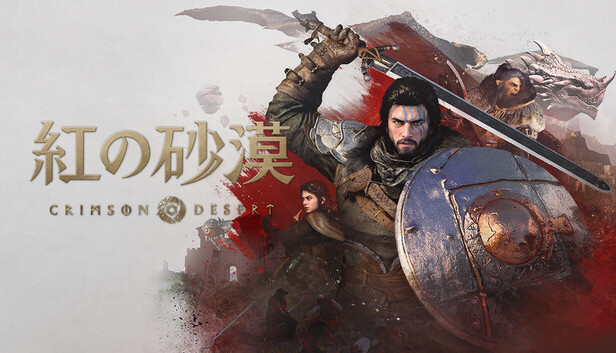
 紅の砂漠 EnhancedFetching price~ ¥9,680
人気の特集すべて見る
123456789101112
12 Best Mystery Games on PC (2026)
12 Best Space Sim Games on Steam (2026)
12 Best Story-Rich Games to Play (2026)
12 Best Turn-Based Tactics Games on Steam (2026)
12 Best Puzzle Games on Steam (2026)
12 Best Games to Play with Friends on PC (2026)
12 Best JRPGs on Steam (2026)
12 Best City Builder Games on Steam (2026)
12 Best Zombie Games on Steam (2026)
12 Best Free Indie Games on Steam (2026)
12 Best Short Indie Games to Try (2026) — Done in One Evening
12 Best Cozy Games on Steam (2026)
人気の似ているゲームすべて見る
Games Like PowerWash Simulator - 12 Best Relaxing Cleaning and Restoration PicksGames Like ARC Raiders - 12 Best Extraction and Co-op Survival ShootersGames Like PEAK - 12 Best Co-op Climbing and Survival PicksGames Like R.E.P.O. - 12 Best Co-op Horror PicksGames Like Clair Obscur: Expedition 33 - 12 Best Turn-Based RPG PicksGames Like Path of Exile 2 - 12 Best Action RPG and Loot PicksGames Like Road to Vostok - 12 Best Hardcore Survival Shooter PicksGames Like Mina the Hollower - 12 Best Top-Down Action and Zelda-Like PicksGames Like Slay the Spire 2 - 12 Best Roguelike Deckbuilders to Play NextGames Like Resident Evil Requiem - 12 Best Survival Horror PicksGames Like Baldur's Gate 3 - 12 Best CRPGs and Turn-Based RPGsGames Like Monster Hunter Wilds - 12 Best Co-op Hunting and Action RPG PicksGames Like Hollow Knight: Silksong - 12 Best Metroidvania Picks (2026)Games Like Dead by Daylight - 12 Best Asymmetric & Co-op Horror PicksGames Like Final Fantasy VII Rebirth - 12 Best Action RPG & JRPG PicksGames Like Forza Horizon 6 - 12 Best Open-World Racing & Driving Picks (2026)Games Like Solarpunk - 12 Best Cozy Survival and Crafting GamesGames Like 007 First Light - 12 Best Stealth and Spy GamesGames Like Subnautica 2 - 12 Best Underwater and Alien-World Survival GamesGames Like Hell Let Loose - 12 Best Tactical Milsim Shooters
人気のレビューすべて見る

Hades II — レビュー
Clair Obscur: Expedition 33 — レビュー

Katana ZERO — レビュー

The Long Dark — レビュー

Shift At Midnight — レビュー
Middle-earth™: Shadow of Mordor™ — レビュー

The Mermaid Mask — レビュー

Killing Floor 2 — レビュー
The Outlast Trials — レビュー

American Truck Simulator — レビュー

Voidling Bound — レビュー

Go-Go Town! — レビュー

Desktop Explorer — レビュー

Dead as Disco — レビュー

Crushed In Time — レビュー

Beastro — レビュー
The review build of "Crimson Desert" also comes with Denuvo this time, but oddly enough, I want to give it a thumbs-up
As a veteran JRPG player who considers 80 hours just the starting point, my first reaction to this kind of news usually isn’t panic, but to see whether the developer dares to be fully transparent. On March 23, 2026, Pearl Abyss gave a rare and direct response regarding encryption in the review version of Crimson Desert.

The core issue is simple. A common industry practice is to provide the media with a “review-only version” that has no encryption and runs more smoothly, then add DRM only for the official release. As a result, the performance reviewers see may be completely different from the version players actually buy on launch day—like in a JRPG where the flashy early scripted battles have nothing to do with the real combat numbers later on. The whole feel is suddenly off.
This time, Crimson Desert developer Pearl Abyss confirmed in a letter to Forbes reporter Paul Tassi that the review code and benchmark footage provided to media outlets and content creators worldwide used the exact same Denuvo solution as the launch version. The article also explicitly stated that the recipients of this code included global media and creators such as Digital Foundry.

To me, the key point here is not whether it has “Denuvo encryption” or not, but whether the real situation is disclosed to players in advance. Pearl Abyss’s reasoning was also very straightforward: "It is crucial that the experience of reviewers and testers ultimately represents the real experience of consumers." In the context of the industry in 2026, that feels a bit like an old-school JRPG laying all its hidden stats out in the open—not necessarily pleasing, but honest enough.
The reaction from the player community was also interesting. The original article noted that less than 24 hours after this public clarification, the anger surrounding Denuvo’s performance impact cooled rapidly. Some players even said outright that this kind of honesty was more convincing than overwhelming waves of marketing copy. Put simply, what players fear most is not that problems exist, but being kept in the dark and only discovering on launch day that they got a completely different experience.

We’ll still need to wait for full reviews and more real-world testing after release to judge the combat system, but as far as handling public perception goes, Pearl Abyss made the right move this time. Unfortunately, if the actual performance doesn’t hold up later, then this transparency will only become a harsher point of contrast.
As for trend analysis, I actually hope more developers adopt this approach. Review versions matching launch versions should be the industry baseline, not some rare achievement. For players planning to pick up Crimson Desert at launch, my advice is simple: prioritize performance tests based on the review code, especially side-by-side results from media outlets and technical creators, because this time they should theoretically be closer to the final consumer experience.
If more developers are willing going forward to proactively disclose whether their review versions include encryption, I’d see that as a signal more worth watching than any trailer. After all, what really affects your launch-day mood has never been how hype the marketing slogans are, but whether the game you get when you press Start is actually the same game being advertised.
紅の砂漠 EnhancedFetching price~ ¥9,680





コメント 0
ご意見をお聞かせください
このゲームについての感想や評価をお寄せください。
コメントはまだありません。最初の一件をどうぞ。