
ニュース
Grab two free PC games before Epic's clock runs out, while Undertale and Divinity: Original Sin 2 are 75% off
Astral Ascent and LUFTRAUSERS are free to keep today, while two of PC gaming's most celebrated RPGs cost less than $14 c
















When I saw that comparison image of Leon in Resident Evil 9: Requiem, my first reaction wasn’t “wow, that’s so sharp,” but a certain sense of discomfort. The original weathered, world-weary charm had been polished into a different kind of face—more refined, more conventionally appealing. It felt like running into an old friend who had suddenly gotten a full cosmetic makeover: you know it’s still him, but the vibe is off.
On March 17, NVIDIA officially unveiled DLSS 5 at GTC 2026. Unlike previous versions, which focused more on super resolution and frame generation, this generation goes a step further by using AI models to reconstruct lighting and shadow details, with the goal of making characters and environments feel closer to the real world. Jensen Huang even called it a major breakthrough in graphics since the arrival of real-time ray tracing in 2018, saying this is the “GPT moment” for game graphics.

Judging from the official demos alone, DLSS 5 is undeniably impressive. The sense of depth is stronger, light and shadow are more clearly defined, and details like rainy nights, skin, and reflections are all more striking. NVIDIA has also confirmed that the technology will officially launch this fall, and titles including Starfield, Assassin’s Creed: Shadows, Hogwarts Legacy, Resident Evil 9: Requiem, Phantom Blade Zero, and The Elder Scrolls have already been confirmed to adopt it.
But what really pulled me out of the experience is the way it seems to understand “faces”—as if it always wants to drag characters toward one uniform version of realism. The examples mentioned in the article are quite telling: Grace goes from an innocent rookie FBI agent to looking like a “Los Angeles socialite”; Leon changes from a rugged older man into something closer to a “deeply affectionate K-drama oppa.” In Hogwarts Legacy, an elderly woman’s wrinkles are intensified to be deeper and denser, while the protagonist also takes on an obvious “AI digital human” look.
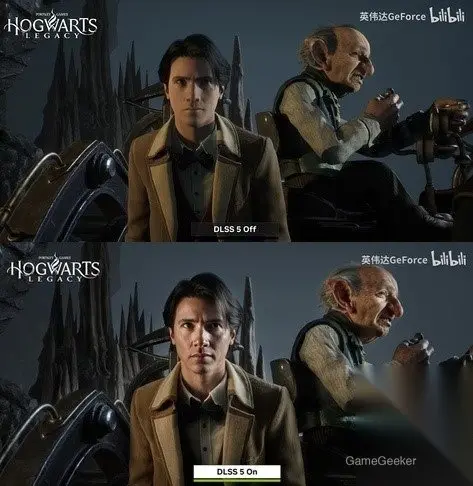
And when it comes to characters, this is exactly where many players are most sensitive. What makes a character emotionally resonant isn’t just whether their features are refined, but whether the fatigue, hesitation, and sense of age on their face actually match what they’ve been through. The way this enhancement works now feels a bit like putting the same filter over different actors: the lighting becomes more real, but the people feel more fake.
The bigger concern is stylistic homogenization. Games were never supposed to pursue only “looking like real people.” Phantom Blade Zero and Hogwarts Legacy were never built on the same visual language to begin with. If everyone starts drifting toward the same kind of AI-generated realistic face, games will start to feel uniformly packaged—polished, yes, but lacking soul. It’s no surprise that the internet is already full of memes comparing “DLSS 5 on vs. off.” Players’ feelings are actually pretty straightforward: looking better is fine, but don’t alter characters until they’re barely recognizable.
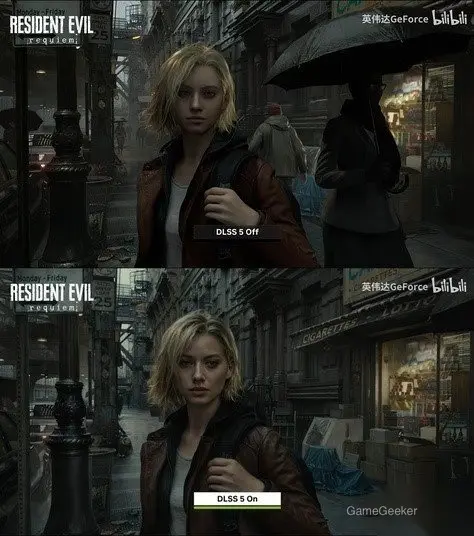
Of course, the situation isn’t completely beyond remedy. NVIDIA responded by saying that developers can actually fine-tune the intensity, color segmentation, and masks, so the final result still depends on how studios choose to use the tool. In other words, DLSS 5 itself may not be the problem—the problem may lie with whoever treats it like a “universal beauty filter.” Facing the controversy, Jensen Huang even said outright that “everyone is wrong,” but that doesn’t make players’ discomfort disappear with a single sentence.
If you ask me for a trend judgment, I’d say DLSS 5 will very likely continue pushing scene rendering forward, especially in lighting, shadow, and spatial layering. But when it comes to character faces, it’s still nowhere near mature. The technology is certainly worth looking forward to, but only if it respects the character’s original temperament. After all, what we fell in love with was never a face that looked more like a real person—it was the character themselves.





コメント 0
ご意見をお聞かせください
このゲームについての感想や評価をお寄せください。
コメントはまだありません。最初の一件をどうぞ。