News
Can "bad moves" actually beat AI at Go? Ke Jie reveals new tactics
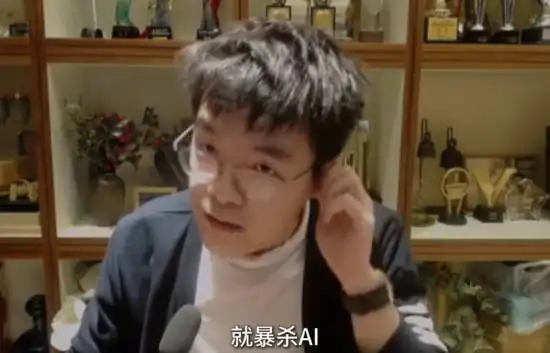
Ke Jie revealed in a stream that humans can trick Go AIs by playing "bad moves," exploiting the AI's
















First, look at the decision point: what this discussion is really tangled up over is not casually slapping a label on AI, but making trade-offs among three scarce resources—“accuracy, smoothness, and transmissibility.” It is like an endgame on a chessboard: every move carries a cost.
Recently, People’s Daily Online launched a public call for a Chinese name for AI, quickly bringing netizens, scholars, and institutions to the same discussion table. The trigger was a People’s Daily article titled “Please Give AI a Good Name,” which argued that the English abbreviation “AI” does not quite fit standardized Chinese character usage contexts, while “artificial intelligence” is indeed rather long. Compared with technology terms like “computer,” “mobile phone,” and “robot,” which have already blended into everyday life, it is clearly less approachable.
From the perspective of system design, the reason this heated discussion was able to break out of its usual circle is that it touched on AI’s changing position today. It is no longer just a high-concept prop in science fiction, but is becoming infrastructure. As the original text puts it, “AI is no longer a distant concept from science fiction films; it is becoming infrastructure like electricity and water,” and I think that judgment is right on target. Once a name is meant to enter daily scenarios, it cannot aim only for professionalism; it also has to consider whether ordinary people are willing to say it and whether they will keep saying it repeatedly.

In terms of strategic depth, the solutions proposed by netizens are actually quite layered. The traditional-Chinese-style route includes names like “灵境,” “灵犀,” “智子,” “玄枢,” and “灵机.” Their strengths lie in rich imagery and high recognizability. Among them, “智子” will also remind many people of The Three-Body Problem, giving it a strong mnemonic advantage for传播. In the practical camp, “仝智” tries to compress the structural meaning of “human” and “artificial” into a single character, which is a clever idea, while “机智” directly extracts the initial characters from “machine intelligence,” making it short and easy to remember. The playful route is more like online community meme-making: names like “硅头,” “掏肯,” and “傻妞” generate a lot of discussion, but they probably cannot hold up in serious communication settings.
But the issue is that naming has never been something that can be settled the moment a solicitation ends. The article also mentions a key opposing view: classic Chinese names like “computer” and “mobile phone” were often not chosen through voting, but naturally sedimented through long-term use. This judgment resembles version evolution in strategy games: designers can set a direction, but what ultimately remains is often the optimal solution repeatedly validated by the player community.
If I were to cast a vote from the perspective of a strategy gamer, I would divide the candidates into two categories: for those prioritizing public communication, the goal should be brevity, stability, and a low barrier to adoption; for those prioritizing cultural expression, a bit of imaginative space can be preserved. The former path, like “机智,” feels more grounded, while the latter, such as “灵机” and “灵犀,” carries more of the aesthetic beauty of Chinese. As for names that lean too heavily into memes, they are lively, yes, but they can easily turn a long-term issue into short-term consumption, which is somewhat wasteful.
From a trend perspective, the value of this discussion does not lie in immediately selecting the one and only standard answer, but in the fact that, for the first time, the public has seriously realized this: as AI enters everyday life, it needs a Chinese entry point that can be widely used. Naming technology may seem like a word game, but in reality it is paving the way for the next round of social consensus. If this step is handled with finesse, a great deal of future communication cost will decrease along with it.


Comments 0
We'd love to hear from you
Welcome! Share your take on this game — being first might come with a surprise.
No comments yet. Be the first!