
News
Grab two free PC games before Epic's clock runs out, while Undertale and Divinity: Original Sin 2 are 75% off
Astral Ascent and LUFTRAUSERS are free to keep today, while two of PC gaming's most celebrated RPGs cost less than $14 c












According to recent reporting, Zhu Ziqing's classic essay Moonlight over the Lotus Pond was recently flagged by an AI detection tool as more than 60% AI-generated, sparking mockery and debate online. The same report also notes that a passage from Liu Cixin's The Wandering Earth once tested at more than 50%, with the explanation coming from Bao Guangsheng, a Westlake University Text Intelligence Lab PhD and one of the developers of Fast-DetectGPT.
Bao's key point is that the public fundamentally misunderstands what an "AI rate" means. A result of 60% does not mean 60% of the words or sentences were written by a machine. In the report's framing, it is closer to saying the text as a whole has a 60% probability of having been generated by AI. Just as importantly, the tool cannot reliably identify which specific words or lines came from AI and which did not.
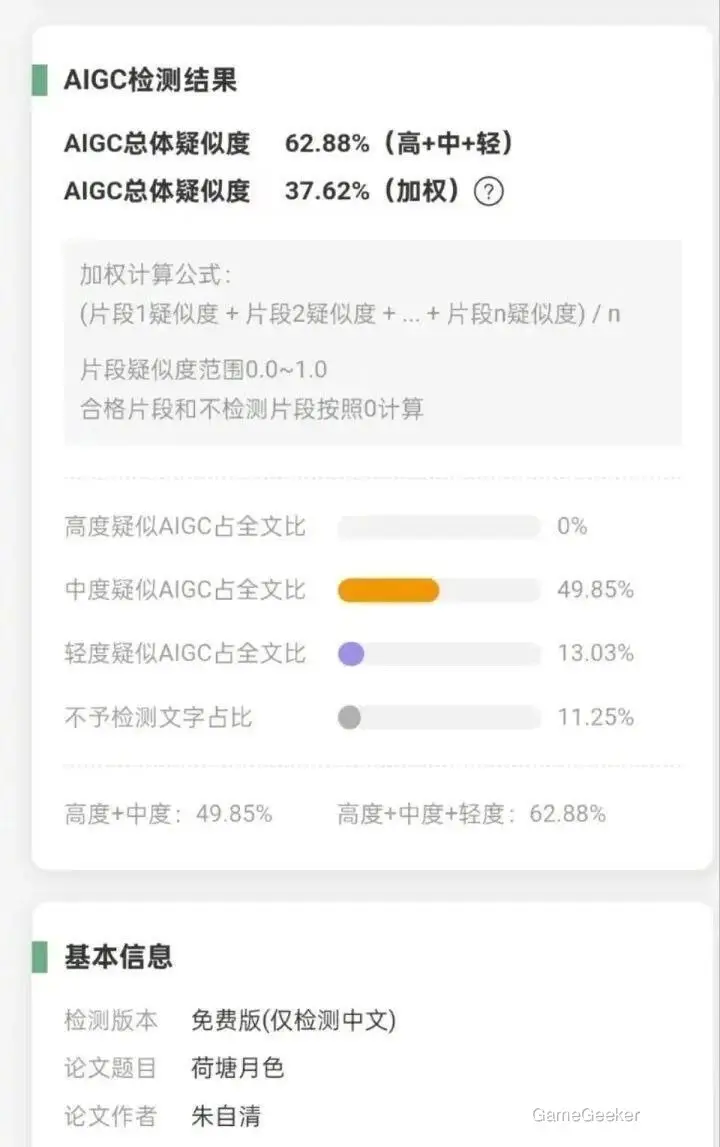
The more interesting question is why a canonical essay like Moonlight over the Lotus Pond, written nearly a century ago and running 1361 Chinese characters in full, could be misclassified in the first place. The core reason, according to the report, is not simply that the tool is clumsy. It is that these literary classics have long since become training material for large AI models. Detection systems compare wording, word-frequency distribution, and how closely a text aligns with model predictions. Because famous works are so thoroughly absorbed by those models, their language can appear highly "model-like" and trigger false positives.
That also explains why this is not an isolated case. A passage from The Wandering Earth was detected at more than 50% AI rate, while Preface to the Pavilion of Prince Teng was at one point labeled 100% AI-generated. The inconsistency gets worse across platforms: users report that the same piece can return AI rates differing by as much as 30% depending on where it is tested. The reason is straightforward. Different tools use different algorithms, with some weighting word frequency more heavily and others focusing on grammar or semantics.

What makes this more than a technical curiosity is how quickly these scores are being used as real-world judgment. The report says detection accuracy is strongly tied to text length: anything under 100 characters is highly unreliable, while results only become meaningfully referential at around 500 characters. Even so, many people still treat a single screenshot from a detector as if it were a verdict. The result is that many students have seen their original papers flagged with high AI rates and then been forced into the miserable position of proving their own innocence.
The market has already responded in the worst possible way. There is now a gray industry built around selling AI writing services and then selling services to lower a text's AI rate afterward. In practice, that often means swapping out high-frequency words to dodge detection. It turns the whole thing into a cat-and-mouse technical contest where the pressure falls not on the quality of the writing, but on who understands the loopholes in the system better.
For anyone writing articles or academic papers, the practical takeaway is fairly plain. Do not treat an AI detection score as a final ruling, and do not flatten your prose into generic template language just to satisfy a checker. Experts have been clear that these tools only produce probabilities, and those results cannot serve as the sole standard for judging originality. If there is a better defense against false positives, it is a more distinctive personal style. AI is good at imitating the shared habits of human writing; it is much worse at reproducing expression with a strong, individual signature.
That, more than the joke value of a famous essay getting flagged, is why this debate has landed so hard. AI detection is not an endpoint. At best, it is a signpost. It can point in a direction, but it cannot walk the road for you, and it certainly should not be used to declare the whole map fake because one sign got it wrong.




Comments 0
Share your game review
Join the discussion and share your review of this game.
No comments yet. Share your review.