
News
over the hill launches with introductory Steam offer and lower-priced key listings
Funselektor’s off-road exploration game is out on Steam at $19.99 with an introductory offer. Approximate third-party ke
















If the chip race is viewed as an endgame, then the choice of architecture is the right to make the first move—and this time, Alibaba has placed its weight directly on the most critical central territory of RISC-V. Today, Alibaba DAMO Academy unveiled the Xuantie C950, and the key message is clear: this is a new flagship RISC-V CPU built for the era of AI Agents. The goal is not merely to make a splash, but to seize the initiative in both performance and real-world deployment.
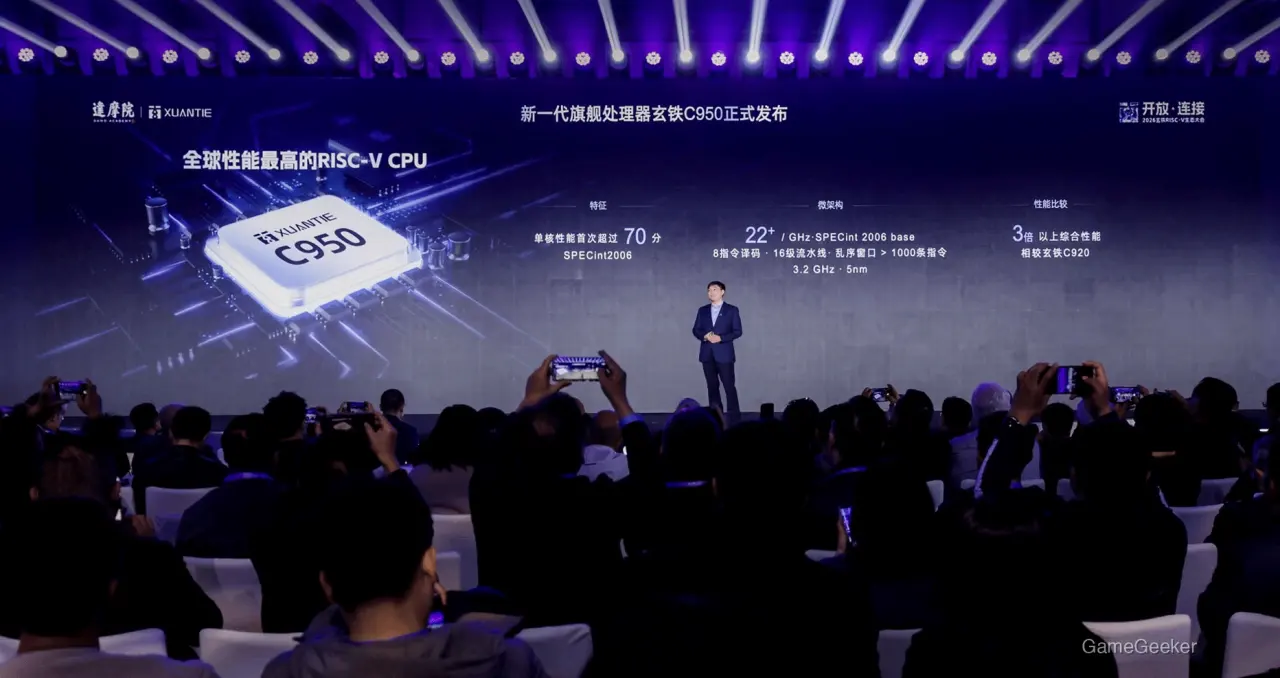
From a system design perspective, the Xuantie C950 adopts the open-source RISC-V architecture, is based on a 5nm process, and is manufactured by TSMC. That combination alone shows it is not just a conceptual game piece confined to the lab. In terms of specifications, it features 8-instruction decode, a 16-stage pipeline, an out-of-order window of over 1000 instructions, and a maximum clock speed of 3.2GHz. In a contest as strategy-heavy as CPU design, this configuration is like taking solid territory with sente in Go—not necessarily the flashiest style, but every move is aimed at tangible returns.
More importantly, the results matter. According to official data, the Xuantie C950 has set a new global RISC-V performance record, with single-core general-purpose performance surpassing 70 in SPECint2006 for the first time. For those following architectural evolution, this is not just about an impressive number—it signals that the high-performance RISC-V path is moving from “usable” to “truly competitive.” Strategically, this move is especially refined because it is not targeting isolated benchmark scores, but large language model inference and training, with explicit support for mainstream models such as Qwen3 and Deepseek.
The concern, however, is that what players and industry observers fear most is seeing advantages on paper ultimately turn into wasted ecosystem potential. Fortunately, Alibaba has also made the next move. The Xuantie C950 supports all standard and optional extensions in RVA23.1 and natively supports CoVE confidential computing, meaning that in terms of server stability, security, and resource utilization, it is offering more than slogans. Combined with hardware-software co-optimization, it has also achieved industry-leading performance in typical cloud workloads such as MySQL, Redis, Nginx, and OpenSSL, while cloud networking and cloud storage performance are more than 30% higher than some mainstream products. That begins to look like a complete winning position, not just an isolated dragon on the board.
Recently, OpenClaw has been gaining traction in China’s tech circles, with companies such as Tencent, Alibaba, and Baidu all paying attention. This also indicates that the competition in foundational computing power for the AI era has entered the middlegame. Whoever can connect CPU, models, and cloud scenarios into an integrated system will look more like they are playing for long-term operations rather than gambling on luck. From my perspective as someone who has spent 3000 hours playing strategy games, what makes the Xuantie C950 truly worth watching is not that “another chip has been released,” but that RISC-V is finally starting to compete in the high-end league.
If you are an ordinary consumer, this news has no direct bearing on whether you buy a computer; but if you care about China’s domestic computing power, AI infrastructure, and the future server ecosystem, then the Xuantie C950 is worth keeping a close eye on. It may not decide the outcome in a single round, but at the very least, this move is not a probe—it is a bid for the core terrain.





Comments 0
Share your game review
Join the discussion and share your review of this game.
No comments yet. Share your review.