 Sid Meier's Civilization VII
Popular PicksView All
123456789101112
10 Best Short-Level Precision Platformers for Focused Movement Practice
10 Best Single-Player Underwater Adventure Games
10 Best Fantasy Shopkeeping Games for Crafting and Trading
10 Best Single-Player Escape-Room Puzzle Games
10 Best Sokoban Games with Creative Twists
10 Best Programming Puzzle Games in 2026: Visual Logic, Bots, and Assembly
10 Best Railway Network Management Games in 2026
10 Best Single-Player Photography Exploration Games in 2026
10 Best Single-Player Monster Taming Games in 2026
10 Best Immersive Sim Games on Steam (2026)
7 Best Time-Loop Mystery Games for Exploration, Dialogue and Deduction
7 Best Fictional Language Deciphering Puzzle Games in 2026
Popular Games LikeView All
Games Like PowerWash Simulator - 12 Best Relaxing Cleaning and Restoration PicksGames Like Dave the Diver - 12 Best Diving, Cooking and Systems-Stacker PicksGames Like Road to Vostok - 12 Best Hardcore Survival Shooter PicksGames Like Path of Exile 2 - 12 Best Action RPG and Loot PicksGames Like Clair Obscur: Expedition 33 - 12 Best Turn-Based RPG PicksGames Like R.E.P.O. - 12 Best Co-op Horror PicksGames Like PEAK - 12 Best Co-op Climbing and Survival PicksGames Like Slay the Spire 2 - 12 Best Roguelike Deckbuilders to Play NextGames Like Mina the Hollower - 12 Best Top-Down Action and Zelda-Like PicksGames Like Baldur's Gate 3 - 12 Best CRPGs and Turn-Based RPGsGames Like Monster Hunter Wilds - 12 Best Co-op Hunting and Action RPG PicksGames Like Hollow Knight: Silksong - 12 Best Metroidvania Picks (2026)Games Like Final Fantasy VII Rebirth - 12 Best Action RPG & JRPG PicksGames Like Dead by Daylight - 12 Best Asymmetric & Co-op Horror PicksGames Like Forza Horizon 6 - 12 Best Open-World Racing & Driving Picks (2026)Games Like 007 First Light - 12 Best Stealth and Spy GamesGames Like Solarpunk - 12 Best Cozy Survival and Crafting GamesGames Like Subnautica 2 - 12 Best Underwater and Alien-World Survival GamesGames Like Lies of P - 12 Best Soulslikes to Play in 2026Games Like Hell Let Loose - 12 Best Tactical Milsim Shooters
Popular ReviewsView All

Mina the Hollower — Review

Clair Obscur: Expedition 33 — Review

Schrödinger's Call — Review

Resident Evil Requiem — Review

Shift At Midnight — Review

Mixtape — Review

Middle-earth™: Shadow of Mordor™ — Review

The Mermaid Mask — Review

MOLE — Review

Desktop Explorer — Review

Mad Max — Review

Go-Go Town! — Review

Dead as Disco — Review

Crushed In Time — Review

Beastro — Review

Moonlight Peaks — Review
Asus Made Even Standard RAM Sound Like Civilization-Level Min-Maxing
On May 12, 2026, ASUS said in a new article that its Intel Z890 and B860 motherboards, updated to UEFI BIOS 3002 and 3103, can use AEMP to support JEDEC-standard memory and some mixed-memory setups. The pitch lands at a practical moment: with memory and storage prices rising, DIY builders are increasingly looking at standard bare modules, single-stick purchases, and phased upgrades instead of buying a matched kit upfront. ASUS also uses the Civilization series as an example of a game category that still reacts noticeably to memory configuration under heavy load.
A four-stick test setup makes the point clearly. On a ROG MAXIMUS Z890 EXTREME paired with an Intel Core Ultra 7 265K CPU, ASUS installed four ordinary sticks with different brands, capacities, and frequencies into the same board. This is not the usual enthusiast story about squeezing every last drop from premium kits. It is a more grounded one: how to assemble a usable system on a tighter budget when parts prices are moving in the wrong direction.
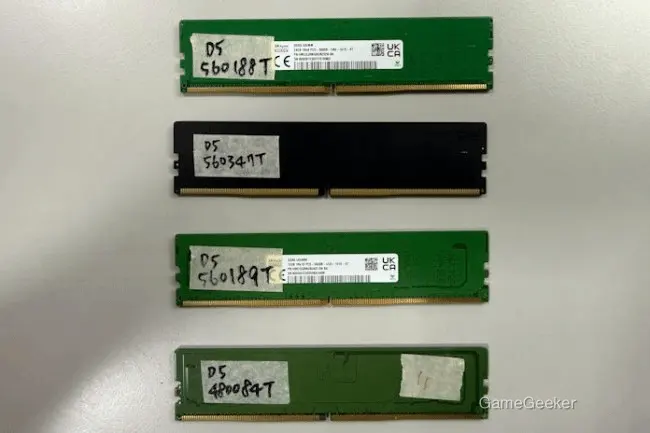
That is also what AEMP is actually for. ASUS is not positioning it as a showcase feature for buyers already using XMP or EXPO memory. It is aimed at JEDEC-standard memory that does not support either profile. According to ASUS, the technology first appeared on Intel Z690 motherboards in 2021. With AEMP II and AEMP III, support has expanded to four-module configurations up to 256GB. Once enabled in BIOS, the motherboard automatically cycles through multiple parameter sets and voltage levels, usually finding a balance between performance and stability within 5 minutes.

The article’s hands-on result is more convincing than the marketing language. ASUS tested Samsung 8GB 4800MHz, SK hynix 12GB 5600MHz, Lexar (Micron) 16GB 5600MHz, and SK hynix 24GB 5600MHz standard modules mixed together on that ROG MAXIMUS Z890 EXTREME and Intel Core Ultra 7 265K platform. After updating to the latest BIOS and enabling AEMP II, memory speed rose from the default 4800MHz to 5200MHz, while timings improved from an average of CL48 to CL36. The gain is not dramatic in headline terms, but it matters because it moves the result from merely bootable to more comfortably usable. For anyone who cannot or does not want to buy a full matched kit at once, that is a practical improvement.
ASUS is really addressing an overlooked reality of DIY building: many users do not upgrade all at once. They buy a single 32GB or 64GB JEDEC stick first, then expand later. The company is also explicit about the limits. On DDR5, U-DIMM and CU-DIMM cannot be mixed, and single-rank and dual-rank memory cannot be mixed either, or the system may fail to boot. In the FAQ, ASUS says AEMP II is for DDR5 U-DIMM with a controllable PMIC, while AEMP III is for DDR5 CU-DIMM with a controllable PMIC. It also explains that CU-DIMM includes a CKD clock driver chip mainly intended to stabilize signaling for very high-frequency memory at 6500MT/s and above.

AEMP still is not magic. Its requirements are strict: the memory has to be ordinary JEDEC-standard RAM, and users are expected to verify details in the BIOS utility menu under ASUS SPD Information. That page can show the memory brand, model, serial number, JEDEC parameters, chip capacity, module architecture, power management chip, and DDR5 type. After training, ASUS says users can check the updated memory information on the BIOS main page after reboot, then stress-test stability with MemTestPro.
If you bought high-performance memory with the Intel XMP protocol, ASUS says the better fit is DIMM Fit or DIMM Fit Pro, which offer more manual control and finer tuning than AEMP for improving stability and exploring overclocking headroom. The trade-off is time. Their training process can take several hours and may involve multiple restarts, though once finished, users can save multiple profiles for different tasks such as gaming or benchmarking. ASUS also notes that both AEMP and DIMM Fit support single-rank and dual-rank memory individually, but neither supports mixing the two, otherwise the system will not boot.

For buyers, the recommendation is fairly straightforward. If you play memory-heavy games such as the Civilization series and current RAM pricing is pushing you toward cheaper upgrades, a single-stick JEDEC-standard configuration on ASUS’s new BIOS support looks like the safer starting point. Expanding later with the same spec is the next step. That is more reliable than blindly mixing modules, and it gives AEMP more room to help. ASUS also says that on modern motherboards and DDR5 platforms, the real-world gap between single-channel and dual-channel has narrowed a lot, but it remains noticeable in heavy-memory scenarios like Civilization. The article’s clearest takeaway is not that mixed memory suddenly becomes ideal. It is that, for budget-conscious builders, ASUS is offering a more realistic path to making ordinary RAM work better.

Sid Meier's Civilization VII





Comments 0
Share your game review
Join the discussion and share your review of this game.
No comments yet. Share your review.