
News
Final Fantasy Resonance key listed at $44.89 — about 10% under Steam, and the demo is free
Square Enix's HD-2D turn-based RPG is listed at $44.89 on Loaded, $5.10 below Steam's $49.99 regular price. The checkout
















Once, while browsing a flea market, I went through stall after stall. What thrilled me most wasn’t buying something, but suddenly uncovering an overlooked item hidden in a pile of odds and ends. That feeling was like discovering an unmarked path at the edge of a map—my urge to explore lit up instantly. But reality isn’t a sandbox game. Many boundaries may look passable, but the moment you cross them, you’ve stepped over a red line. This cross-border daigou case in Beijing is a textbook example.
A case reported by the Beijing Municipal People’s Procuratorate Fourth Branch on April 10 has recently been adjudicated. In September 2024, a female passenger in her forties, surnamed Wang, arrived in Beijing from Tokyo, Japan, carrying 2 large suitcases, 1 small suitcase, 1 handbag, and 2 bags of duty-free goods. The amount of luggage was already excessive, and coupled with abnormal scan images, it quickly drew the attention of customs officers. After inspection, both large suitcases were found to be packed with comic books whose covers were marked “18+” and whose contents were explicit.
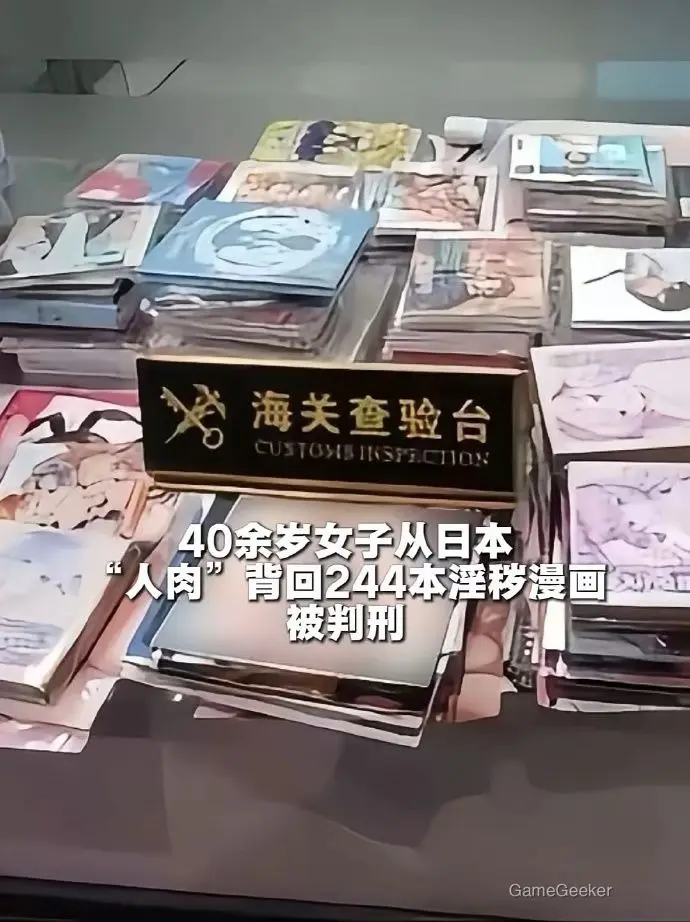
After subsequent inventory and professional appraisal, 244 of the publications involved were identified as obscene materials. Seen in that light, this was no longer a simple case of an ordinary daigou “bringing back some limited-edition merchandise,” but had already crossed into the criminal territory of smuggling obscene materials. The court ultimately sentenced Wang to one year and six months in prison, suspended for two years, and imposed a fine of RMB 10,000 for the crime of smuggling obscene materials.
Looking a little deeper, you’ll find that this case also reveals a very typical slice of the industry. Investigations showed that Wang worked for a company in Japan and had long been posting advertisements on online platforms as a “cross-border daigou,” claiming she could purchase Japan-exclusive manga, toys, badges, and more on behalf of customers, earning service fees in the process. In other words, she wasn’t just casually helping friends bring back goods on a whim—she had been running this business for quite some time. The risk wasn’t some random event suddenly spawning on the map; the warning signs were there all along, and she still kept heading into the restricted zone.
In many ACG circles, labels like “Japan-exclusive,” “adult-oriented,” and “hard to buy domestically” are often packaged as marks of scarcity. Some people even think that since they’re just books, they’re not as serious as other prohibited items. But beyond the map, the rules do not soften simply because a product is dressed up as cultural consumption. Especially on the path of cross-border daigou, people have been testing the gray area for years—from cosmetics and figurines to limited-edition books. But once obscene materials are involved, the legal classification is very clear, and there is basically no save point for wishful thinking.
If you’re already following overseas manga, setting collections, or limited-edition merchandise, my advice is simple: stay away from obscure “private daigou” sellers, especially those who use explicit content as a selling point. The reliable approach is to prioritize compliant platforms and formal customs declaration channels. If you can’t buy it, then accept it—it’s far better than taking a shortcut and ending up trapped in a dead end. For consumers, cases like this are also a reminder: don’t mistake “common within the circle” for “permitted by law,” because the real world is not an open-world map—once you hit the boundary, punishment often comes faster than you expect.





Comments 0
Share your game review
Join the discussion and share your review of this game.
No comments yet. Share your review.