
News
Grab two free PC games before Epic's clock runs out, while Undertale and Divinity: Original Sin 2 are 75% off
Astral Ascent and LUFTRAUSERS are free to keep today, while two of PC gaming's most celebrated RPGs cost less than $14 c
















Two characters are locked in combat on the grasslands. The frame feels dense, the action fierce, but if you think about the recent behind-the-scenes development revelations surrounding this project, the first feeling that rises to the surface is not excitement, but a sense of weightlessness that comes from a narrative rewritten midway through. It feels like a road movie whose script was hastily redone only after reaching the second half: the scenery is still there, but the characters no longer know why they set out on the journey.

According to Eurogamer, two Pearl Abyss developers revealed on the anonymous platform Blind that Crimson Desert suffered from long-term management chaos and repeated shifts in direction during development. The claims then spread across Korean social media and were indirectly corroborated by some developers familiar with the studio. At the time the original report was published, Pearl Abyss had not yet issued an official response. From another angle, the reason this kind of news makes players especially sensitive is not just because “the project has problems,” but because it precisely explains one of players’ deepest concerns about big-budget productions: systems can be patched, visuals can be polished, but once the narrative’s tone is only settled late in development, many cracks cannot be repaired.
The most worrying point is that the leak claims Crimson Desert only finalized its story close to launch, ultimately causing a disconnect between content and narrative. For a game that emphasizes worldbuilding and the weight carried by its characters, this is almost like finishing the house before deciding where to place the foundation. Character motivations, quest structure, and level pacing should have been tightly interlocked, yet now may only feel assembled. Unfortunately, this kind of problem is often especially obvious once players get their hands on the game: you can tell the characters are speaking and the systems are functioning, but they do not truly understand each other.
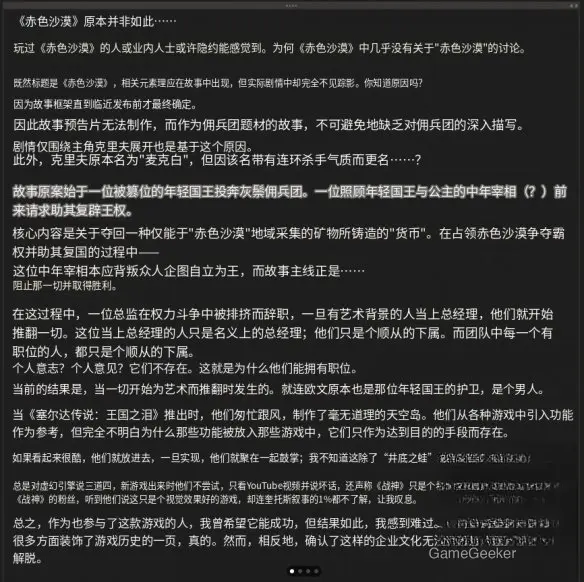
But the deeper issue is that the leak points directly at the management structure itself. Some said that within the project, the “person in charge” was nominally a leader but in reality just an executor obedient to higher-ups. Others described the company as an “inverted pyramid,” with more people in management than on the front lines of development. Add to that the original director being forced out, and the successor—coming from an art background—overturning the previous direction, and this no longer sounds like ordinary production turbulence. It feels more like a struggle in which control over the narrative kept changing hands: today one person wants to make an epic, tomorrow another wants to build a spectacle, and what remains in the end is a work that wants to say everything yet fails to say any one thing accurately.
There is another detail in the leak that speaks volumes: after The Legend of Zelda: Tears of the Kingdom launched, the team reportedly rushed to add a mechanic similar to “sky islands,” without truly understanding the design logic behind it, leaving behind nothing but a collage of borrowed elements. On the narrative level, this is exactly the trap many industrial-scale blockbusters fall into—they seem to possess many “right answers,” but those answers originally grew from the soil of someone else’s work. Once crudely transplanted, they turn into dazzling branches and leaves that obscure the skeleton the work itself was supposed to grow.
It is not hard to understand why player communities react so strongly to rumors like these. Another person, claiming to have left the company after long involvement in development, said that once the game launches and they see player reviews and streamer impressions, their feelings will be bittersweet, because the problems players point out are exactly the issues the team had repeatedly discussed internally. The tragedy is that when creators can already see the cracks but have no power to repair them, the project can only keep sliding downward under its own inertia.
If you are still following Crimson Desert now, my advice is to stay hopeful, but do not rush to extend it your trust in advance. For projects this visibly shaped by production management, what is truly worth watching is not how many more spectacles the trailers can pile on, but whether the official side will provide a clear response going forward, and whether the final product can prove that the characters, story, and systems have been reconnected. In the end, the scariest thing for a game is not having ambition that is too big, but not even having decided who is supposed to tell its story.





Comments 0
Share your game review
Join the discussion and share your review of this game.
No comments yet. Share your review.