
News
Grab two free PC games before Epic's clock runs out, while Undertale and Divinity: Original Sin 2 are 75% off
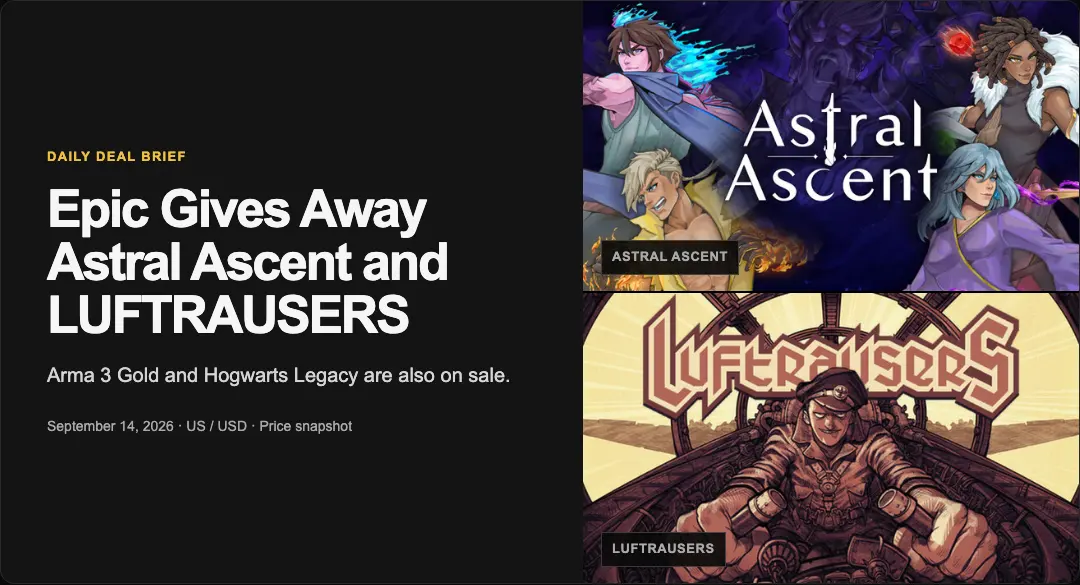
Astral Ascent and LUFTRAUSERS are free to keep today, while two of PC gaming's most celebrated RPGs cost less than $14 c














If you break Death Stranding 2 apart, it really feels like a finely tuned “post-apocalyptic logistics sandbox”: on one hand, it pushes players forward with emotion; on the other, it keeps them on the road with its systems. Recently, overseas outlet pcgamesn gave the PC version high praise, even stating outright that the PS5 version was already its personal Game of the Year for 2025, and that after the PC version launched, it became a contender for 2026 as well.

That praise is not just about the visuals. The core point of the review is that Death Stranding 2 continues the first game’s “sad but not hollow” post-apocalyptic storytelling, while further refining the delivery gameplay into a loop that feels both action-oriented and strategic. You still play as Sam, and the story picks up directly after Death Stranding: he had originally left behind his role as a courier in post-apocalyptic America to focus on raising BB, but after suffering a series of blows, he is forced to hit the road once again, this time with the stage shifting to Australia.

This time, the mission is to work with a private transport company to gradually connect Australia to the Chiral Network. What makes it so captivating is that the map is not just a static backdrop, but a space that players gradually “tame” bit by bit. As you complete deliveries and unlock new areas, the flow keeps becoming more streamlined thanks to new equipment; even more interestingly, the shared structures system remains the soul of this gameplay. Some people build roads, some leave behind climbing tools, and some slowly transform rugged terrain into flat roads that can continuously charge vehicles—and you can give likes to these useful structures. This kind of asynchronous cooperation allows both loneliness and a sense of connection to coexist.

Of course, it is not without its problems. The reviewer clearly pointed out that there are still flaws in both the environmental design and the story design, but overall it is still considered one of the best games of last year. In other words, this is not a “perfect sequel,” but a work with a very clear direction and strengths strong enough to carry it: it knows exactly what kind of pacing, emotion, and gameplay it wants to use to hit players where it counts.
For PC players, the significance of this port is fairly straightforward. Although making the jump from PS5 exclusivity to PC in less than a year is somewhat delicate for the PlayStation camp, if you enjoy strong narrative experiences and also like systems-driven gameplay with high replayability, then it absolutely deserves a spot on your must-play list. My suggestion is: if you have not played the first game, do not rely only on the built-in story recap—ideally, play Death Stranding first. That is because many of Death Stranding 2’s emotional echoes cannot be fully replaced by explanatory text alone.

If traditional open worlds excel at giving you objectives, Death Stranding 2 is better at giving meaning to the “path” itself. And that is precisely why it can still earn such high regard on PC.



Comments 0
Share your game review
Join the discussion and share your review of this game.
No comments yet. Share your review.