News
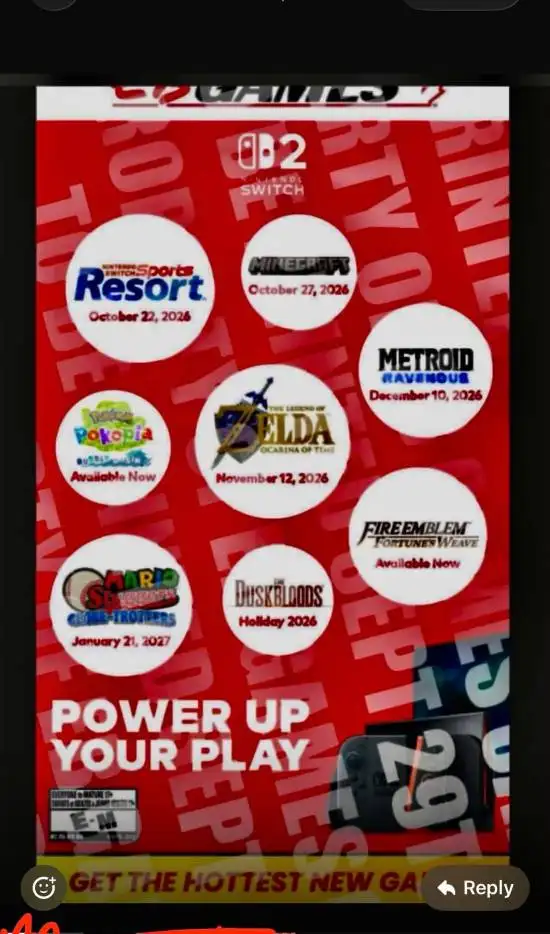
EB Games Leak Reveals Ocarina of Time Remake Release Date
A Reddit user claims an EB Games poster leaked several Switch 2 release dates, though the listing remains unverified. Ni
















After reading this news, my first reaction was that it felt a lot like playing a puzzle level in It Takes Two: the rules are written rigidly, but reality is far more complicated than any level. Recently, 16-year-old paralyzed girl Xinxin accidentally purchased a ticket on the “Ferris Wheel” platform for G.E.M.’s April 9 concert in Taipei, China. Her father, Mr. Ouyang, applied for a refund immediately after discovering it, only to run into two locks first: “no refunds after sale” and a high bar for proof. What makes this so painful is not just a mistaken tap, but the fact that a family already pushed to its limit by life was forced to bear nearly a month of living expenses for an order they obviously could not use.

Mr. Ouyang’s situation is anything but abstract. After a car accident 4 years ago, his daughter remained in a coma for nearly three months. When she woke up, she was unable to speak and was paralyzed in all four limbs. A judicial assessment identified her as having a Grade 1 physical disability and a Grade 2 mental disability, and she now requires assistance with everyday activities. The family’s savings were drained by rehabilitation treatment, and his wife has also lost the ability to work due to systemic lupus erythematosus. At present, the whole family mainly relies on him driving for a ride-hailing service to get by, and they are a household receiving minimum living allowance support. Against this backdrop, a ticket costing about 2000 yuan is not something that can be brushed aside as a mere “consumer mistake”; it represents an entire month of basic living expenses.

What is even more controversial is the platform’s initial handling of the matter. According to reports, this order involved a non-real-name ticket purchase for the Hong Kong, Macao, and Taiwan region of China, and the page clearly stated “refunds not supported.” From the standpoint of platform rules, this was not entirely without basis. But the problem, much like a hidden mechanism in a puzzle game, is precisely this: rules cover standard situations, not extreme individual cases. A girl confined to bed at home, able to operate a tablet using only her two little fingers, clearly does not have the normal ability to attend a concert. Continuing to apply a one-size-fits-all template only makes the rules appear cold.

After media intervention, the incident finally reached a more reasonable outcome. The platform stated that after the family submitted the relevant supporting materials, it decided to proactively bear the full loss for the refund and process a full refund for the order, with 2015 yuan already returned through the original payment channel. The platform further stated that if conditions permit, it would provide ticket support for Xinxin and her father, helping her fulfill her wish to attend a concert nearby. This ending at least shows one thing: compared with mechanically enforcing clauses, the mark of a more mature platform is the ability to provide a humane solution in exceptional situations.
If this matter is placed back into the broader consumer environment, it actually serves as a reminder to all players and ordinary users alike. First, when it comes to concerts, secondary ticketing, and cross-region non-real-name orders, be sure to repeatedly confirm the refund and change policy before making payment, because the fine print is often what determines the outcome; second, if payment tools are linked to minors, seriously ill patients, or people with cognitive impairments at home, it is best to set up additional payment verification to reduce the risk of accidental taps; third, platforms should also consider establishing a fast-track appeal channel for users in special hardship circumstances, rather than waiting until public opinion blows open the level before issuing a late pass.
Judging from community feedback, many people are not actually opposed to “no refunds after sale”; what they dislike is the one-size-fits-all approach. Whether players or consumers, what people truly hope to see has never been the disappearance of rules, but rather that when rules face special circumstances, they can be like well-designed game levels: having boundaries, while still leaving a way out. This time, the 2015 yuan was refunded, which counts as clearing the level; but more importantly, similar levels in the future should not require media intervention just to be completed.




Comments 0
Share your game review
Join the discussion and share your review of this game.
No comments yet. Share your review.