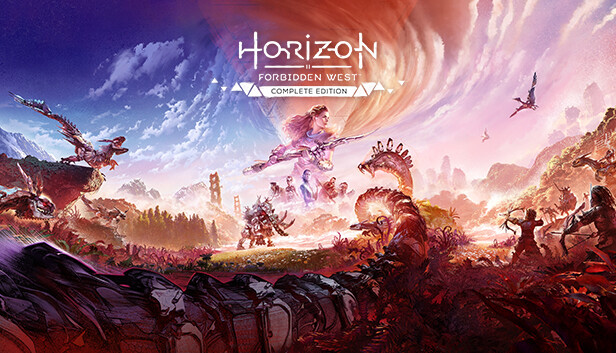
 Horizon Forbidden West™ Complete EditionFetching price~ $59.99
Popular PicksView All
123456789101112
12 Best Mystery Games on PC (2026)
12 Best Space Sim Games on Steam (2026)
12 Best Story-Rich Games to Play (2026)
12 Best Turn-Based Tactics Games on Steam (2026)
12 Best Puzzle Games on Steam (2026)
12 Best Games to Play with Friends on PC (2026)
12 Best JRPGs on Steam (2026)
12 Best City Builder Games on Steam (2026)
12 Best Zombie Games on Steam (2026)
12 Best Free Indie Games on Steam (2026)
12 Best Short Indie Games to Try (2026) — Done in One Evening
12 Best Cozy Games on Steam (2026)
Popular Games LikeView All
Games Like PowerWash Simulator - 12 Best Relaxing Cleaning and Restoration PicksGames Like Dave the Diver - 12 Best Diving, Cooking and Systems-Stacker PicksGames Like Road to Vostok - 12 Best Hardcore Survival Shooter PicksGames Like Path of Exile 2 - 12 Best Action RPG and Loot PicksGames Like Clair Obscur: Expedition 33 - 12 Best Turn-Based RPG PicksGames Like R.E.P.O. - 12 Best Co-op Horror PicksGames Like PEAK - 12 Best Co-op Climbing and Survival PicksGames Like Slay the Spire 2 - 12 Best Roguelike Deckbuilders to Play NextGames Like Mina the Hollower - 12 Best Top-Down Action and Zelda-Like PicksGames Like Baldur's Gate 3 - 12 Best CRPGs and Turn-Based RPGsGames Like Monster Hunter Wilds - 12 Best Co-op Hunting and Action RPG PicksGames Like Hollow Knight: Silksong - 12 Best Metroidvania Picks (2026)Games Like Final Fantasy VII Rebirth - 12 Best Action RPG & JRPG PicksGames Like Dead by Daylight - 12 Best Asymmetric & Co-op Horror PicksGames Like Forza Horizon 6 - 12 Best Open-World Racing & Driving Picks (2026)Games Like 007 First Light - 12 Best Stealth and Spy GamesGames Like Solarpunk - 12 Best Cozy Survival and Crafting GamesGames Like Subnautica 2 - 12 Best Underwater and Alien-World Survival GamesGames Like Lies of P - 12 Best Soulslikes to Play in 2026Games Like Hell Let Loose - 12 Best Tactical Milsim Shooters
Popular ReviewsView All

Mina the Hollower — Review

Clair Obscur: Expedition 33 — Review

Schrödinger's Call — Review

Resident Evil Requiem — Review

Shift At Midnight — Review

Mixtape — Review

Middle-earth™: Shadow of Mordor™ — Review

The Mermaid Mask — Review

MOLE — Review

Desktop Explorer — Review

Mad Max — Review

Go-Go Town! — Review

Dead as Disco — Review

Crushed In Time — Review

Beastro — Review

Moonlight Peaks — Review
Has *Horizon* Been Given a New Face by DLSS 5—Does It Look Better Now?
When Aloy’s face—originally marked by wind and sun—was processed by technology into something smoother and brighter, with even her emotional fluctuations seeming to be gently veiled by a layer of soft light, the debate surrounding DLSS 5 had already become about more than just graphics card technology. It was more like a trial over whether a character could still be “recognized.”
At GTC 2026, NVIDIA unveiled DLSS 5. What should have been just another upgrade announcement within tech circles unexpectedly ignited an aesthetic divide among players. The cause was not complicated: overseas user @poliwa_93 posted comparison images of Horizon protagonist Aloy “using” DLSS 5, accompanied by a rather provocative remark that roughly suggested that simply enabling this technology would make female characters more attractive.

The problem lies precisely in those words, “more attractive.” On a narrative level, a character’s face is never just an art asset; it is also a vessel for personality, experience, and emotion. What makes Aloy work is not whether she fits some internet-template standard of beauty, but how the angular features, fatigue, and unappealing realism on her face together form the character’s distinct identity. What many players dislike now is not merely the increase in clarity, but the homogenized feeling of sending a character through assembly-line retouching software, ending up with a polished yet hollow “influencer face.” It is like a film whose grain has been smoothed away in post-production: the technology looks shinier, but the character feels more distant.

Of course, some supporters argue that the visual improvements brought by DLSS 5 are tangible, and that this is still only an early form of the technology, with every possibility of finding a balance in the future between preserving detail and enhancing visual appeal. That judgment is not without merit. In the history of technology, many solutions that initially seemed stiff or heavy-handed later learned restraint. But from another angle, players’ current wariness is equally justified: once “more beautiful” is implicitly treated as synonymous with “more standardized,” game characters may lose the faces that should rightfully belong to them.

NVIDIA CEO Jensen Huang responded quite forcefully to the critics, bluntly stating that “they are completely wrong.” But the deeper issue is that aesthetics has always been difficult to settle through parameters alone. Resolution, frame rate, and sharpening strength can be quantified; a character’s aura cannot. Especially in a work like Horizon Forbidden West, which relies heavily on facial characterization, even a slight shift in expressive texture can alter how players perceive the character.

There was also one slightly absurd detail in this controversy: the original page launched a poll asking whether DLSS 5 makes the visuals more beautiful or ruins the original artistic style, but although voting was still ongoing, the number of participants was shown as 0, and the percentage was still NaN%. It felt like unintentional dark humor—the argument had already grown as noisy as a public square debate, yet any real consensus that could be recorded remained blank.
If we speak only of trends, my view is that AI graphics technology will undoubtedly become ever more deeply involved in character presentation in the future, but the backlash from player communities will also force companies to confront an old question once again: is the goal of game visuals to look “more like a glossy advertisement,” or “more like the character themself”? The former is better at pleasing the eye, but the latter determines whether the character truly endures. Unfortunately, at least judging from this controversy surrounding Horizon, DLSS 5 still has quite a long way to go between being “visually stunning” and being “convincing.”
Horizon Forbidden West™ Complete EditionFetching price~ $59.99




Comments 0
Share your game review
Join the discussion and share your review of this game.
No comments yet. Share your review.