
News
Grab two free PC games before Epic's clock runs out, while Undertale and Divinity: Original Sin 2 are 75% off
Astral Ascent and LUFTRAUSERS are free to keep today, while two of PC gaming's most celebrated RPGs cost less than $14 c
















A 7 out of 10. Because in these three news stories, the truly interesting part isn’t who put out another roadmap—it’s who’s still willing to admit they’re not ready.

First, Slay the Spire 2. Mega Crit laid out its post-Early Access update plan in full, with 17 items in total, including a new character, variants for Chapters 2 and 3, more language support, and a whole pile of fixes and improvements. The issue is, it still didn’t give a release window for the full version. A lot of studios would get flak for that—doesn’t this look like the classic “make promises first and figure it out later”? But honestly, this time I don’t really feel like criticizing them.
The reason is simple. Not long ago, it stumbled because of a balance update, and its Steam reviews briefly dropped from “Mostly Positive” to “Mixed,” with the community’s reaction being pretty blunt. The developers didn’t play dumb either—they made it clear that many of the changes are still being tested, that this isn’t the final version, and that 1.0 will probably take another 1 to 2 years. To put it plainly, that’s more trustworthy than the approach of shoving a half-finished product out the door as a “full release.” At least it’s not like certain sequels that rush out early and end up moving stiffer than zombies from the PS2 era.
More importantly, they don’t plan to suddenly inflate the team just to rush 1.0. Veteran players know this well: a team swelling overnight doesn’t necessarily mean efficiency takes off. More often, it’s like old Capcom projects where the headcount looked doubled on paper, but the level design, balance, and game feel all seemed stitched together by completely different groups. For a game like Slay the Spire 2, which lives and dies on balance and deckbuilding, Early Access is supposed to be used for repeated testing in the first place. If players are already sentencing it to death by final-product standards, that’s a bit premature. My advice is simple: veteran players should wait and see, then jump back in once the test branch and later major updates stabilize. New players, meanwhile, shouldn’t be so quick to conclude that this is “another masterpiece sequel that crashed and burned.”

The second story feels more like a snapshot of Capcom’s form in recent years. After Pragmata launched on April 17, its Steam positive review rate quickly climbed to 97%, while its SteamDB rating reached 93.87%, already making it one of Capcom’s highest-rated games on Steam, just slightly below Resident Evil 9: Requiem and Resident Evil 4 within the series. This result isn’t luck. It was first revealed back in 2020, originally targeting 2022, then delayed past 2023 and still kept polishing. The core challenge was the dual-protagonist system: players have to control both Hugo and Diana at the same time, and the team did a great deal of optimization to make that feel smooth.
So what does that show? Delays themselves aren’t the original sin—chaotic delays with nothing to show for them are. The smartest thing Capcom has done in recent years is knowing when to revise and when to keep polishing. That’s also why Resident Evil 9: Requiem has been selling so fast this year, becoming one of the fastest-selling titles in the series’ history. You can say Capcom has gotten better and better at doing the math, but as long as the final product is solid enough, players aren’t unreasonable. Put simply, Capcom now feels like those veteran Japanese studios from the late PS1 era: they may not amaze you every single time, but they basically understand what it means to deliver a finished product.
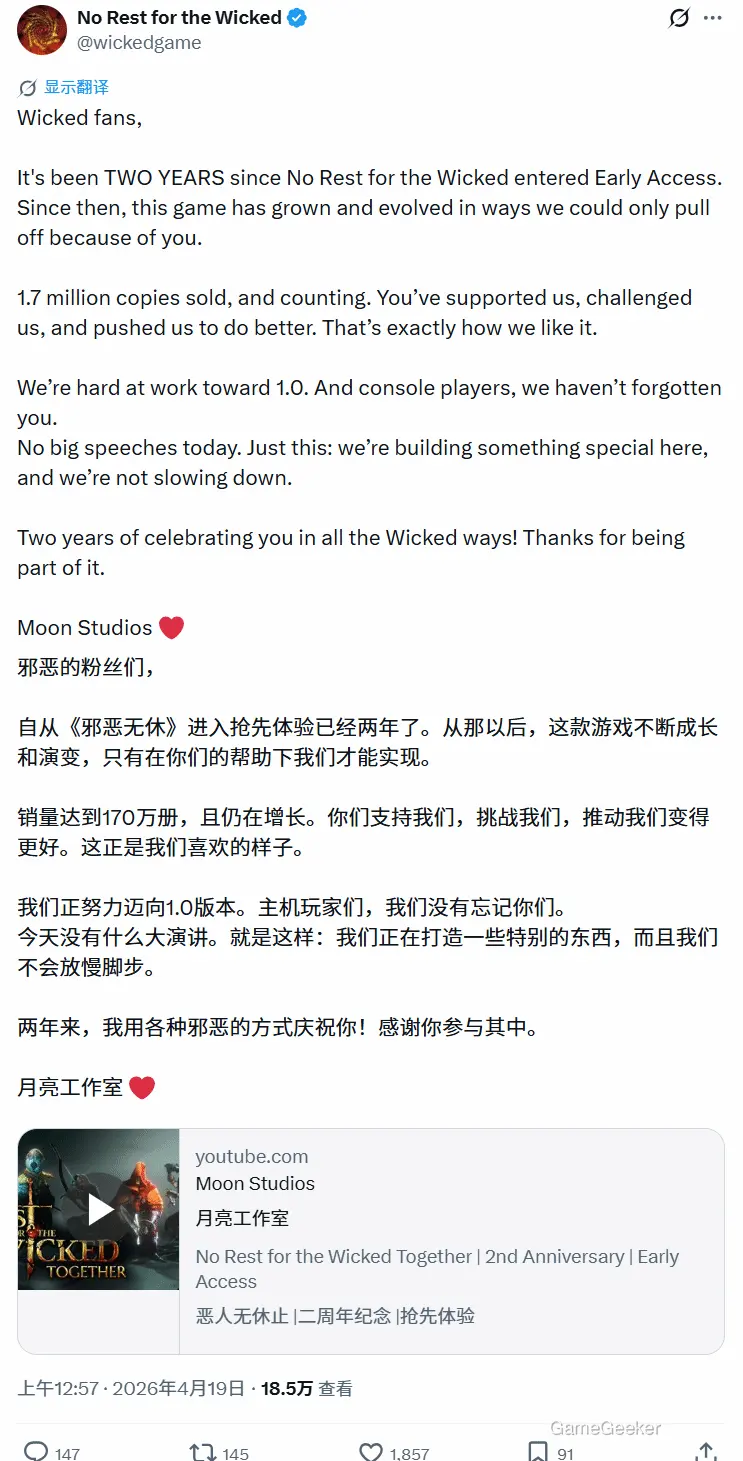
Finally, there’s No Rest for the Wicked. Moon Studios is celebrating the second anniversary of its Early Access launch, and the game has now sold more than 1.7 million copies, with that number still rising. The developers were also very straightforward: much of the game’s growth over the past two years has come from player feedback, and the community played a key role in shaping the current version. They’re still pushing toward 1.0 now, while also preparing a future console version. In fact, this approach is somewhat similar to Slay the Spire 2, except Moon has already spent two years proving that Early Access doesn’t have to mean treating players like unpaid QA labor—it can also mean steadily steering a product onto the right track.
So when you look at these three pieces of news together today, the conclusion is actually pretty consistent: what’s most worrying right now isn’t slowness, but trying to be fast while pretending to be steady. Player communities are very pragmatic these days—good content gets praise, bad balance gets blasted, and if Steam reviews drop, nobody’s going to spare anyone’s feelings. After seeing too many “game of the year contenders” crash and burn at launch, I’m actually more willing to accept this kind of development pace that doesn’t treat a release date like a sacred decree. As long as what finally gets served isn’t another half-finished relic from a bygone era, then this bit of waiting is really no big deal.




Comments 0
Share your game review
Join the discussion and share your review of this game.
No comments yet. Share your review.