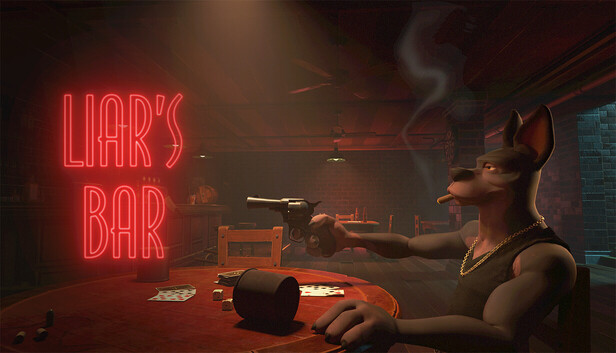
 Liar's Bar
Popular PicksView All
123456789101112
10 Best Minesweeper Puzzle Games With Rule or Logic Twists
10 Best Train Routing Puzzle Games
10 Best Nonogram Puzzle Games
10 Best Typing Combat Games for Keyboard-Focused Action
10 Best Dice Roguelikes for Tactical Combat
10 Best Time Manipulation Puzzle Games
10 Best Evidence-Reconstruction Detective Games
10 Best Single-Player Climbing Games
10 Best First-Person Spatial Puzzle Games
10 Best Steam Scream V Horror Games for a Halloween 2026 Wishlist
8 Best Pinball Games with Adventure and Combat Twists
7 Best Tile-Placement Puzzle Games, From Landscapes to Area Control
Popular Games LikeView All
Games Like PowerWash Simulator - 12 Best Relaxing Cleaning and Restoration PicksGames Like Dave the Diver - 12 Best Diving, Cooking and Systems-Stacker PicksGames Like Road to Vostok - 12 Best Hardcore Survival Shooter PicksGames Like Path of Exile 2 - 12 Best Action RPG and Loot PicksGames Like Clair Obscur: Expedition 33 - 12 Best Turn-Based RPG PicksGames Like R.E.P.O. - 12 Best Co-op Horror PicksGames Like PEAK - 12 Best Co-op Climbing and Survival PicksGames Like Slay the Spire 2 - 12 Best Roguelike Deckbuilders to Play NextGames Like Mina the Hollower - 12 Best Top-Down Action and Zelda-Like PicksGames Like Baldur's Gate 3 - 12 Best CRPGs and Turn-Based RPGsGames Like Monster Hunter Wilds - 12 Best Co-op Hunting and Action RPG PicksGames Like Hollow Knight: Silksong - 12 Best Metroidvania Picks (2026)Games Like Final Fantasy VII Rebirth - 12 Best Action RPG & JRPG PicksGames Like Dead by Daylight - 12 Best Asymmetric & Co-op Horror PicksGames Like Forza Horizon 6 - 12 Best Open-World Racing & Driving Picks (2026)Games Like 007 First Light - 12 Best Stealth and Spy GamesGames Like Solarpunk - 12 Best Cozy Survival and Crafting GamesGames Like Subnautica 2 - 12 Best Underwater and Alien-World Survival GamesGames Like Lies of P - 12 Best Soulslikes to Play in 2026Games Like Hell Let Loose - 12 Best Tactical Milsim Shooters
Popular ReviewsView All

Mina the Hollower — Review

Clair Obscur: Expedition 33 — Review

Schrödinger's Call — Review

Resident Evil Requiem — Review

Shift At Midnight — Review

Mixtape — Review

Middle-earth™: Shadow of Mordor™ — Review

The Mermaid Mask — Review

MOLE — Review

Desktop Explorer — Review

Mad Max — Review

Go-Go Town! — Review

Dead as Disco — Review

Crushed In Time — Review

Beastro — Review

Moonlight Peaks — Review
Hell Roulette's Steam Demo Is Live, Supporting 2-6 Players Who Can Betray Each Other
Hell Roulette—a tabletop-style, asymmetric multiplayer game built around Russian roulette, chips, and effect cards—has hit Steam and opened playtest sign-ups, Gamersky reports. The title supports 2–6 players and is listed under Steam app 4791340.
The hook is not guessing the next bullet. Risk here is a currency you trade at a dim table. Each round starts with players being dealt cards, then they bet and raise on who gets the revolver; the highest bidder wins the gun for the next turn. That looks like control, but it also puts the biggest elimination target on the winner's back.

Once someone is holding the gun, everyone else is not just waiting to die. Cards let players add or remove bullets, raise or lower the shot count, peek at the chamber, protect themselves or another player, heal, or steal the revolver outright. The probability math gets ugly fast—one screenshot shows a 5/7 chance of a hit in a round that calls for five shots. Betting is therefore not just about turn order; the bid can add bullets, extra shots, and the right to pull the trigger.

After every other player has played a card, the gun holder acts last and picks a target. Firing continues until the set shot count is reached or the holder dies. Survivors then scoop the chips on the table and move to the next round. The gun holder has a late-action edge and wants to take everyone else out quickly; everyone else chips away with cards, bluffs, and survival math.

As players drop, the asymmetry evens out. With fewer opponents, the gap between the shooter and the unarmed shrinks. In a one-on-one endgame, a player without the gun with self-protection can corner the shooter into a losing choice—which is why the piece calls the real skill "handing the gun to someone else." The unarmed also operate in a fragile alliance: cooperate long enough to let the shooter eliminate rivals, then find a way to remove the shooter before the pot is locked in.
The result sits somewhere between probability calculation, chip management, mind games, and a little friendly backstabbing. It belongs in the same conversation as Buckshot Roulette and Liar's Bar, though its bidding, gun-stealing, and politics among the unarmed mean every choice has to weigh immediate survival against long-term payoff.
Gamersky notes that the visuals are still early and rough, so the current build is better for testing whether the rule loop and multiplayer friction hold together than for judging final presentation. If probability math, lies, and mutual sabotage sound appealing, the playtest is worth joining. Players who want polished art and a complete feature set should wait for clearer development milestones before committing.
Liar's Bar Russian roulette~ $0.99Loading store offers





Comments 0
Share your game review
Join the discussion and share your review of this game.
No comments yet. Share your review.