
News
After 3 Years Offline, Marvel's Avengers Accidentally Appears on a PS Collection Cover, Sparking Debate
September 12 saw Marvel’s Avengers on a PS Store Marvel bundle cover—likely oversight—three years offline. Marvel’s Wolv
















Riot Games designer August Browning has confirmed what League of Legends players have long suspected: when someone hits the surrender button, they are almost always right. Drawing on Riot's internal match data, Browning revealed that the studio cross-referenced the economic gap at the moment a surrender vote is called against historical win rates for comparable deficits. The comeback probability at those exact moments is extremely low.
The method here is straightforward. Riot pulled a massive sample of historical matches, pinpointed the exact timestamp when players initiated a surrender, and compared that moment's gold and vision deficit against the eventual match outcome. The correlation was clear: the vast majority of surrender votes happen when the historical chance of a comeback is practically zero. Players are essentially reading the game state accurately, with their snap judgments closely matching Riot's own backend data.
This alignment is no accident. The in-game economy panel and vision dominance create a compounding psychological weight on the losing side. When a team collectively decides the match is unrecoverable, the numbers almost always prove them right. Browning acknowledged as much, stating that "in most cases, players' surrender judgments are mostly correct." He was careful to note that not every surrender vote is perfectly justified, but the alignment between what players perceive and how the game actually plays out is remarkably tight.
This highlights one of MOBA design's oldest and most persistent tensions. Once a leading team builds a sufficient economic and map-control lead, the snowball effect takes hold. The losing team falls further behind, and no amount of micro-level mechanic tuning can realistically generate suspense in those scenarios. Seen this way, the surrender system is less a concession to frustrated players and more a clean exit from a match state that is practically unrecoverable.
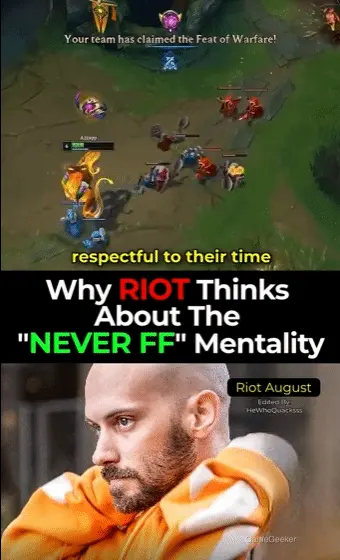
There is also a practical, player-focused aspect to this. Letting players leave a lost game early is, at its core, a strategy for managing their most precious asset: time. As Browning put it, allowing players to opt out is fundamentally "a form of respect for the time everyone has invested." Forcing players to sit through matches with no meaningful interactive value—where the outcome is already settled and the remaining minutes are just a slow grind—only breeds toxicity and burns out the community. A clean, fast restart into the next match is almost always the healthier outcome for long-term player retention.
The bottom line is straightforward. Surrender mechanics are not about appeasing tilted players. They are a data-backed acknowledgment that sometimes the game is, in fact, already over—and that respecting that reality serves everyone better than pretending otherwise.




Comments 0
Share your game review
Join the discussion and share your review of this game.
No comments yet. Share your review.