
News
Grab two free PC games before Epic's clock runs out, while Undertale and Divinity: Original Sin 2 are 75% off
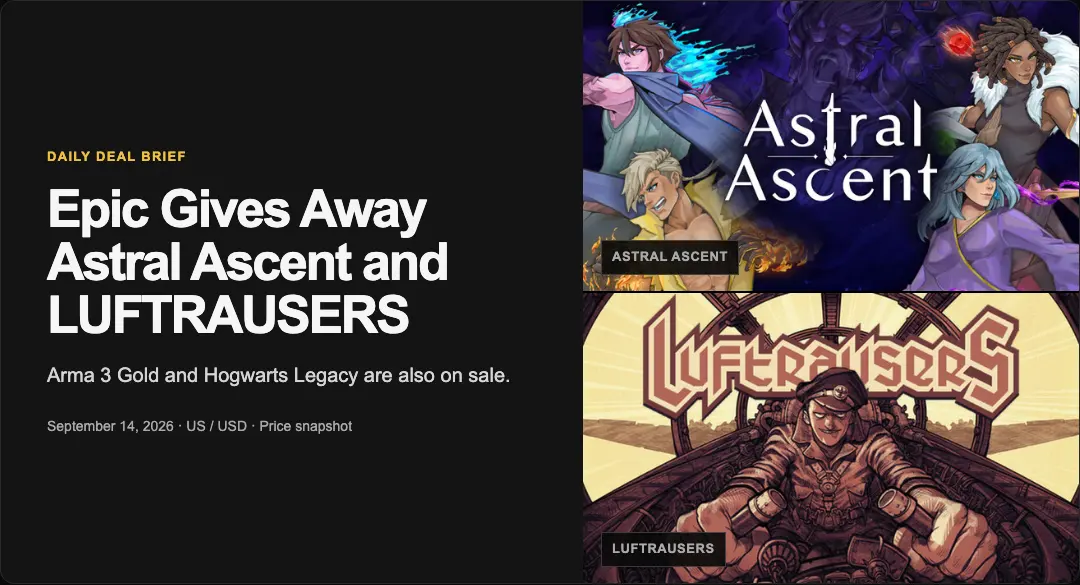
Astral Ascent and LUFTRAUSERS are free to keep today, while two of PC gaming's most celebrated RPGs cost less than $14 c









This wave of news from French publisher Nacon has made both racing and action game players slam on the brakes. On March 23 local time, Nacon announced that 4 of its subsidiaries had filed for insolvency and requested the launch of France’s judicial reorganization procedure. More importantly, this is not an isolated incident—back in February, Nacon itself had already entered the same procedure due to the impact of debt default by its parent company, Bigben Interactive, indicating that pressure at the group level is still continuing to spread.

The 4 companies caught up in this situation are hardly unfamiliar names to players: Spiders, Kylotonn, Cyanide, and Nacon Tech. Spiders made GreedFall, Kylotonn is best known for the WRC series, Cyanide released the Styx series, and Nacon Tech mainly handles motion capture work. In other words, it’s not just the publishing side being affected—development, technical support, and content production have all entered the same repair lane.

For racing game players, the most sensitive point is obviously Kylotonn. It has long been closely associated with rally-themed games, so seeing the company enter reorganization, the community’s first reaction is often not financial-report jargon, but rather: will project schedules change? Will updates slow down? Will future licensing partnerships remain stable? These concerns are very real, because once group restructuring enters deeper waters, resource allocation, project approval pace, and promotional investment may all be reordered.

From an institutional perspective, France’s judicial reorganization does not mean an immediate shutdown. Under local law, this procedure can freeze debt for up to 18 months, giving companies breathing room and time to restructure. Nacon has also stated that it will maintain business operations through debt renegotiation and restructuring plans, while advancing the group’s reorganization with the assistance of lawyers and court-appointed administrators. So at this stage, it feels more like the race has entered the pit lane rather than waving the white flag and retiring outright.
But the risks are still clearly there. Nacon has a total of 25 subsidiaries, 16 of which are game studios. Now that 4 have formally filed, other subsidiaries may also be affected in the future. This means that if players are following Nacon-related titles, what they should be paying closer attention to in the short term is development pace and post-launch support, rather than blindly expecting a major acceleration in large-scale new projects.

My view is that this may not immediately hit the day-to-day experience of any single older game, but it will cast a clear shadow over the medium- to long-term product pipeline. Mid-sized publishers and studio-based operations are, after all, more like endurance racing, where the real test is cash flow, rhythm, and steady support. Once the parent company’s debt problems start filtering downward, even the most capable team will be forced to slow down. For players, what matters most next is not who shouts the loudest slogans first, but who can still finish games on time, keep updates coming, and maintain stable service.



Comments 0
Share your game review
Join the discussion and share your review of this game.
No comments yet. Share your review.