
News
Grab two free PC games before Epic's clock runs out, while Undertale and Divinity: Original Sin 2 are 75% off
Astral Ascent and LUFTRAUSERS are free to keep today, while two of PC gaming's most celebrated RPGs cost less than $14 c
















When a console that has yet to appear first enters the rumor mill in the dual form of a “home console plus handheld,” what it brings is not just excitement over a spec sheet, but something more like a long-running film franchise revealing the positions and relationships of its main characters before a new chapter begins. A recent roundup of multiple leaks compiled by Twitter user @TCMF2 sketches exactly such a blueprint for the PS6: Sony may launch the PlayStation 6 hardware lineup in late 2027, during the next holiday season, and the target may not be a single machine, but an entire ecosystem.
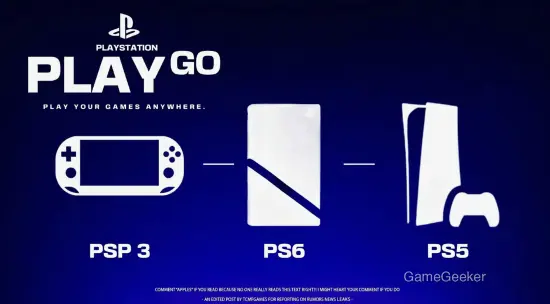
If these reports are ultimately confirmed, then the narrative focus of the PS6 is already quite clear: rather than simply emphasizing “more power” as in the past, it seems to be trying to bring the living room, handheld play, and cost control into the same framework. The leaks mention that the PS6 could debut as two devices at the same time, or launch in phases: on one side a traditional home console, on the other a handheld with a docked mode similar to the NS; there is even speculation that this handheld approach could eventually spin off into a lower-cost form similar to a “PSP TV.” From another angle, this looks less like a simple generational upgrade and more like Sony writing an ensemble drama for PlayStation, where every hardware character serves the same shared universe.
The rumored specs for the console itself are fairly detailed, including 7 to 8 Zen 6c cores for gaming, 2 Zen 6 LP low-power cores for the system, and a GPU based on the RDNA 5 architecture with 52 to 54 compute units. The memory bus is said to be 160-bit, with support for up to 40GB of GDDR7 and bandwidth reaching 640GB/s. According to the leaks, pure rasterization performance would be 2.5 to 3 times faster than the PS5, while ray tracing could see an even bigger jump of 6 to 12 times. But what is really intriguing is not the numbers themselves, but another, more important line: Sony reportedly defined it as a “low-cost architecture system” from the very beginning of the project. That suggests the PS6’s central dramatic tension may not be about piling on hardware, but about finding a balance among performance, price, and form factor without letting any of them spiral out of control.

This sense of balance is especially apparent in the rumors surrounding pricing and configuration. Reports say the base PS6 could come in below the roughly $900 PS5 Pro, but the trade-offs are equally straightforward: it may drop the built-in disc drive, requiring a separate purchase, and the standard storage could be only a 1TB SSD. In narrative terms, this is a bit like a well-produced film that trims away side plots, concentrating its budget on the shots that really need to be seen. Unfortunately, for players who collect physical discs or care deeply about native storage capacity, this kind of compromise may not be appealing. Especially against the backdrop of an increasingly digital future, it feels more like a platform strategy than a straightforward technological upgrade.
The handheld, by contrast, may be the most compelling character in this round of leaks. According to KeplerL2, the PS6 handheld, codenamed “Project Canis,” would be no slouch in performance: its rasterization capability is expected to surpass the Xbox Series S, while its ray tracing and even path tracing performance could go a step further. It may also feature the next-generation AI upscaling technology PSSR 3, with image quality targets even being compared to NVIDIA DLSS. Its core specifications are said to include 4 Zen 6c cores, 2 Zen 6 LP cores, 16 RDNA 5 compute units, 24GB of LPDDR5X memory, and a 192-bit bus, built on TSMC’s 3nm process with a chip area of about 135mm². In the context of today’s handheld market, this does not look like a traditional “secondary device,” but more like a next-generation entry point compressed into a portable form.

But the deeper question is: what kind of story does Sony actually want the PS6 to tell? If the release window really lands between late 2027 and early 2028, then it will be facing not just a hardware race, but also the reality that player habits have already changed: the console is no longer the sole center, and cross-device use, streaming, digital purchases, and AI-driven image enhancement are rewriting the value of a platform. For players still on the fence, my advice is simple: there is no need to make buying decisions in advance based on leaks, especially for current PS5 users. Just keep watching to see whether Sony can truly make the “home console + handheld + low-cost ecosystem” concept come together. Because what a new console fears most has never been specs that are not impressive enough, but rather having too many characters and too much world-building, only to end up like an unsteady sequel in a long-running franchise—grand in scale, but failing to make its characters stand.




Comments 0
Share your game review
Join the discussion and share your review of this game.
No comments yet. Share your review.