
News
over the hill launches with introductory Steam offer and lower-priced key listings
Funselektor’s off-road exploration game is out on Steam at $19.99 with an introductory offer. Approximate third-party ke
















This time, CAPCOM made a very clear trade-off: it pushed the PC version of Pragmata directly onto the technology stack of path tracing and DLSS 4. Rather than simply increasing material resolution, it hands light propagation, reflection, refraction, and attenuation over to real-time computation—effectively tying the upper limit of the scene’s visual fidelity to GPU capability and algorithm-based frame generation.

From a design perspective, the lunar city setting is a very professional choice. Neon signs, streetlights, combat effects, and metallic building surfaces are already ideal assets for showcasing path tracing; refraction through transparent materials, diffuse scattering in dark areas, and reflections along metal edges can all create more continuous light-and-shadow interaction. If this kind of image relies only on traditional screen-space reflections, it can easily end up feeling like a “texture patchwork,” whereas path tracing is at least more coherent in terms of visual logic.

From a technical standpoint, the issue is also very real: path tracing comes with a very heavy performance bill. The test platform used an Intel Core Ultra 9 285K, a Z890 ACE motherboard, and 32GB of DDR5 6800MT/s memory—already far from an entry-level setup. With 4K path tracing enabled and frame generation turned off, the RTX 5080 managed only around 35 fps, but after enabling DLSS 4 with 4× Multi Frame Generation, it reached 121 fps. That scale of improvement is dramatic, and it also shows just how intense the native rendering load really is.

The key to DLSS 4 this time is not just “raising the frame rate.” The second-generation Transformer super resolution model, Multi Frame Generation, and Dynamic Multi Frame Generation are designed to handle image clarity, ghosting, flicker, and frame rate pressure all at once. On the RTX 5080, native performance at 4K with only ray tracing enabled was 82 fps; after turning on DLSS 4, 2× pushed it past 150 fps, while 4× reached 252 fps. Under 2K path tracing, it could also be boosted from 66 fps to 210 fps, an increase of about 218%. This is not just icing on the cake—it is the core support determining whether the entire visual quality strategy can actually be delivered.
The performance of mid-range cards better illustrates the commercial logic. Under 4K path tracing, the RTX 5070 can reach 61 fps with DLSS 4 set to 3×, and nearly 80 fps at 4×; if only ray tracing is enabled, native performance is 48 fps, while the 4× mode can push it to 179 fps. The RTX 5060, meanwhile, is better suited to 2K and 1080p targets: at 2K with ray tracing, native performance is 77 fps, and the increase after Multi Frame Generation is about 170%; at 1080p, whether ray tracing is enabled or not, minimum frame rates can stay above 95 fps.

My recommendation is straightforward: if you want to experience path tracing at 4K, Pragmata clearly favors high-end cards like the RTX 5080; the RTX 5070 can trade DLSS 4 for a playable 4K experience, but it is best to accept the involvement of Multi Frame Generation. RTX 5060 users are advised to stick to 2K with ray tracing or 1080p high frame rates, and not force full path tracing settings. This is not conservative tuning—it is performance budget management.
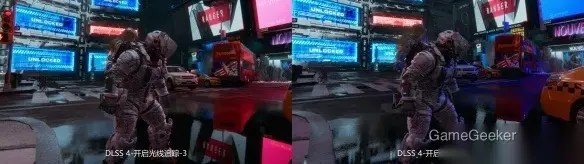
Viewed in the broader trend, Pragmata feels more like a joint stress test of the RE Engine and the RTX 50 series. After six years of waiting and three delays, it is finally set for a global release on April 17, and its visual foundation does indeed carry that solid CAPCOM craftsmanship seen in recent years. But players should also recognize that so-called “next-generation graphics” are becoming increasingly dependent on heavyweight post-processing and AI-generated pipelines. In the future, the standard for judging PC optimization may no longer be native frame rates alone, but whether the developers have integrated this entire technical workflow with enough care.





Comments 0
Share your game review
Join the discussion and share your review of this game.
No comments yet. Share your review.