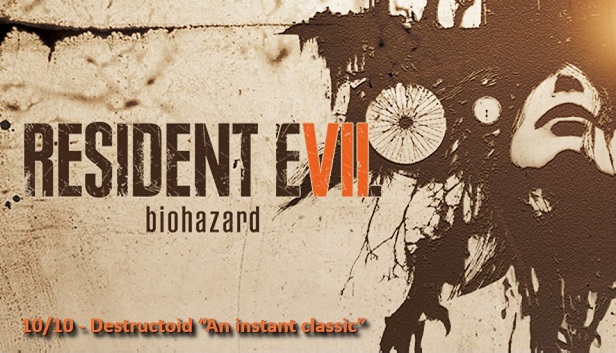
 Resident Evil 7 Biohazard
Popular PicksView All
123456789101112
10 Best Programming Puzzle Games in 2026: Visual Logic, Bots, and Assembly
10 Best Railway Network Management Games in 2026
10 Best Single-Player Photography Exploration Games in 2026
10 Best Single-Player Monster Taming Games in 2026
10 Best Immersive Sim Games on Steam (2026)
10 Best Mech Games on Steam (2026)
10 Best Single-Player Pirate Games on Steam (2026)
10 Best Steam Autumn Sale 2026 Games by Budget and Play Style
10 Best Rhythm Games on Steam (2026)
10 Best RTS Games on Steam (2026)
10 Best CRPGs on Steam (2026)
7 Best Fictional Language Deciphering Puzzle Games in 2026
Popular Games LikeView All
Games Like PowerWash Simulator - 12 Best Relaxing Cleaning and Restoration PicksGames Like Dave the Diver - 12 Best Diving, Cooking and Systems-Stacker PicksGames Like Road to Vostok - 12 Best Hardcore Survival Shooter PicksGames Like Path of Exile 2 - 12 Best Action RPG and Loot PicksGames Like Clair Obscur: Expedition 33 - 12 Best Turn-Based RPG PicksGames Like R.E.P.O. - 12 Best Co-op Horror PicksGames Like PEAK - 12 Best Co-op Climbing and Survival PicksGames Like Slay the Spire 2 - 12 Best Roguelike Deckbuilders to Play NextGames Like Mina the Hollower - 12 Best Top-Down Action and Zelda-Like PicksGames Like Baldur's Gate 3 - 12 Best CRPGs and Turn-Based RPGsGames Like Monster Hunter Wilds - 12 Best Co-op Hunting and Action RPG PicksGames Like Hollow Knight: Silksong - 12 Best Metroidvania Picks (2026)Games Like Final Fantasy VII Rebirth - 12 Best Action RPG & JRPG PicksGames Like Dead by Daylight - 12 Best Asymmetric & Co-op Horror PicksGames Like Forza Horizon 6 - 12 Best Open-World Racing & Driving Picks (2026)Games Like 007 First Light - 12 Best Stealth and Spy GamesGames Like Solarpunk - 12 Best Cozy Survival and Crafting GamesGames Like Subnautica 2 - 12 Best Underwater and Alien-World Survival GamesGames Like Lies of P - 12 Best Soulslikes to Play in 2026Games Like Hell Let Loose - 12 Best Tactical Milsim Shooters
Popular ReviewsView All

Mina the Hollower — Review

Clair Obscur: Expedition 33 — Review

Schrödinger's Call — Review

Resident Evil Requiem — Review

Shift At Midnight — Review

Mixtape — Review

Middle-earth™: Shadow of Mordor™ — Review

The Mermaid Mask — Review

MOLE — Review

Desktop Explorer — Review

Mad Max — Review

Go-Go Town! — Review

Dead as Disco — Review

Crushed In Time — Review

Beastro — Review

Moonlight Peaks — Review
Why *Resident Evil 7* Became the Critical Turning Point for the Series
If you think of a long-running game IP as a constantly expanding horror theme park, then the Resident Evil of the Resident Evil 6 era felt more like it had crammed in roller coasters, demolition shows, and action-movie soundstages all at once. It was lively, sure, but the “haunted house” itself had been pushed into a corner.
Recently, insider Dusk Golem mentioned on social media while looking back on the series’ turning points that Capcom had already clearly realized the seriousness of the problem in early 2014: although Resident Evil 6 sold a respectable number of copies, it still clearly fell short of the 6 million units target. More troubling was that sales pressure was only the surface issue—the real damage was to its reputation. The gameplay felt unbalanced, the storytelling was messy, longtime fans were drifting away, and new players weren’t being firmly won over either. The brand image kept sliding until it hit a low point.

From that perspective, Capcom’s later decision to scrap the more action-oriented plan that had originally been conceived as a Resident Evil 6 sequel, with Leon and Sherry as dual protagonists, was essentially an emergency demolition. Instead of continuing to add floors onto the old building, they first acknowledged that the foundation itself had gone in the wrong direction, and then chose to rebuild. That led the development team toward Resident Evil 7, where they opted to return to the roots of survival horror and more thoroughly redefine the series’ identity.
The value of Resident Evil 7 wasn’t just that it was “scarier.” It was more like an experiment in spatial design through reduction: shrinking the stage from large-scale action set pieces back to a closed, damp, deeply unsettling mansion-like environment; pulling players out of the “clear everything with firepower” mindset and back into a rhythm of “careful exploration, resource anxiety, and psychological pressure.” That shift made Resident Evil feel like Resident Evil again.

The results were immediate. According to the information revealed this time, Resident Evil 7 received unanimous praise from both players and the media after launch, and was seen as the key title that helped bring the series back into the ranks of the world’s top game IPs. For many fans of the franchise, it felt like a successful “hard reboot”: preserving the brand’s core emotional essence while discarding the habitual design choices that had been weighing it down.
From an industry perspective, this also stands as a textbook example of how a classic IP can save itself: when sequel logic keeps pushing a series farther and farther away from what it once was, the most effective move is not necessarily to pile on more content, but to precisely rediscover the nerve that made players fall in love with it in the first place.

If you’re a player who came to the series later, my advice is straightforward: if you want to understand the starting point of Resident Evil’s revival in recent years, Resident Evil 7 is almost an unavoidable stop. It wasn’t just a single game turning its reputation around, but a model project in subtracting from an old IP, recalibrating its direction, and setting it running again. For Capcom, this was a ruthless cut—but it truly saved the lifeblood of the series.
Resident Evil 7 Biohazard Resident Evil 6
 On saleResident Evil
 On saleResident Evil (1996)
 On saleResident Evil 2 (1998)





Comments 0
Share your game review
Join the discussion and share your review of this game.
No comments yet. Share your review.