News
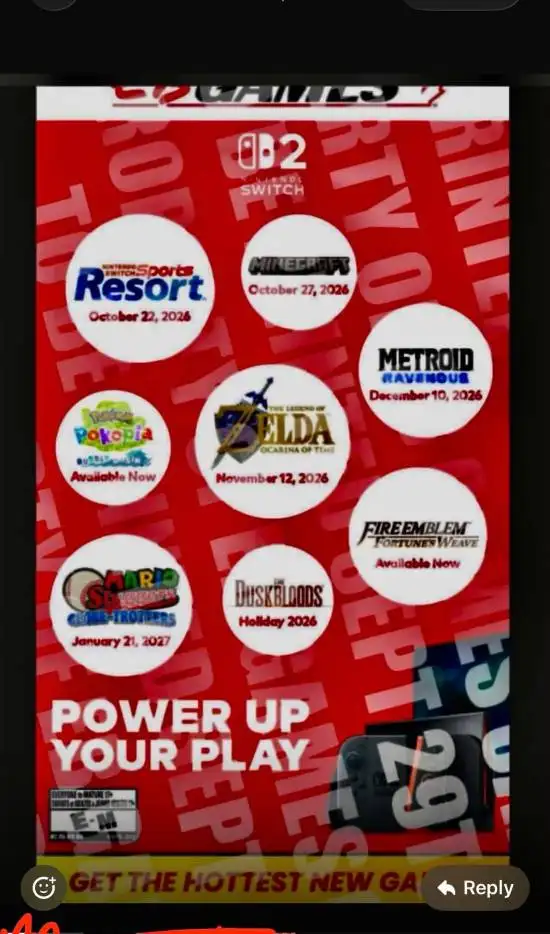
EB Games Leak Reveals Ocarina of Time Remake Release Date
A Reddit user claims an EB Games poster leaked several Switch 2 release dates, though the listing remains unverified. Ni
















I’d give it a 7. Not for this comparison itself, but for the spectacle around it. Because at the very least, it has dragged an old question back onto the table: if both games are labeled with DLSS, why can they end up looking so different?
Recently, the overseas blogger @Pirat_Nation made a post comparing DLSS visuals from Resident Evil 9 and Death Stranding 2.0. On the left was the protagonist of Death Stranding 2, and on the right was Grace, the female lead of Resident Evil 9: Requiem. The result was pretty striking. A lot of people felt that Resident Evil 9 looked like it had a full-on “influencer face” filter slapped on, and the vibe just felt off.

The thing is, players aren’t that easy to fool. As soon as this comparison went up, the comment section erupted. Some sided with Death Stranding 2’s visual quality, saying its character detail and skin texture looked more stable. Others weren’t buying it at all, suspecting the image set was a bit of a “Tian Ji horse racing” situation. To put it bluntly, if you force together different lighting, different camera angles, and different character states into one side-by-side image, of course you can manufacture a conclusion. So how much reference value does that really have?

Having played games all these years, I’ve always been wary of this kind of screenshot judgment. Back in the PS3 era, publishers loved passing off cutscenes as real gameplay, and only later did people wise up. Now it’s AI upscaling instead, but the essence is pretty much the same: the technical jargon sounds more advanced, but the information gap is still the same old information gap. If you really want to compare DLSS performance, then at the very least it should be the same resolution, the same dynamic scene, and the same compression conditions. Better yet, compare video footage—not two face close-ups that are easiest to use for steering the narrative.
That said, this doesn’t mean Resident Evil 9 definitely has no issues. On the contrary, the reason players react so strongly is that once a character’s face starts to look distorted, it’s incredibly easy to break immersion. Veteran players all know this: character modeling is like the cutscenes in Metal Gear Solid 4—if it falls just a little short, the whole impression drops from “high-end” to “plastic.” And for a series like Resident Evil, which relies heavily on character expressiveness, once the face falls apart, half the atmosphere is gone before anything else.

Looking at the community reaction, it’s actually perfectly normal that opinion has split into two camps. One side thinks Death Stranding 2 currently looks stronger overall and supports it winning this round of comparison. The other side is focused on the comparison method itself, questioning whether the blogger deliberately matched the worst-looking state of one game against the best-looking state of the other. Some comments even explicitly said “the controversy below this is huge,” and others argued that it used “a Tian Ji horse racing kind of tactic.” Those two lines basically get to the heart of this whole uproar.
Judging from the trend, this kind of controversy is only going to become more common. That’s because next-generation graphics technology depends more and more on reconstruction, frame generation, and post-processing. What players see may not necessarily be “native power,” but rather the combined performance of an entire display pipeline. When it’s done well, it’s like when Uncharted 2 first lit up the HD era. When it’s done poorly, even the highest specs can look like someone slapped an HD skin onto a PS2 game.

My advice is simple: don’t rush to pick a side, and definitely don’t sentence a game to death based on a single screenshot. Wait for more real gameplay footage, wait for more standardized comparison conditions, and then draw your conclusions. Criticize if you want, but make sure you’re criticizing the right thing. Praise it if you like, but don’t start too early. After all, I’ve seen far too many “game of the year contenders” get hyped up like God of War during pre-release marketing, only to land like a side quest in Assassin’s Creed once they actually came out.




Comments 0
Share your game review
Join the discussion and share your review of this game.
No comments yet. Share your review.