
News
Grab two free PC games before Epic's clock runs out, while Undertale and Divinity: Original Sin 2 are 75% off
Astral Ascent and LUFTRAUSERS are free to keep today, while two of PC gaming's most celebrated RPGs cost less than $14 c
















It’s blowing up! This topic has really set players’ emotions on fire!
Recently, a player on Reddit, @r4in, made a post that thrust the issue of Steam account inheritance into the spotlight. He said his account already contains more than 3000 games, worth tens of thousands, and his core demand boils down to one sentence: when a person is gone, should their library have to disappear too? Can family members inherit it? This instantly turned “digital inheritance” into a trending hot-topic discussion.
Here’s the key point. Under Steam’s current Terms of Service, accounts and related subscription content generally cannot be transferred. Put plainly, what players pay for is usually not legal ownership of the game itself, but a license to use it. By this point, a lot of people are probably already feeling their blood pressure rise: I’ve been buying games for so many years, and it turns out it’s more like a “long-term rental”? It feels like spending years building up a full warehouse, only for the system to tell you in the end: “For personal use only.”
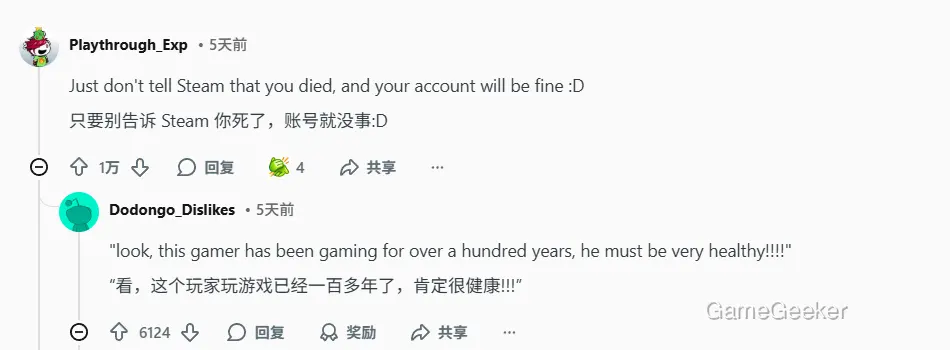
So naturally, the comment section got lively. Some people joked about it pretty viciously. I’ll quote just one line: “As long as you don’t tell Steam that you died, your account will be fine forever.” And honestly, that kind of dark humor really does hit a nerve because it reflects reality. Other users kept the joke going, saying that in the future the backend might show “ancient players” who have been gaming for over 100 years, which would be hilariously absurd.
But jokes aside, there are also real cases in the community. One widow, whose spouse passed away 8 years ago, said she has been logging into her husband’s account the whole time, and everything has worked normally for 8 years. She also suggested leaving account credentials with someone you trust. It’s a very down-to-earth approach, and it represents the current “unofficial solution” for many players: if the platform won’t provide a proper channel, then handle it privately.
But here’s the thing! Why doesn’t Valve just add an inheritance feature directly? There are quite a few pitfalls involved. First, there are legal issues: how do you validate a will, how do you define the scope of relatives, how do you adapt to laws across different regions? Any one of those is enough to be a headache. Second, there are security concerns: once the policy is loosened, long-inactive accounts could easily become new targets for account theft and scams. What you see as inheritance, someone else may see as a chance to grab inventory, cosmetics, or even the entire game library.

Looking at the trend, this issue won’t stop with Steam. As digital purchases become more and more common, movies, music, games, and e-books will all run into the same question in the future: when consumption becomes fully digital, can digital assets really be passed on to family members like physical property? This is not just one platform’s minor annoyance, but a hard-core issue for the entire internet era.
My view is very straightforward: an official inheritance mechanism is worth supporting, but it must come with strict verification. For example, limit it to immediate family members, set a cooling-off period, and introduce legal document reviews. It doesn’t matter if the process is a bit cumbersome; at least it’s more reliable than the current approach of relying entirely on “just don’t say anything.” The player community will most likely keep arguing about this, and Valve will have to face it sooner or later.
If you’re a heavy Steam user, my advice is also very practical: don’t count on the official feature being added anytime soon. At the very least, organize important account information securely, and leave passwords, verification methods, and device information with the person you trust most—but only with proper attention to privacy and risk boundaries. After all, these days, a game library is not just an inventory; for many players, it’s also an archive of more than a decade of youth.
So here’s the question: which side are you on? Do you support an official inheritance mechanism, or do you think private handling is enough? All I can say about this wave of discussion is that on the surface it’s about accounts, but underneath it’s really about what happens after we’re gone in the digital age. It’s realistic—and it hits hard.




Comments 0
Share your game review
Join the discussion and share your review of this game.
No comments yet. Share your review.