
News
Grab two free PC games before Epic's clock runs out, while Undertale and Divinity: Original Sin 2 are 75% off
Astral Ascent and LUFTRAUSERS are free to keep today, while two of PC gaming's most celebrated RPGs cost less than $14 c
















On April 10, Ten Days to End officially began filming at Qingdao Oriental Movie Metropolis. As soon as the news broke, the buzz in discussion forums was hard to cool down. For me, the most interesting thing about this drama isn’t just whether Xiao Zhan’s new look is eye-catching enough, but that from the very start it presents a strong ambition to “build a world”: Chinese-style infinite flow, a suspense framework, and the support of a virtual soundstage. This combination itself feels a lot like creating a high-concept survival sandbox. It isn’t simply telling one character’s story, but trying first to construct “the Endland” as a rule-based space, and then push the characters into it to collide.

What first set Weibo’s trending searches on fire this time was, unsurprisingly, lead actor Xiao Zhan’s character statement. Speaking in the role of Qi Xia, he said, “My name is Qi Xia. I’m a liar. You can only believe half of what I say.” In a single line, it maxed out the character’s uncertainty, sense of danger, and suspenseful undertone. Paired with the released solo poster—black outfit, wolf-tail hairstyle, and a gesture of holding chess pieces—he looks like a player standing outside the rules, observing the game. This kind of visual expression is extremely effective for the suspense genre. More importantly, related topics surpassed 100 million views within an hour, showing that this character introduction really did hit the audience’s curiosity.

If you pull the perspective back a little more, Ten Days to End actually has a fairly “asset-heavy” production approach. With a total investment of over 200 million yuan, the production team specifically built an 8000㎡ virtual soundstage to recreate “the Endland,” while the core scenes were handed over to MORE VFX, the special effects team behind The Wandering Earth. The signal this combination sends is very direct: what it wants to make is not an ordinary studio-shot suspense drama, but a visual experience leaning toward an immersive, rule-based world. For viewers who like detailed settings, logical scene design, and the oppressive tension of puzzles, the ceiling for this kind of project is higher than that of traditional urban suspense dramas.
I also noticed two details that are easy to overlook, but actually have a big impact on the viewing experience. First, the official account deliberately chose to release the filming announcement at 12:31, matching Qi Xia’s birthday. This kind of time-based easter egg is essentially a way of cultivating audience participation in advance, making following the drama feel like solving a pre-buried clue. Second, the article mentions that the cast’s ages match the original work, and Xiao Zhan’s original voice delivery has also been well received. That means the production is, at the very least, not focusing solely on “traffic-driven launch hype,” but is also laying groundwork in character texture and auditory experience. The addition of actors such as Mao Xiaotong and Lan Yingying also gives the overall cast a steadier acting foundation.
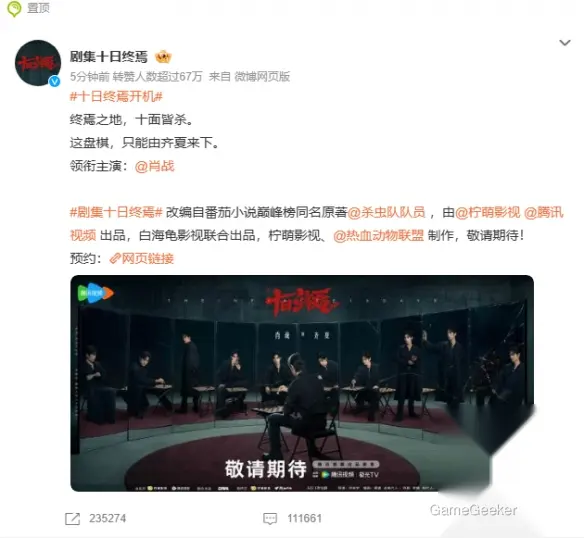
From an industry trend perspective, more and more Chinese dramas of this “high concept + strong setting + virtual production” type are appearing, but the real challenge has never been the hype at the start of filming. It’s whether, afterward, the production can clearly explain its rules, establish its characters, and land its twists. Infinite flow as a genre is a lot like a boxed-garden game: no matter how big the map is or how flashy the mechanics are, if the quest chain and character behavior aren’t internally coherent, players will quickly lose immersion. So my judgment of Ten Days to End is this: it has already pushed its art design, atmosphere, and market attention to a very high starting line; what comes next depends on whether the script and pacing can deliver on that promise.
If you usually enjoy tightly paced suspense like Reset, or have a preference for survival mystery stories with a strong sense of world rules, then this drama is worth putting on your watchlist for now. What makes it most appealing at the moment is not just star power, but the possibility that it could truly turn “Chinese-style infinite flow” into a content space that is watchable, discussable, and worth revisiting. Once it officially airs, what I’ll be more interested in seeing is not just whether individual episodes trend, but whether viewers will begin actively breaking down every rule of this “Endland” the way they would study a complex map.





Comments 0
Share your game review
Join the discussion and share your review of this game.
No comments yet. Share your review.