
News
MSI Claw 1 price hits $749 Best Buy sparking controversy
GamesRadar criticizes Best Buy selling MSI Claw A1M for $749.99, a massive hike from its previous $400 clearance price.
















If a roof tile, when viewed up close, still shows variations along its edges and corners instead of instantly blurring into a flat texture, that’s when geometric detail truly holds up. What Ubisoft has revealed this time is not just the addition of a few visual-effect filters, but a formal showcase of Micropolygons in the Anvil engine—that is, micropolygon technology—with a very clear goal at its core: bringing “cinematic-level detail” into real-time rendering.

In terms of fidelity, this technology will first be applied to Assassin’s Creed: Shadows, with the aim of capturing the intricate structures of feudal Japanese environments. The official emphasis is not on how detailed a single model can be, but on the engine’s ability to render millions of tiny geometric details at once while keeping microscopic textures and large-scale architecture at a consistent level of precision. The idea is a bit like an armored force advancing with its supply lines moving forward in sync, rather than relying on two separate systems—high detail up close and scaled-down detail in the distance—each doing its own thing.
More importantly, it attempts to reduce the visible presence of traditional LOD. In many open-world games in the past, distant and close-up scenery often felt like two units with completely different formations, making transitions painfully immersion-breaking; Anvil’s system, by contrast, emphasizes that developers no longer need to manually set LOD for near and far objects, as the system will automatically stream extremely dense asset resources. For players, the most immediate benefit is that as the camera moves forward, building surfaces, terrain contours, and decorative outlines are less likely to suddenly “pop” into different models. If this is fully implemented in the final product, my verdict would be simple: the research is solid, and the technical direction is the right one too.
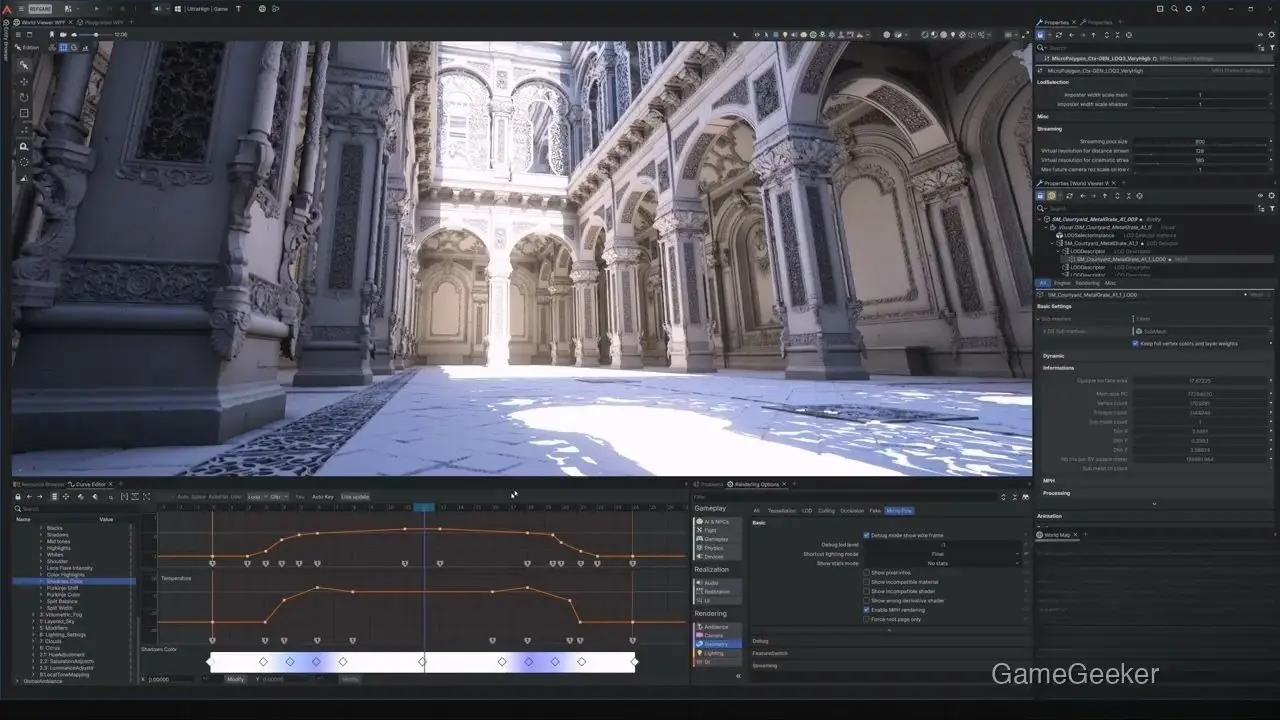
In the official demonstration, Ubisoft also used NVIDIA’s Zorah Demo to show how much geometry the system can handle, with the visuals focusing on the sense of layering in dense structures under real-time lighting and shadows. One thing to keep in mind here is that a tech demo is still not a full game. A demo scene being able to run does not mean an open world can do the same without trade-offs once AI, physics, and mission systems are added. As a longtime player, I’ve always taken this kind of showcase by first looking at the implementation path, then waiting for the final product to prove itself—I’m against hyping a concept video as if it were already battle-ready equipment.

From a tactical standpoint, this matters especially for Ubisoft. Open-world design has reached a point where simply piling on more map area is nearing diminishing returns; what truly creates separation now is whether scene assets can maintain stable precision throughout large-scale exploration. If micropolygon technology can really deliver results in Assassin’s Creed: Shadows that come close to the demo, then Ubisoft’s open worlds may indeed be entering a new phase approaching “lossless visual quality”; but if, in the end, only a handful of fixed scenes look good while the larger map still relies on traditional corner-cutting to hold things together, then that would be a textbook case of a lack of rigor.

My assessment is straightforward: this is worth paying attention to, but it’s still too early to start celebrating. For players considering Assassin’s Creed: Shadows, this technology should be treated as a key point to watch, especially the consistency of vegetation, wooden architecture, dense urban areas, and distant mountain ranges in actual gameplay. If all of those scenes can maintain their detail, then Anvil’s latest push will be more than just a slogan—it will have genuinely struck at the heart of what matters in upgrading open-world visual quality.





Comments 0
Share your game review
Join the discussion and share your review of this game.
No comments yet. Share your review.