
News
After 3 Years Offline, Marvel's Avengers Accidentally Appears on a PS Collection Cover, Sparking Debate
September 12 saw Marvel’s Avengers on a PS Store Marvel bundle cover—likely oversight—three years offline. Marvel’s Wolv
















The humanoid robot track has been very hot over the past two years, but what truly creates a gap is often not a one-time peak performance metric, but a comprehensive capability that is reproducible, autonomous, and able to complete tasks stably in complex environments. Judging from its performance in this Beijing Humanoid Robot Half Marathon qualifier, Unitree H1 looks more like a product that has already reached the second-generation validation stage, rather than just a prototype showing off its strength.

According to information released by Unitree Robotics, H1 completed the 1.9-kilometer multi-turn course in 4 minutes and 13 seconds this time, reaching an average speed of 7.51 meters per second. The key point about this figure is not just that it is fast, but that under the competition rules, it was completed fully autonomously: there was no remote control throughout the race, and no preset route. It relied on its own sensors to identify the road, avoid obstacles, and make decisions. Objectively speaking, this is more valuable as a reference than a simple remote-controlled sprint, because the organizers also explicitly stipulated that the results of non-autonomous robots must be weighted by a factor of 1.2, which is effectively a direct acknowledgment that autonomous running has a higher technical threshold.
From a comparative perspective, 7.51 meters per second already exceeds the average pace corresponding to the human world records in the 1500 meters, 1 mile, and 2000 meters, which are 7.28 meters per second, 7.21 meters per second, and 7.06 meters per second respectively. Of course, this comparison cannot simply be understood as “robots have comprehensively surpassed humans,” because the race distance, event nature, and the limits of mechanical physical capability are all different. But it at least shows that under a humanoid structure, H1’s sustained output efficiency is no longer confined to the level of a laboratory demonstration. In other words, it is beginning to qualify for a place on the main stage of the industrial narrative.
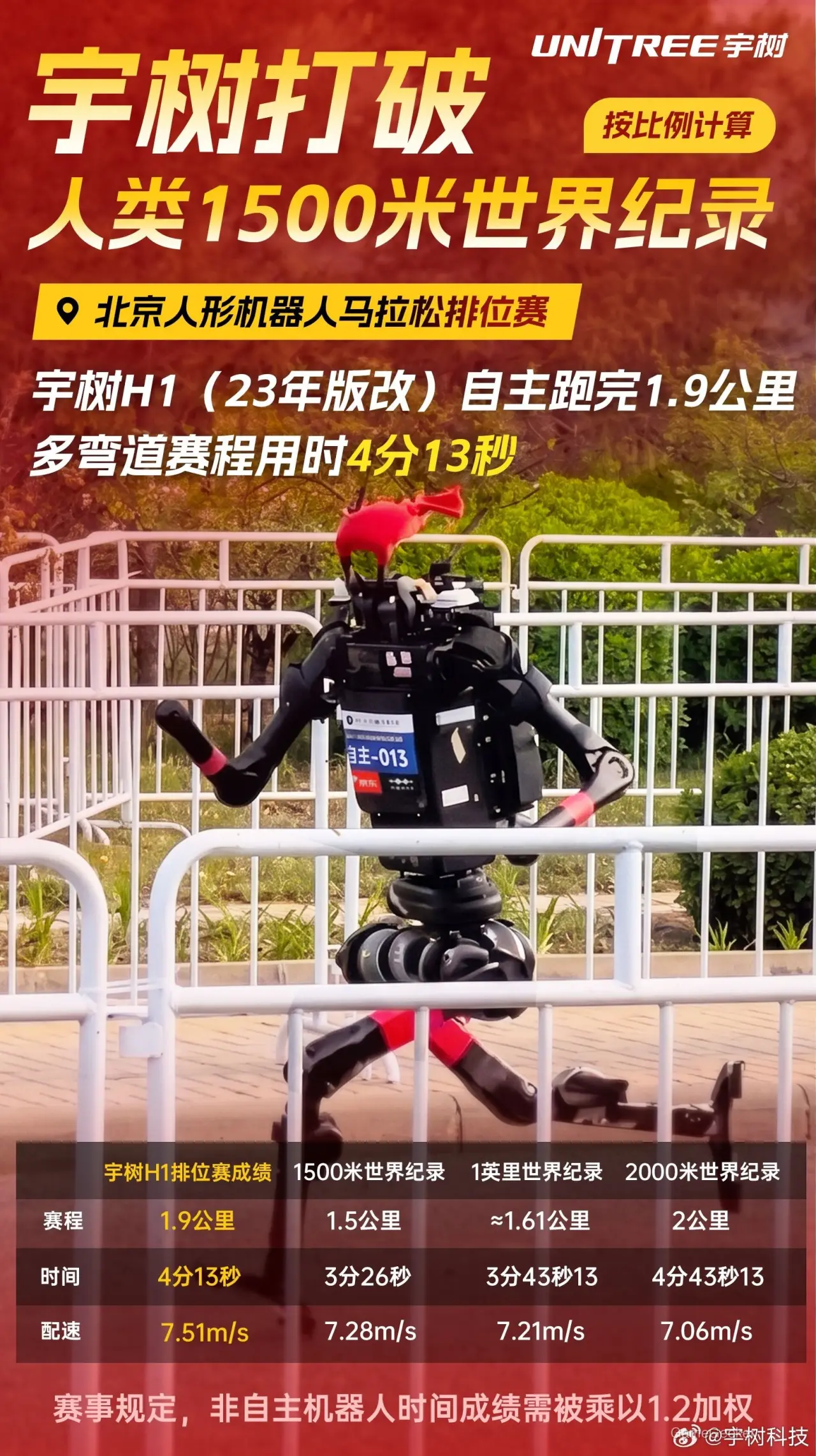
From a design perspective, H1’s hardware foundation is also fairly clear. It is about 180 centimeters tall, weighs 47 kilograms, and uses self-developed M107 joint motors and a carbon-fiber body structure. The direction is very clear: within a human-like size, reduce weight as much as possible while improving joint responsiveness. In a test video released by Unitree on April 11, H1 had already reached a peak speed of 10 meters per second; and from 3.3 meters per second at the World Humanoid Robot Games in August 2025 to the current average speed of 7.51 meters per second, its performance has more than doubled in 8 months. This scale of iteration is even more aggressive than the upgrade across an entire product generation in many hardware projects.
However, what is more worth watching at this stage is whether it can stably replicate its qualifier results over a longer distance. Unitree previously mentioned that H1’s best half-marathon result in internal testing was around 50 minutes; if it can truly complete the full 21 kilometers at this speed, its theoretical finishing time would come to 46 minutes, even lower than the human half-marathon world record of 58 minutes and 35 seconds. The issue is that 1.9 kilometers and 21 kilometers are two entirely different product tests: the former emphasizes burst performance and control, while the latter depends more on energy consumption, heat dissipation, joint lifespan, and the stability of continuous decision-making. None of these are cheap optimizations.
From an industry trend perspective, the significance of H1’s run this time may be greater than the ranking in a single race. It proves that humanoid robot racing has already begun shifting from “can it run” to “how fast can it run, how stable is it, and is it worth it.” For manufacturers, this feels a lot like the eve of consumer electronics moving from concept models to mass-production validation: parameters are starting to become concrete, and different technical routes are beginning to show clear strengths and weaknesses. The official competition begins today, with more than 70 teams competing on the same stage. What is truly worth watching is not who sprints out first, but who can keep both autonomous capability and hardware cost under control. For this category, speed is the showcase, but cost-performance is what will determine the industry pecking order in the next stage.





Comments 0
Share your game review
Join the discussion and share your review of this game.
No comments yet. Share your review.