
News
Grab two free PC games before Epic's clock runs out, while Undertale and Divinity: Original Sin 2 are 75% off
Astral Ascent and LUFTRAUSERS are free to keep today, while two of PC gaming's most celebrated RPGs cost less than $14 c
















Yesterday, while clearing out my Steam wishlist, I casually took another look around the community and tools pages. It felt a lot like discovering an unmarked path at the edge of a map. You only meant to pass by, but the more you looked, the more it seemed that Valve might not just be patching up a signpost this time—they could be adding an entirely new navigation system to the whole map. The latest leak mentions that Valve is developing an AI tool called “SteamGPT,” initially aimed at Steam customer support. But if you follow the trail a bit farther, you start to see that it could also extend into anti-cheat for CS2.

This news comes from reporting related to VideoCard, with the core evidence based on data mining and code snippets. The leaker, Gabe, posted several fields on social media, such as “Trust_GetTrustScoreInternal,” “CSbot,” “player_evaluation,” and “SteamGPTRenderFarm,” which don’t really sound like the naming of a simple chatbot. In particular, terms like “Trust” and “player_evaluation” naturally bring to mind player reputation scores, behavioral assessment, and more complex risk-control logic.
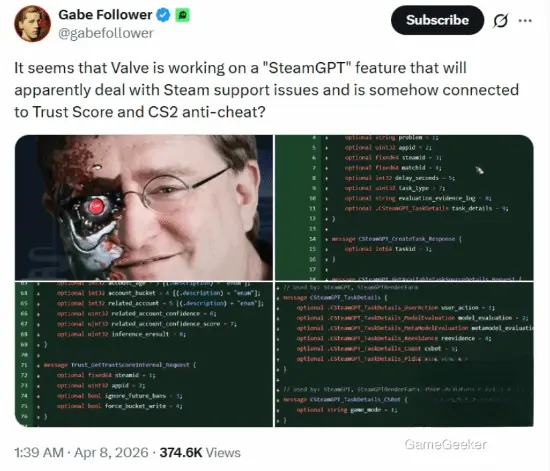
If you look at the customer support side first, it’s actually easy to understand. Right now, the most practical use of large language models is handling repetitive question triage, classifying technical support issues, and automating processing workflows. For a platform the size of Steam, being able to respond more quickly to high-frequency issues like accounts, payments, and logins would create a very obvious difference in user experience. It would be like turning a winding mountain road into a tunnel—you save not just time, but also users’ patience.
But beyond the map, what really excites players is anti-cheat in CS2. According to the leak analysis, SteamGPT may strengthen Valve’s existing VAC self-learning anti-cheat system by analyzing player behavior and report data to improve its ability to detect cheating. If this direction works out, it would be a big deal, because the most frustrating thing about anti-cheat isn’t just that bans come slowly—it’s that in many matches, you can already feel something is off in the air, while the system still seems to be standing far away watching the weather, taking forever to reach a conclusion.

From an industry trend perspective, Valve isn’t the first company to head down this road; it’s simply finally catching up to the main route of large models entering workflow automation. My view is that bringing AI into customer support will probably move forward steadily and safely; bringing AI into anti-cheat has huge potential, but it will also put greater pressure on controlling false positives and maintaining transparency. What the player community really wants is not a flashy new buzzword, but a cleaner matchmaking map: reports that get responses, abnormal behavior that can be identified faster, and legitimate players who don’t get caught in the crossfire.
So at this stage, the best attitude is still to stay hopeful—but don’t pop the champagne just yet. After all, everything so far is still based on leaks and code clues, and Valve has not officially announced SteamGPT’s features or launch plans. But looking at the direction this is heading, if it really can raise both Steam customer support efficiency and the match environment in CS2, then this new road won’t just be open—it could very well change the exploration experience of the entire platform. For someone like me who can’t stand seeing dirty spots on the map, what I most want to see is a little less of the shadow of cheating in CS2’s matchmaking list, and a few more matches genuinely worth playing through.





Comments 0
Share your game review
Join the discussion and share your review of this game.
No comments yet. Share your review.