

























Opening
Twenty minutes of work, and your siege machine looks flawless: spinning blades up front, a belly full of explosives, two rows of wheels underneath. You hit the spacebar. It lurches forward three meters, and then — with a single dry crack — it snaps clean in half at the exact spot where you ran that one beam too long. The blades spin off and decapitate your own cockpit.
That crack is not a bug. It is Besiege talking to you, telling you the beam was too long and unbraced to carry the weight up front. The entire joy of this game lives inside that sound. You are not stacking blocks; you are being schooled by honest physics, over and over, and then crawling happily back to the editor to thicken the beam, add a brace, and try again.
Besiege is the work of Spiderling Studios, a small British team that put it into early access in 2015 and spent a full five years sanding it down before the 1.0 release landed in February 2020. The shell is a medieval siege war. The core is a material-physics sandbox that, a decade on, almost nobody has matched. Here is why it earned 95% positive across more than 47,000 Steam reviews — and why it is emphatically not for everyone.
What follows is a tour through six dimensions, but keep one thing in mind throughout: in Besiege, the line between "playing" and "failing" barely exists. Every wreck is a data point, every absurd contraption a hypothesis, and the whole loop is closer to a physics lab with explosions than to a conventional game. If that sounds like your idea of a good evening, read on.
Story | 6.0/10
Fabuła: 6/10Come here for plot and you will leave thirsty. Besiege has almost no story in the conventional sense. There are four themed island nations, each with a little environmental flavor, but you will not remember a single character's name or tear up at a single cutscene. This is the one dimension it never intended to win — and yet it quietly found a different way to tell a story.
The four islands are not a narrative — they are a question generator

The 55-level base campaign spans four island nations, and they read less like maps than like four sets of exam conditions. Your objective always lands in one of four buckets: flatten a structure, wipe out the garrison, haul some cargo to a finish line, or simply survive. The terrain, weather, and enemy layout shift from island to island, the question changes with them, and the game never once hands you an answer key.
So the "script" here is not in dialogue — it is in level design. A level drops a fortified castle in front of you and says nothing about whether you should bull through with a trebuchet, strike from above with a flying contraption, or ram a bomb-laden cart straight into the gate. All three clear it. The level only sets the problem; how you solve it is your story to write. Against games that pin you to a fixed plot line, that "premise-as-narrative" approach hands you far more room to author your own run.
The only proper drama hides out on the water in The Splintered Sea

If you genuinely crave something with a beginning and an end, the 2024 expansion The Splintered Sea is the closest this game comes to having a villain. It gives you a named enemy — Admiral Drasckar and his fleet, plus the prized galleon he sails. Across fifteen oceanic levels you annihilate that fleet, go toe-to-toe with the flagship, and slip beneath the waves to dodge traps and fend off creatures of the deep.
That is the ceiling of Besiege's narrative density, and it is still feather-light. The admiral has no lines; the galleon is just a tougher target with more hit points. What makes the sea memorable is not a plot but the fact that fighting different hull types forces you to relearn how to build a boat from scratch, and a design that bullied its way through the land campaign will simply capsize the moment it hits the water. Story stays a garnish here. The machine, as always, is the main course.
And really, the deepest "narrative" in Besiege is the one you build yourself — the private epic between you and your terrible little machine, each one an arc from the first collapse to the tenth wobble to the twentieth elegant breach of a wall. Like Kerbal Space Program, the storytelling is not scripted; it is what you write across hundreds of failures. Your rocket exploding on the pad for the nth time and your siege cart disintegrating in place for the nth time are, at bottom, the same kind of story — an engineer's epic that needs no screenwriter. That is exactly why the story score sits low, and exactly why that low score misses the point: this game's ambition was never to tell you a tale. It hands you the tools and the stage, and lets the drama emerge from your own stubbornness.
Audio | 6.5/10
Dźwięk: 6.5/10The sound design in Besiege is not lavish, but it is clever in one specific way: a lot of the audio exists to inform, not to flatter. The game wires your ears straight into the physics feedback loop, so you can half-close your eyes and still know roughly what just went wrong with your machine.
Creaks and that one snap are your machine filing a status report

Overload a structure and it starts to groan and warp first — a warning that something is about to give. The real break is a clean, dry crack. Spend enough hours here and you develop a reflex: a groan means add a brace, a crack means that run was wasted. Using audio as a dashboard is of a piece with the whole "the crash is the lesson" philosophy that runs through the game. Explosions, impacts, and metal scrape all carry their own signatures too, so a charge mid-assault tells you by ear whether the explosives went off, the armor took a hit, or a wheel is just spinning uselessly in place against a wall. After a while you stop watching the machine and start listening to it, the way a mechanic diagnoses an engine by sound alone. Sound here is a channel, not a decoration.
Half the slapstick is something you hear, not see

Underneath everything, Besiege is physical comedy, and comedy lives or dies on timing — half of which is carried by sound. Garrison troops launched screaming on a parabolic arc, a castle coming down in a chain of detonations: those destruction effects, married to the exaggerated ragdoll physics, manufacture a kind of absurd, deeply satisfying payoff. You will replay your last charge again and again partly because that little "boom-boom-clatter" is so cathartic.
The music, by contrast, is deliberately quiet — a light, unobtrusive bed in the background that leaves your full attention on the building and the tinkering. That is a choice, not laziness: a game that demands intense focus while you tweak parameters has no business burying you under a bombastic score, and any composer who tried to make this soundtrack "epic" would simply be sabotaging the very concentration the game runs on. The restraint is the design. The 2024 expansion adds new water and wave layers for its naval levels, thickening the ambience a touch, but the philosophy holds: the soundscape stays a servant, never a star.
Set it beside Kerbal Space Program and the two share almost the same audio instincts: functional effects over melody, the roar of an engine and the crunch of a breakup carrying the show. Neither game wants a hummable theme; both want you to trust your ears as an instrument panel. So this dimension does not dazzle, and a 6.5 is an honest number for it — the sound was never built to move you, only to tell you how your machine is doing right now. Judged on that narrow brief, though, it succeeds completely, and you would miss it the moment it was gone.
Visuals | 7.0/10
Grafika: 7/10Besiege does not try to seduce you with its looks. The art is clean, plain, low-poly — no photoreal textures, no extravagant lighting. Hold off on the deduction, though, because that visual style is doing one very specific job: making it instantly obvious how force travels through your machine and where the structure is about to fail.
The plain art exists so you can read the load

Photorealism smears information together with texture, shadow, and effects. Besiege runs the other way on purpose: it keeps the picture simple so that every beam, every hinge, every joint stays legible. When your structure begins to deform, you can see precisely which piece of wood is bending, how far, and which connection is starting to loosen. The art is not ornament — it is an engineering blueprint that happens to move, and it puts "readable" ahead of "pretty," which is a remarkably clear-headed trade.
The engine underneath is Unity. The picture itself is unremarkable; what actually eats the performance budget, and what is genuinely the technical heart of the thing, is the real-time material physics simulation running behind it. Render light, spend the compute on physics — a trade that fits the game's whole purpose. You are not here for scenery. You are here to watch your machine and figure out why it keeps collapsing.
The frame where a beam bows and snaps is the most information-dense image in the game

If you had to pick the single most screenshot-worthy moment in Besiege, it would not be some glamour shot. It would be the frame where a wooden beam bows slowly under load and finally tears apart at the point of greatest stress. That is stress visualization: the game turning an abstract physical quantity into deformation you can see with your own eyes. You never need a data panel — the direction and arc of the bend tell you where to add support and which beam to swap for a sturdier material. This "image as feedback" design is the real craft hiding under the modest art, and it is why veterans will tell you that watching your machine break is, in itself, a pleasure. The failure is rendered so legibly that it reads as a diagnosis rather than a defeat, which is a small miracle of restraint.
On consoles, 4K at 60fps makes the falling-apart look better

There are real differences across platforms. The PS5 build runs at 4K and 60fps, and the extra fidelity makes the chaos of exploding debris and disintegrating machines genuinely more watchable — when everything comes apart more crisply and smoothly, the absurd thrill of destruction scales up with it. The Switch handheld mode drops some fidelity but, thanks to dragging parts around directly on the touchscreen, plays surprisingly well and has been called a solid port for a nine-year-old PC game. Lined up against Kerbal Space Program, it walks the same road: art ceding ground to physical legibility, chasing comprehension over spectacle, trusting that a clear picture of cause and effect is more compelling than a pretty one. So a 7.0 here does not mean the visuals are weak — it means they carry a quiet, function-first intelligence whose entire reason for existing is to help you be the engineer. Plenty of prettier games tell you less; Besiege's plainness is doing real work on every frame, and once you understand that, you stop wishing it looked like something else.
Combat | 9.0/10
Rozgrywka: 9/10This is where Besiege earns its 9.0, and where it genuinely stands tall. The short version: other building games let you assemble a machine, while Besiege makes you build one that actually works by the laws of physics — and falls apart by them too. The gap between those two verbs is enormous. One is arranging parts into a pleasing shape; the other is asking whether that shape can actually bear the load, transmit the force, and survive its own first movement. Everything good about this game flows out of that single, unglamorous distinction.
A crash is not a fail state — it is the game's teaching method

The core mechanic fits in one line: materials have real physics. Wood has a strength limit, and run it too long and heavy and it bends visibly before tearing apart at the point of greatest stress. Metal is sturdier but heavier, dragging on your power and balance. Ballast lowers the center of gravity to stop a tip-over, but pile on too much and the thing won't move. You are not snapping together Lego; you are doing structural engineering, and a trebuchet arm without a diagonal brace will twist the whole frame into a pretzel the instant it swings.
That is precisely the irreplaceable part: the crash itself is the lesson. No written tutorial teaches "brace it here" as effectively as watching your own machine shear off at a beam. Failure is not punishment; it is information, pinpointing exactly what went wrong, so you go back to the editor, fix that specific thing, and run it again. That build-test-collapse-fix loop will swallow whole evenings for anyone who likes to tinker.
Seventy-plus blocks, from trebuchets all the way to mechanical spiders

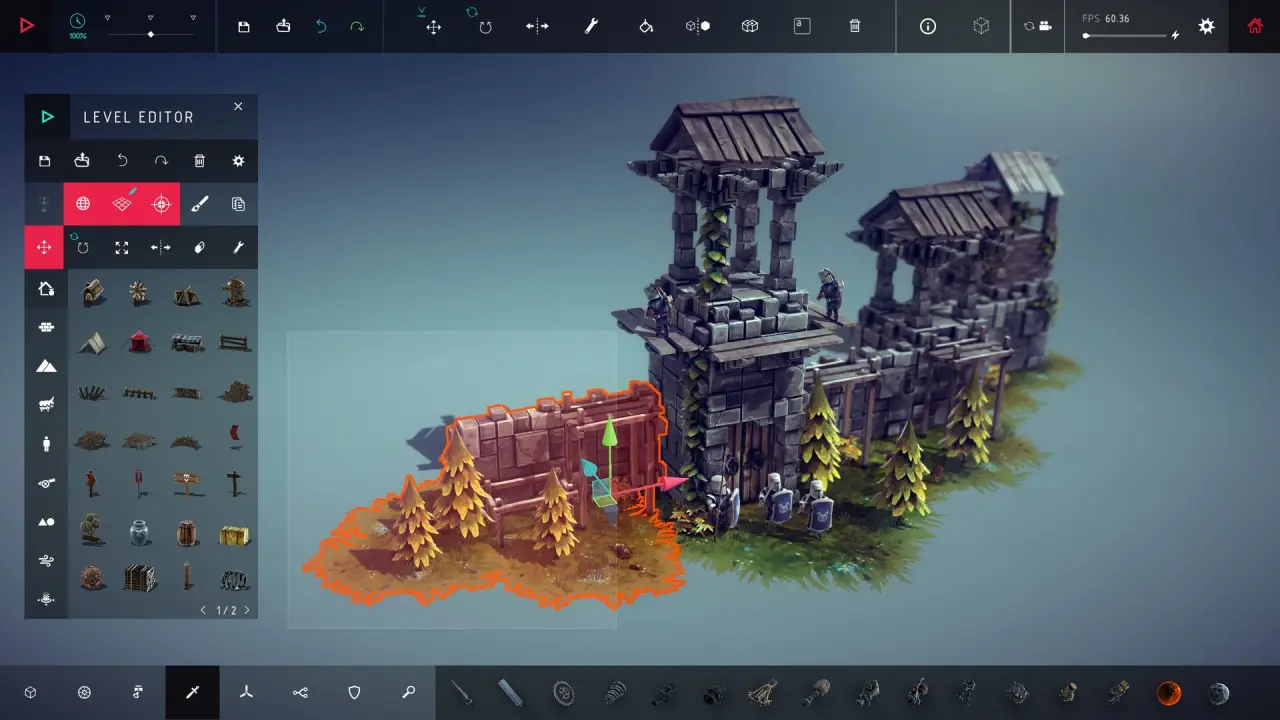
Holding the whole thing up are more than 70 building blocks. From the basics — wooden blocks, wheels, motors — out to flamethrowers, explosives, hinges, and armor, and on to the logic gates and sensors added in the full release. The breadth of that parts library sets the ceiling on your imagination: people build trebuchets and siege towers, tanks and helicopters, and walking war-machines that stride on two mechanical legs while spitting fire and whirling blades. Each part carries its own physical properties — motors have torque, hinges rotate, ballast has mass, springs store energy — and it is the combination that produces behavior you never quite predicted, the emergent kind that makes you laugh out loud. If it holds up physically, the most ridiculous idea in your head can be assembled, block by block, in the editor, and then watched as it either works or self-destructs spectacularly.
Many solutions, one premise, your call every time

The cleverest design in the 55-level campaign is that it never gives you a model answer. Same castle: one player batters it from range with a giant ballista, another flies a drone around to strike from behind, a third just rams a bomb-stuffed cart in and goes out in a blaze — and you can probably invent a fourth. That open-endedness is the cleanest dividing line between this and ordinary puzzle games. A puzzle game waits for you to find the single answer its designer hid, and walls you off until you do; Besiege waits for you to invent an answer it never even considered, and the wilder your creativity, the more gloriously absurd your victory. Fixed premise, open solution — that structure lets a single level become a completely different story in two different players' hands.
The price of that depth is real: it does not hold your hand

In fairness, this depth comes at a cost. The campaign barely teaches you anything; newcomers stall on the first few levels in that fog of "I know I need to build something, but I have no idea where to start." The camera and controls take time to settle into. And grind the campaign back to back and the late levels start converging on the same solutions, which gets stale. These are genuine barriers, and players who don't enjoy tinkering may well put it down inside two hours. But set it next to its most direct rival, Kerbal Space Program, and the cleverness shows: Kerbal's learning curve is a heavy meal — grand in scope, steep at the door — while Besiege slices the same hardcore engineering into bite-sized, level-by-level puzzles you can pick up and drop at will. It didn't lower the depth of the engineering; it just paved the front steps flatter. That single move is what turns "being an engineer" — normally a thing that scares people off — into something genuinely addictive. You arrive thinking you are here to win a level, and you leave having accidentally learned why bracing matters, where mass wants to go, and how torque fights gravity, all without a single line of instruction. Few games teach so much while pretending to teach nothing.
Content | 6.5/10
Zawartość: 6.5/10On content, Besiege is a fascinating case. Judge it by the base campaign alone and it is merely ordinary in size; fold in the Steam Workshop and it becomes effectively bottomless. The gap between those two numbers is the key to understanding the whole game.
Fifty-five levels in the box, done in a few evenings

The base campaign runs 55 levels across four island nations, with a main-story length of roughly nine hours — a few evenings and you are through. On its own that figure does not stand out among indies at this price, and that is exactly where the critics docked points: a thin campaign with late levels that converge and repeat is the main reason its scores sit between 77 and 85. If you buy it to clear it once and walk away, you will find nine hours a light meal for a building game. But this is the easiest place to misjudge it. The campaign was never the whole of Besiege's content — it is more a story-wrapped tutorial and inspiration sampler, teaching you how the physics plays and showing off the level types. The part that pulls people in for hundreds, even thousands of hours, all sits after the credits.
Two hundred thousand Workshop machines are the real reason it has lasted a decade
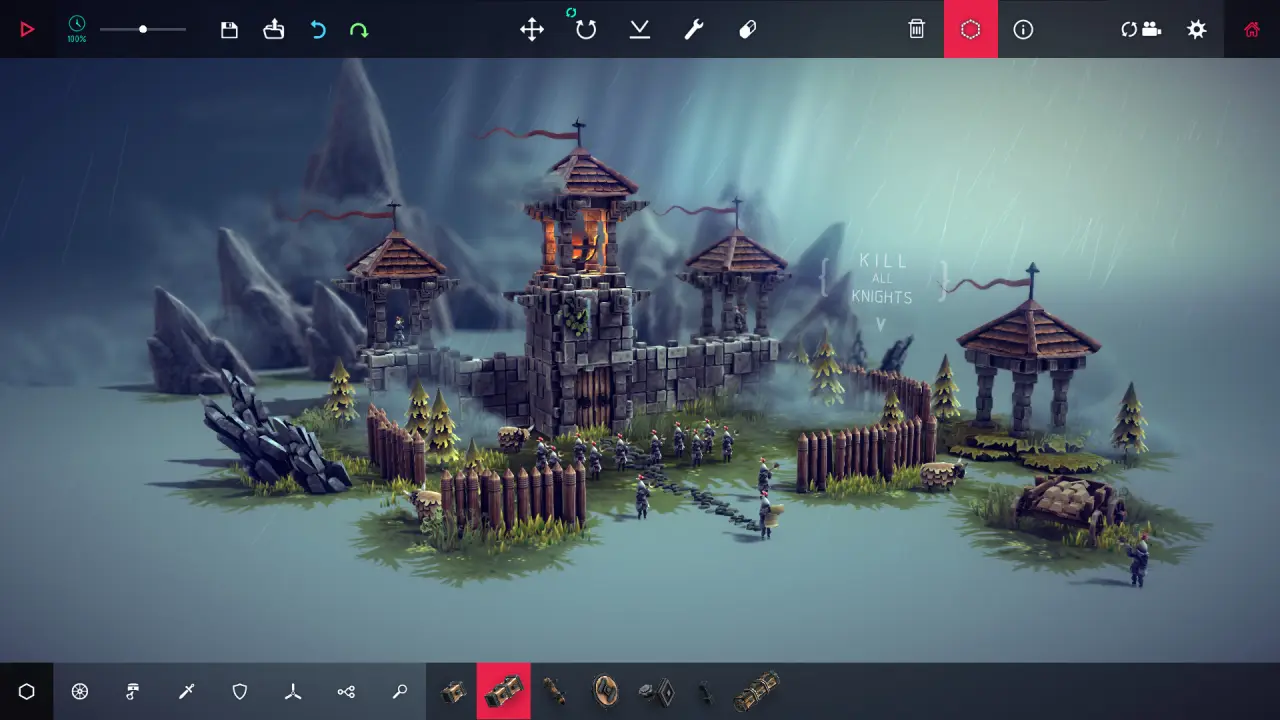
Open the Steam Workshop and you find over 200,000 community machines, plus an uncountable pile of player-made levels. Someone recreates a real-world feat of engineering, someone else builds a fully automated war machine that auto-targets and auto-fires, another person specializes in cruel trap levels, and yet another spends hundreds of hours assembling a mechanical clock that actually keeps time. That long tail is the root of why Besiege's reputation has not slipped in ten years. The box gives you 55 levels; the Workshop turns that into a practical infinity — you download someone's genius contraption, take it apart to learn why it moves, and rework it into your own version, and that reverse-engineering loop is content that never runs out. Plenty of people pour far more time into the Workshop than into the campaign itself, and a sizable subculture treats building elaborate machines as the entire point, ignoring the campaign almost completely. Judge the game by what its community actually does with it, and "thin on content" becomes a strange thing to say.
The Splintered Sea is the one expansion, and it gives the game water

The 2024 DLC, The Splintered Sea, is a substantial addition. It bolts a whole layer of water physics onto the game — different hull shapes meet different drag, density decides whether you float or sink, build too heavy and you go straight to the bottom, too light and the waves flip you, and a high-speed slap onto the surface carries real impact. With it come fifteen oceanic levels, a brand-new sandbox, and eight new blocks purpose-built for naval warfare: floats, a rudder, a spear launcher for engaging enemy ships, and more. It sits at 86% positive on Steam. Tellingly, the developers have said it was precisely the paid-DLC model that made all that costly water physics financially viable — for a small independent team, that is the practical answer to how it keeps updating after a decade.
Multiplayer and co-op editing add a social dimension
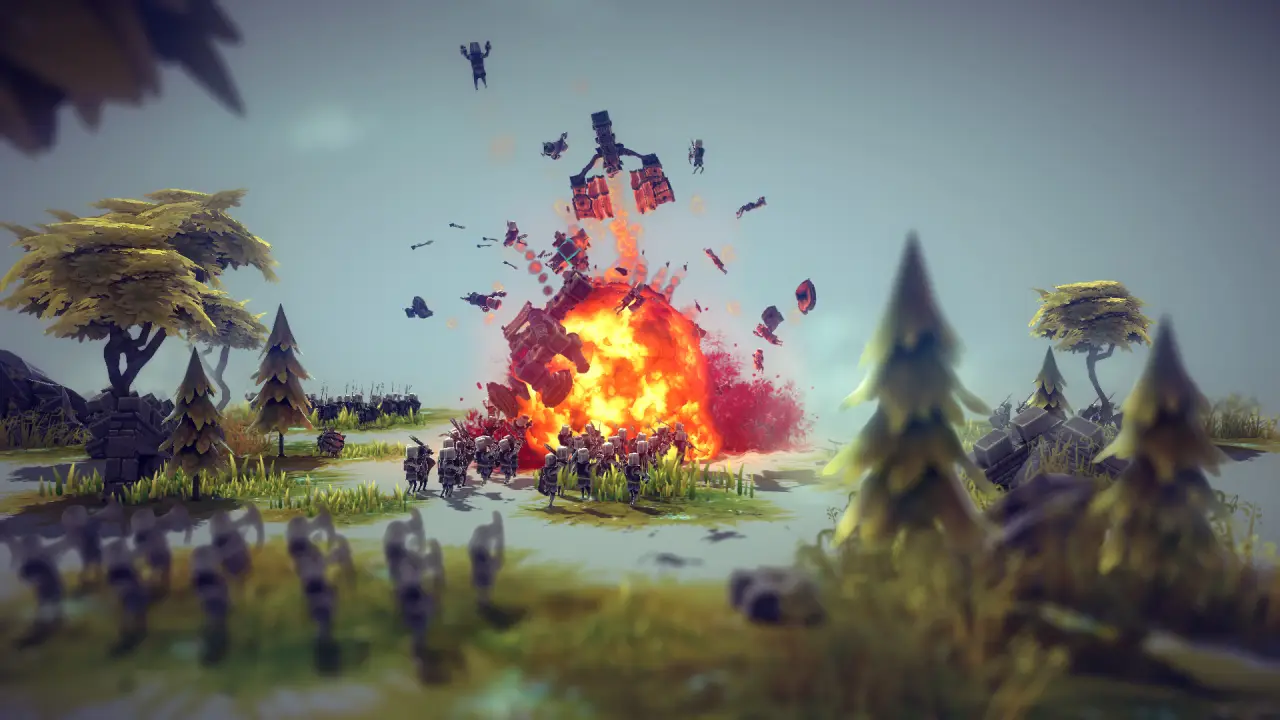
The 2020 Multiverse update brought in multiplayer for up to eight players, so you can drag everyone's machines out and smash them together. Better still, the level editor itself is collaborative — you and a friend can edit the same level at once, one of you test-running it locally in Ghost Mode while the others keep editing on the server, no interruptions. That turns building from a solitary act into something you tinker at together. There is a trap to clear before buying, though: the console versions (Xbox, Switch, PlayStation) include all 55 campaign levels but cut the level editor and multiplayer and leave out The Splintered Sea entirely. Console players get a "complete campaign, gutted long tail" edition, which is fine if 55 levels is all you want and a genuine loss if it isn't. As with Kerbal Space Program, the true volume of Besiege rests on the Workshop and the sandbox — only here the levels are smaller and easier to digest, so you can dip in for fifteen minutes or vanish for a weekend. So the 6.5 is aimed squarely at the base game in the box, while the real content ceiling, the one measured in community uploads and your own half-finished projects, sits well above that number.


Komentarze 0
Chętnie poznamy Twoje zdanie
Witaj! Napisz, co sądzisz o tej grze — pierwsza osoba może się mile zaskoczyć.
Nie ma jeszcze komentarzy. Napisz, co sądzisz o tej recenzji.