



















Opening
Most blockbusters open by handing you power. Red Dead Redemption 2 opens by taking it away, slowly, over fifty hours, until all you have left is a dying man watching the sun come up.
In October 2018 a single screenshot — a horseman in mud and gunsmoke against a snowbound ridge — saturated every feed on the internet. Eight years later the game behind it has quietly climbed to eighty-five million copies sold, the third best-selling game in history behind only Minecraft and Grand Theft Auto V. That number is not the reason to play it. It is the receipt for a gamble: Rockstar bet, in the year of the Ubisoft icon-cleanup open world, that players would sit still for a slow Western about a gang dying out of its own era. The bet paid, and the industry is still catching up.
The story starts with a botched ferry heist and ends with Arthur Morgan swallowing his last breath facing a sunrise. The Van der Linde gang retreats southeast out of the Blackwater snowline — Horseshoe Overlook, Clemens Point, Saint Denis, and finally the collapse at Beaver Hollow. Rockstar does not let you play the winner. It makes you witness the dissolution of a time: the West is ending, Dutch's anarchist dream is curdling into paranoia, and you, as Arthur, are the muscle who slowly realizes the cause is already lost. The genius is that the game tells you the ending in the first hour — tuberculosis, decline, death — and still makes the fifty-hour walk toward it the most-felt arc in the medium.
This review covers the game as it stands in 2026: the 2019 PC version as the canonical platform, with notes on the still-missing current-gen 60fps patch and the long-abandoned online mode. The deck leans hard toward story and craft. That is the deck Rockstar dealt. Saddle up; the ride is long, deliberate, and the slowness is the point.
Story | 9.9/10
Fabuła: 9.9/10Red Dead Redemption 2 tells you how it ends in the first chapter — Arthur Morgan is going to die — and then spends fifty hours making you feel every step toward it. That is the trick no other open world has matched.
Arthur Morgan's death march is the most complete protagonist arc in the medium

Arthur contracts tuberculosis midway through the campaign, and from that diagnosis the writing turns the entire back half into a man reckoning with the life he chose. Roger Clark won the 2018 Game Awards Best Performance for the role, and the award was for the arc, not a single scene — the slow shift from gang enforcer to a man trying to do one decent thing before the end. The honor system makes this literal: a high-honor Arthur and a low-honor Arthur get different dialogue, different final-chapter behavior, and different deaths. Most games offer a protagonist you steer. RDR2 offers one you grieve.
What makes the arc land is the journaling. Arthur keeps a diary that updates after major beats, sketches and all, and reading it is optional — which means the players who do read it are choosing to sit with his interior life. The diagnosis scene itself is staged without melodrama: a doctor's office, a quiet verdict, Arthur walking out into a street that has not changed while everything inside him has. From there the writing lets him be afraid, then bitter, then slowly generous, never rushing the turn and never letting it feel earned by a single redemptive gesture. It is the rare game arc that treats death as a process rather than a cutscene, and the fifty hours of accumulated small choices are what give the final chapter its weight.
The gang's collapse is the spine. Six chapters and two epilogues track the Van der Linde gang from its Horseshoe Overlook peak — when Arthur brawls in Valentine saloons, breaks wild horses, and robs trains, and the player mistakes the whole thing for an open-world power fantasy — down through escalating desperation to the Beaver Hollow dissolution. There is no victory state. The writing refuses to let the gang win, because the historical thesis is that men like them were already obsolete. You are not playing the rise. You are playing the end.
Saint Denis is the chapter where the West dies on screen

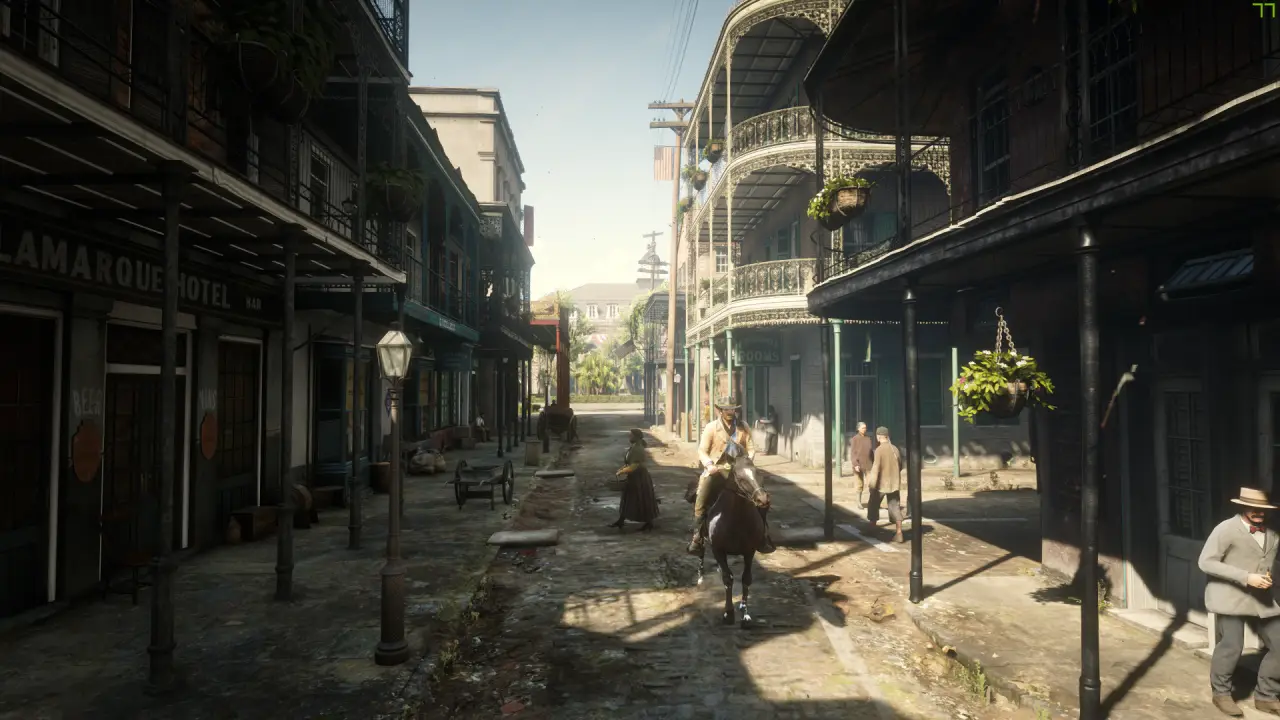
Chapter 4 drags the outlaws into Saint Denis, the game's one true city — streetcars, electric lights, banks, a stock-hatted capitalist class, the full apparatus of the industrial revolution rendered in front of men who still settle disputes with revolvers. Rockstar spends an entire chapter pressing the gang's anachronism into Arthur's face. The thematic hinge of the whole game lives here: the frontier is not being lost in a gunfight, it is being paved over by trolleys and ledger books, and no amount of Dead Eye fixes that. It is the rare AAA set piece that advances theme rather than spectacle. The contrast is staged visually as well as narratively — Arthur in his trail-worn coat standing on a paved boulevard, dwarfed by a building with electric lighting, looking like a man who has wandered out of his own century. Dutch's response to the city is to plan ever-larger scores, refusing to read the writing on the wall, and the chapter quietly establishes that his leadership has curdled from vision into denial. The player feels the gang's doom settle in not through a death but through an architecture: the West that made these men possible is already gone, and Saint Denis is its gravestone.
Sixty Strangers, each written like another game's main quest

The Stranger side-quests — roughly sixty of them — are written to a density that other RPGs reserve for their critical path. The traveling preacher, the Civil War veteran haunted by what he did, the taxidermist, the lovesick rancher: each is a complete short story with a beginning, a turn, and a cost. Rockstar did not treat them as filler between mission markers. They treated them as the texture that makes the world feel inhabited rather than decorated. Several of them span multiple chapters, with a stranger reappearing hours later in a changed circumstance that only resolves if the player tracked them down across the map — a structure that demands the player care enough to follow up. The most-cited example is the tragicomic arc of a man documenting American wildlife who slowly reveals himself as a danger to it; another follows a feud that ends in a way the player's choices genuinely shape. None of these are required, and that is the point: the writing budget was spent on content most players will never see, which is the clearest signal of a studio writing for the world rather than for the trailer. The epilogue extends this further — thirty hours as John Marston rebuilding a farm, a second full-size game bridging directly into the opening of the original Red Dead Redemption. The grief of Arthur's death is given somewhere to go: into the slow, quiet labor of building a home, and into the dramatic irony that anyone who played RDR1 knows exactly how John's story ends too.
Audio | 9.7/10
Dźwięk: 9.7/10The audio in Red Dead Redemption 2 won the 2018 Game Awards Best Score, and the most impressive thing it does is know when to stop playing.
Woody Jackson's score doubles the density and never loops

Woody Jackson returns from the 2010 original and keeps the same noir-Western foundation — upright bass holding the floor, harmonica and brass for color, the occasional long electric-guitar wail — but roughly doubles the density. RDR2 carries about two hundred independent dynamic music segments, stitched in real time according to where the player is, the time of day, the story chapter, and even the gait of the horse. No segment loops. The engine assembles the score the way the world assembles itself: continuously, responsively, without the seams showing. It is the most ambitious adaptive-music system of its console generation, and it earned the award on technical scale alone before you even reach the artistry. The instrumentation was recorded with the musicians playing in the same room rather than tracked separately, a choice that gives the score a loose, human swing instead of grid-locked precision — you can hear the players breathing with each other. Jackson also tuned the whole soundtrack to a slightly flat, dusty timbre that matches the period and the palette, so the music sounds like it was recorded in 1899 even though the adaptive engine behind it is bleeding-edge. That marriage of antique tone and modern technology is the score's quiet thesis.
The boldest design choice is silence
Jackson's nerviest decision was to let the music drop out entirely. The Saint Denis daytime market has no score — only voices, hooves, and streetcar bells. Arthur's lone sixth-chapter ride toward Beaver Hollow runs on wind and the horse's labored breath. Rockstar and the composer agreed on a rule: when the image is already speaking, the music yields. That restraint is what makes the cues that do land hit so hard — the score is a guest that knows when to leave the room, and the silence becomes its own instrument. The contrast also does narrative work: the busiest, loudest place in the game is the industrial city that is killing the gang's way of life, and the quietest moments are the ones closest to Arthur's death. Sound and silence are mapped to the theme, not just to the action.
The vocal songs are their own achievement. Original tracks like "That's the Way It Is" and "Unshaken" drop at precise story beats, scored to land as the player rides toward an irreversible turn, and they function the way a needle-drop functions in prestige television — a single song that crystallizes a chapter's emotional thesis. Rockstar commissioned these rather than licensing existing music, which let the lyrics speak directly to Arthur's situation without the dissonance of a recognizable pop song pulling the player out of 1899.
Voice, foley, and platform audio

Roger Clark's Arthur anchors a voice cast that, like the writing, trims rather than reaches — performances built on what is withheld. The performances were motion-captured with the actors playing scenes together on a volume stage, so the timing and overlap of dialogue feel like conversation rather than recorded lines stitched in a booth. The foley is sampled to a paranoid degree: boot crunch differs across snow, mud, and board sidewalk; a gun report echoes differently across canyon, forest, and open plain; the click of a revolver cylinder is its own recorded sound, not a stock asset. On PC and current-gen back-compat the mix scales up to Dolby Atmos, and the spatial separation in a firefight — knowing where a flanking shooter is by ear before the screen tells you — is dense enough to play tactically. Eight years on, the audio is the pillar that has aged the least, because adaptive systems and good silence do not date the way a static loop does. If any single craft area makes the strongest case for RDR2's enduring quality, it is the sound — it is the part that still has no peer in the open-world genre.
Visuals | 9.8/10
Grafika: 9.8/10Eight years after launch, Red Dead Redemption 2 is still the open world other studios get measured against, and the reason is that it was built as geography rather than as a checklist.
Five states organized by transition, not by icon-spam

The map covers five fictional states — Ambarino, New Hanover, Lemoyne, West Elizabeth, New Austin — across roughly seventy-five square kilometers. Rockstar did not flood it with Ubisoft-style icons. They organized it by geographic transition: northern snow peaks, central plains, southeastern swamp, southern desert, each flowing naturally into the next. Ride half an hour south from Valentine and you watch the vegetation, the ground texture, and the animal species all change together in a continuous gradient. The world is legible as a place, not as a service menu, and that single design decision is why it has aged better than nearly everything released since. The transitions are engineered down to the soil: the snowline does not cut off abruptly but thins into alpine scrub, then pine forest, then grassland, the way a real continent's biomes blend at their edges. Each region also carries its own light — the cold blue of the Grizzlies, the golden haze of the Heartlands, the green murk of Lemoyne's bayou — so that a screenshot's location is identifiable by color temperature alone. This is the kind of art-direction discipline that does not announce itself but accumulates into a world that feels continuous rather than zoned, and it is the foundation everything else in the graphics pillar is built on.
Density drops north to south, and that is the point

The map's density decreases deliberately from north to south. The northern snow chapter has almost no NPCs — snow and wind build the isolation that the gang's flight demands. The central plains and the towns of Valentine and Rhodes manufacture the bustle of the gang's golden age. The southeastern city of Saint Denis crams streetcars, electric lights, banks, a Chinatown, and a theater into the only true metropolis in the game. The density is authored to match the emotional arc — loneliness, then community, then the suffocating modernity that ends the Western. Map design as narrative pacing is rare, and RDR2 does it across the entire play space. The geography also rewards the patient traveler with discovery rather than markers: a hermit's cabin, a crashed wagon, a hidden cave painting, a stranger in distress — none flagged on the minimap, all found by riding and looking. Rockstar trusted players to explore without breadcrumbs, and the trust pays off in the specific pleasure of stumbling onto something the game never told you was there. That restraint — the confidence to leave the map quiet — is the part competitors find hardest to copy, because a quiet map looks empty in a feature comparison even when it is the richer design.
Eight-kilometer draw distance and an ecosystem no one has copied

Two hundred-plus animal species, cross-map weather systems, and an eight-kilometer draw distance combine into an open-world ecosystem that no AAA has replicated in the eight years since. Predators hunt prey whether or not the player is watching; a storm seen on the horizon arrives minutes later; a deer carcass attracts scavengers in real time. The 2019 PC version raised draw distance and unlocked framerate beyond the console caps, and it remains the canonical platform for that reason. The one honest caveat is that there is still no native PS5 or Xbox Series X 60fps patch as of 2026 — the single most-requested community fix, and the only place the game's technical ambition shows its 2018 birth year.
The photo mode and cinematic camera are the final proof of the art direction's robustness: the world holds up at any framing, any time of day, any weather, because it was built to be photographed rather than merely traversed. Players have spent eight years filling photography forums with RDR2 stills that still look like a current release. The detail budget runs absurdly deep — horse coats grow muddy and then clean as you brush them, snow compresses under hooves and fills back in, NPCs in towns recognize Arthur if he wears the same coat twice, and mud splatter on a coat dries to a different color over a few in-game hours. None of these systems advertise themselves. They simply accumulate into a world that feels observed rather than decorated, and that texture is the part competitors keep failing to budget for, because it does not show up in a trailer — it shows up in the fortieth hour when you realize the game has been quietly tracking things you never asked it to.
Combat | 8.2/10
Rozgrywka: 8.2/10Red Dead Redemption 2's gameplay is the most divisive thing about it, and the 8.2 score is honest: the systems are deep and deliberate, and the deliberateness will lose some players in the first week.
Dead Eye is a combat system bound to a dying man

The combat shell continues the original's third-person over-the-shoulder Western shooting with Dead Eye time-dilation, but the core is rewritten on Euphoria physics. Dead Eye is a five-tier progressive system: tier one auto-slows and auto-marks; tier two lets you mark manually without showing vitals; tier three reveals red kill-points; tier four grades them; tier five opens only after Arthur's tuberculosis worsens, letting you see internal organs for precise shots. Rockstar bound the unlock to the story as a metaphor — the closer Arthur gets to death, the more clearly he can deal it. It is the cleanest fusion of mechanic and narrative in the game. The progression also doubles as difficulty scaffolding: early Dead Eye is forgiving enough to carry a new player through the learning curve, and by the time the higher tiers unlock the player has internalized the manual aiming the system was quietly training. Most games gate power behind XP; RDR2 gates it behind mortality, so that the mechanical reward and the emotional arc tighten together. By the final chapters, aiming down an enemy in slowed time while Arthur coughs blood between shots is a gameplay loop and a character beat at the same instant.
Euphoria physics give the heaviest hit-feedback of its generation
Shoot an NPC and they do not drop on a canned animation. They stagger backward, clutch the wound, stumble against a railing, and fall in a way computed live from the shot's angle and force. The Euphoria physics give RDR2 the heaviest per-shot hit feedback of any game of its era, and it is the reason gunfights feel consequential rather than arcade. Every body has weight; every hit has a reaction; nothing is a ragdoll afterthought. The system extends beyond combat: a horse stumbles on uneven ground, a drunk Arthur sways and trips, a man shot in the leg drags himself toward cover. Because the physics are simulated rather than animated, edge cases produce emergent moments no designer scripted — a wounded enemy crawling for a dropped revolver, a body tumbling down a ravine with believable momentum. This is the layer that makes violence in RDR2 feel weighty and slightly sickening rather than satisfying, which is exactly the tone a game about a dying outlaw wants. The gunplay is not built to feel good; it is built to feel like consequence.
The weight, the menus, and the one-week acclimation tax
This is where RDR2 divides its audience. The controls carry deliberate weight and friction — Arthur turns like a real two-hundred-pound man, looting has an animation, the six-layer radial weapon menu takes a week to internalize. Efficiency-first players raised on snappy modern action will bounce off this hard inside the first ten hours, and that reaction is legitimate. The game is asking for an acclimation tax most blockbusters refuse to charge. If you pay it, the weight becomes immersion; if you do not, it reads as sluggishness. There is no settings toggle that resolves the mismatch — it is the design. The choice is philosophically consistent with everything else in the game: Rockstar wanted the player's hands to feel the era's slowness, the way a horse must be coaxed rather than driven and a rifle must be cleaned rather than reloaded with a button. The friction is an argument that immersion is worth more than convenience, and it is the single most-debated design decision in the game's history. Reasonable players land on opposite sides, and both are right about their own experience — which is why the gameplay score sits at 8.2 rather than higher or lower. It is a deliberate, divisive, defensible 8.2.
Honor and the camp survival sim underneath the shooter
The systems most reviews under-credit are the slow ones. The honor system shifts story, dialogue, and ending based on whether you greet, antagonize, rob, or defuse — verbs most action games omit entirely. Beneath the shooter sits a survival-sim layer: Arthur's cores and stamina deplete, you eat and sleep and maintain weapons, the camp has an economy you fund and provision. None of it is mandatory on lower difficulties, but engaging it is where the world stops being a backdrop and starts being a place you live. The depth is optional, which is exactly why the players who find it rate the game a 10 and the players who skip it rate the combat a 6.
The interaction system deserves its own credit. Press a button near almost any NPC and Arthur can greet or antagonize, and the exchange escalates believably — a polite nod defuses a tense moment, a sneer starts a bar fight, a drawn weapon empties a street. Robberies can be talked down or shot out. Witnesses report crimes to law that pursues across the map with bounty posters. These are not scripted set-piece interactions; they are a systemic web that responds to how the player carries themselves, and the same encounter plays out differently depending on Arthur's reputation in that region. It is the connective tissue that turns the shooter and the survival sim into a single coherent world, and it is the layer that the players who fall in love with RDR2 are actually falling in love with.
Content | 9.4/10
Zawartość: 9.4/10Eighty hours. That is the typical complete playthrough of Red Dead Redemption 2, and the unusual part is that the last thirty arrive after the protagonist you spent fifty hours with is dead.
Fifty-hour main plus a thirty-hour second game
HowLongToBeat puts the main story at roughly 48.5 hours — about twice the length of a same-generation AAA campaign. Then the epilogue adds another thirty hours as John Marston rebuilds a ranch, a stretch many players do not realize is coming until they are inside it, collecting what amounts to a full bonus game. Rockstar designed the epilogue deliberately as long-tail companionship: it gives you time to climb out of Arthur's death, and it uses John's farm-building to push the Western timeline forward into the opening of the original Red Dead Redemption. The length is not padding; it is grief management with a gameplay loop. The epilogue's tonal shift is the proof of intent — after the operatic collapse of Arthur's chapter, the game hands you fence posts to hammer and cattle to herd, and the mundanity is the medicine. A lesser studio would have ended on the emotional peak and rolled credits; Rockstar understood that the player needs the same decompression the character does, and built thirty hours of quiet labor to provide it. It is one of the boldest structural decisions in any blockbuster, precisely because it risks boring the player in service of an emotional truth.
Dramatic pacing across the chapters
The pacing distribution is unusually theatrical for an open world. Chapters one through three slow down and let you live the gang's daily rhythm — camp chores, hunting, small heists. Chapter four's Saint Denis suddenly accelerates, pressing industrial modernity into Arthur's face. The final chapters collapse toward Beaver Hollow with a momentum that most games cannot sustain because most games front-load spectacle. RDR2 saves its heaviest emotional beats for hours forty through eighty, betting that the player who stayed will be rewarded. The bet is why the ending lands the way it does. This is the inverse of standard AAA pacing, which spends its budget in the opening hours to hook the player and then coasts; RDR2 deliberately under-sells its first ten hours and over-delivers in its last twenty. The structure is a filter — it sheds the players who want immediate spectacle and keeps the ones who will be there for the payoff, and the design accepts that trade openly. It is also why word-of-mouth on the game skews so heavily positive among people who finished it and so mixed among people who bounced early.
Commercial scale and the one content failure
Eighty-five million lifetime sales make RDR2 the third best-selling game in history, behind only Minecraft and Grand Theft Auto V. The single-player has zero post-launch story DLC — the base game is the complete product, no season pass, no upsell, which in 2026's live-service landscape reads as almost quaint generosity. The one clear content failure is Red Dead Online: the standalone multiplayer mode stopped receiving content updates in 2022 and has been effectively abandoned, leaving players who bought it alone feeling stranded. If you are buying RDR2, buy it for the single-player campaign and treat the online mode as a defunct bonus, not a reason to purchase.
The replay question is worth addressing because the answer is unusual for a story game. RDR2's honor system, optional Stranger quests, and missable encounters mean a second playthrough genuinely diverges — a low-honor run reframes Arthur's entire final act, and the sixty Strangers are far more than any single playthrough surfaces. Most narrative-heavy games are one-and-done; RDR2 holds up to a second pass because the world keeps revealing systems and stories the first run never touched. Combined with the eighty-hour base length, the total engaged time for a completionist comfortably crosses a hundred and fifty hours, which recontextualizes the price entirely.
The value math is straightforward: the game frequently drops below twenty dollars in Steam seasonal sales, and eighty hours of the best-crafted open world of its generation at that price is among the strongest dollar-per-hour returns in AAA gaming. The PC version is the canonical platform for framerate and draw distance. The only caveat that keeps this from a perfect content score is the missing current-gen 60fps patch and the abandoned online mode — both platform-and-service issues, not flaws in the game itself.




Komentarze 0
Chętnie poznamy Twoje zdanie
Witaj! Napisz, co sądzisz o tej grze — pierwsza osoba może się mile zaskoczyć.
Nie ma jeszcze komentarzy. Napisz, co sądzisz o tej recenzji.