





















Opening
Most games announce danger with a swell of music. Resident Evil announces it with a door. The first time you push through one of the mansion's tall wooden doors and the camera cuts to that slow, fixed opening animation, nothing has actually happened yet, and that is exactly why it works. You are not allowed to rush. You can only watch the latch turn while your imagination fills the gap, and the design quietly trains you to dread the next room before you have even seen it. By modern standards the trick looks almost clumsy. It is also one of the most honest pieces of pacing the genre has ever produced, because the unease comes from your own anticipation rather than from anything on screen.
That patience is the whole point. Scarce ammunition, restricted saves, and a steady drip of hostiles combine into a single feeling that the game protects above all else: the hesitation of someone who would really rather not waste this one round. The best part of Resident Evil is not the creatures or the puzzles. It is the moment of arithmetic you run in your head before you commit to anything at all. Should I take this fight, or slip past it? Do I still have a healing herb if this goes wrong? That arithmetic is the texture of the experience, and it is what separates surviving from simply clearing rooms.
What is remarkable is how the mansion turns that hesitation into momentum. You pick up a key and immediately remember a door three corridors back that would not open. You hear a shuffle down a hallway and your first instinct is not to aim but to count your supplies. Progress feels like working a puzzle box, prying it open one panel at a time, and the level structure pulls you deeper without ever padding itself out with filler. It is old. Genuinely, unmistakably old. But some of these old ideas have not aged out so much as gone unreplaced, waiting under flashier packaging for someone to notice they still hold.
Story | 7.0/10
Fabuła: 7/10A remote mansion, a viral experiment, a corporate conspiracy: this skeleton went on to become one of the most enduring opening chapters the series ever produced. The strength of Resident Evil's narrative is not that it tells a complicated story. It is that the mystery advances with real momentum. You genuinely want to know what happened in this place, who is hiding what, and which of the people around you is only pretending to be calm. That sense of a truth being peeled back one layer at a time is welded directly to the act of exploring the map, so the plot never floats off as detached supplementary reading.
A mystery welded to the map
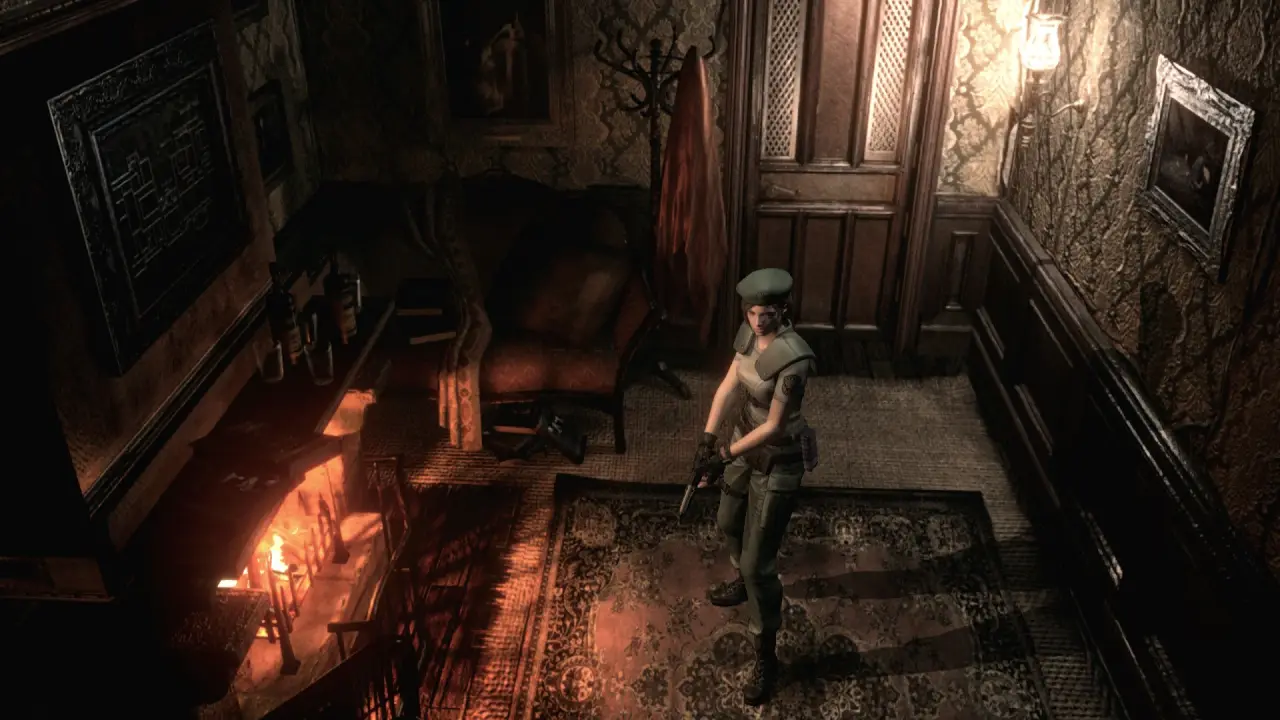
The smartest decision the storytelling makes is to refuse the cutscene as its primary engine. Instead, revelation and traversal move in lockstep. A locked wing you could not enter an hour ago suddenly matters because a document just told you why, and the geography of the house becomes the geography of the plot. This is why the suspense lands so cleanly: you are not waiting passively for the next scripted beat, you are walking into it. The image of an armed figure on guard while a tense companion follows close behind captures the narrative posture exactly. Words are few. The unease is worn openly on the face instead, and the story trusts your attention to assemble the meaning rather than spelling it out. The effect is a plot you uncover with your feet, which keeps the dread personal and immediate in a way a passive cutscene never could. Because the pacing of the story is yours to set, every revelation arrives already weighted with everything you risked to reach it, and a note found in a back room hits harder than any monologue because you paid for it in nerves and supplies. The mansion becomes a slow confession, given up room by room, and the slower you go the more it seems to be hiding.
Characters with edges, dialogue without polish
Honesty requires admitting where it shows its age. The text and the dialogue carry an unmistakable early-game-era stiffness. The character archetypes are vivid and several beats are genuinely memorable, but once you get down to the actual lines and the dramatic tension between them, a strong period flavour sets in. It does not exactly break the spell, yet it would be generous to call it nuanced. The practical effect is clear enough: the story is more than capable of pulling you forward through the night, but it is unlikely to leave you turning the relationships over in your head long after the credits. Think of it as a competent genre screenplay. The structure is legible, the mood lands where it should, and the lines are best not scrutinised too closely. That is not a failing so much as a boundary, and the game stays comfortably within it. The voice acting and the script were products of their moment, and you can feel the studio reaching for a cinematic register the technology of the day could not quite deliver. The strange thing is how little it matters in practice. You remember the situations far more than the sentences, the dread of a hallway rather than the wording of a warning, and the writing earns its keep by setting scenes in motion rather than by lingering in them.
Worldbuilding by fragments
Where the writing genuinely shines is in how it completes its world through scattered documents. Fragmentary information thickens the sense of conspiracy and leaves deliberate room for players who want to dig. A figure staring at an old photograph, an emotionally heavy blur of a shape lingering in the background, these are precisely the images this game's narrative voice was built for: not grand performance, but a trail of small clues that walks you toward the truth one step at a time. Set against the lingering psychological aftertaste of a title like the Silent Hill remake, this is more direct and less haunting; set against the second-game remake, it has less sheer scale. It is watchable. It is properly classic. Just do not expect its storytelling to leap past the era that produced it, and you will find a foundation that has aged with far more dignity than its dialogue alone would suggest. The fragments reward patience rather than demanding it, so a player who skims will still follow the thread while a player who reads everything is quietly rewarded with a fuller picture of the conspiracy. That two-tier design, a clear surface plot with a deeper layer waiting underneath, is exactly the kind of restrained worldbuilding the genre would spend the next two decades refining.
Audio | 8.5/10
Dźwięk: 8.5/10Plenty of games use music to tell you when to be afraid. Resident Evil does something colder and more effective: much of the time it tells you nothing at all. Ambient hum, stretches of silence, the rhythm of your own footsteps, the distant rasp of something unseen, these stack into a low and continuous pressure that never quite releases. Quiet, here, is the loudest tool in the kit. Walk a corridor with nothing but the sound of your own movement and any stray noise gets magnified out of all proportion, the way a held breath makes your heartbeat impossible to ignore.

Silence as the sharpest instrument
The most distinctive choice the sound design makes is restraint. Rather than scoring every room with menace, it leaves long passages almost bare, like the deliberately lingering empty shots in a tense film that refuse to cut away. That emptiness is not a shortcut or a limitation of the hardware; it is the whole strategy. By withholding the cue you would normally lean on, the game hands the work of dread back to you, and your own anticipation does the heavy lifting. It tightens your nerves first and only later confirms that the worry was justified. There is no full-orchestra swell to flatten the mood into something legible. There is space, and space turns out to be far more unsettling than any sting, because your imagination fills it faster and more cruelly than any composer could. The few stretches that do carry music feel earned precisely because the game spent so long saying nothing, so a single sustained note in an otherwise silent wing reads like a warning rather than a flourish. That contrast is the entire trick: deny the player the cue they expect for long enough, and the absence itself becomes the cue, until you find yourself bracing against quiet the way you would brace against a scream.
Sounds that do a job
What elevates the design above mere atmosphere is how functional the audio is. The creak of a door becomes a reflex trigger; you learn to hold your breath at it without deciding to. Footsteps give the space physical dimension, telling you how large a room is and where its edges lie before your eyes confirm it. And the rasp of an unseen hostile makes the not-seeing scarier than the seeing ever could, because a thing you can hear but not locate occupies far more of your attention than one standing plainly in front of you. The score, when it appears, is similarly economical, arranged less to be pleasant than to park anxiety in exactly the right place and leave it there. Every sound is pulling double duty, and that economy is precisely why the soundscape still reads as deliberate rather than dated. Even the small mechanical noises, an inventory shuffle, the click of a lock, the soft chime of a save point, are placed to give the world weight and to remind you how fragile your position is. Nothing is decorative. The audio is constantly feeding you information about space, threat, and consequence, and because it never wastes a sound, you learn to trust it completely, which is exactly what makes it so easy to terrify you when it finally chooses to.
How well it holds up today
Played now, the sound design remains genuinely effective, and in some respects it understands restraint better than a good many contemporary releases that mistake volume for tension. The honest caveat is one of fidelity. Constrained by its era, the audio simply cannot match the layering and finish of later benchmarks, and if you set it beside a series successor like the second-game remake the difference in texture and polish is plain. That gap exists and it is fair to acknowledge it. But it does not undermine the achievement, because the design grasps the one thing that matters most about frightening sound: make the listener start imagining first, and the unease will arrive on its own. On that fundamental, the original still teaches a lesson many newer games have yet to learn. It is the rare soundtrack that becomes more impressive the more you understand about how sound design actually works, because so much of its power comes from what it chooses to leave out. A modern remaster could add layers and clarity and lose the whole point in the process. The genius is in the discipline, and discipline is the one quality that does not date, which is why a listener coming to it cold today can still feel their shoulders climb toward their ears in a corridor where, by every technical measure, almost nothing is happening at all.
Visuals | 6.5/10
Grafika: 6.5/10Judged purely on artistic temperament, this game still carries a hard, sombre charge. Pre-rendered backgrounds, fixed camera positions, and dim, close spaces combine into something that looks like the set of an old genre film: you know full well it has been composed and arranged, and you get caught by the composition anyway. Firelight rakes across a corridor, a laboratory hides in shadow, and the crypts and flooded passages drag the oppression to its limit. A grim laboratory where you stumble onto a warped hostile is the textbook example, because the scene unsettles you a beat before the creature in it ever does.

Composition over horsepower
The visual value here was never about raw technical muscle, and understanding that is the key to grading it fairly. What the art direction does brilliantly is staging. Every fixed angle is a chosen frame, and the designers use that constraint as a weapon rather than apologising for it. They decide exactly what you can see and, more importantly, what you cannot, so a doorway becomes a held breath and a stairwell becomes a question. Light is rationed as carefully as your ammunition: a single source pushing back a wall of dark does more for the mood than any amount of detail could. The flooded conduits and the firelit halls are not impressive because they are dense with geometry; they are impressive because they are composed like photographs, every element placed to make the space feel like it is watching you back. The fixed perspective, so often treated as a limitation, is really the source of the whole effect, because a camera you do not control is a camera that can hide things from you on purpose. The designers knew exactly where your eyes would land and built every shot to exploit it, tucking a threat just outside the frame or framing an empty room so it looks anything but safe. That authorial control over what you see is something free cameras gave up, and it is a large part of why these old, static rooms still manage to unsettle players raised on far prettier ones.
The weight of its years
The problems are sitting right there in the open and there is no point glossing over them. By any modern measure the presentation is plainly old. Character models and animation are visibly bound by the limits of their time, and now and then the figures and the backgrounds sit slightly apart from one another, the seam between a flat painted backdrop and a polygonal body showing through. A convincing atmosphere does not make the underlying visuals advanced. The real cost lands on the barrier to entry: a newcomer will not necessarily find it beautiful at first glance, and may well trip over the period look before the atmosphere has a chance to take hold. That is a genuine hurdle, though not a fatal one, because the things the art is actually good at survive the dated surface entirely intact. The pre-rendered backdrops in particular are a curious case: frozen in time, they cannot be patched or upscaled into something modern, yet their craft was always in the painting rather than the polygon count, and a well-composed painted room ages far more gracefully than a low-detail model ever could. The friction, then, is concentrated almost entirely in the moving parts, the figures and their stiff animation, while the static stages hold up surprisingly well. Knowing where to look forgiveness on, and where not to, is half the work of meeting an old game on fair terms.
Grading a classic honestly
This is the awkward part of assessing any genuinely old game. It has been on the market far, far longer than the five-year mark past which nostalgia stops being a valid excuse, and you can neither inflate its score on sentiment nor pretend its era never existed. Measured against its own contemporaries, its scene art and brooding atmosphere are genuinely representative of the best of their day. Measured against what a player actually experiences in front of a screen now, it struggles to hold a high mark. The heroine standing in a dim, flooded passage with the oppression all but spilling out of the frame proves the point in both directions at once: hold your eye on the staging and it still grips, then shift your attention to the way the character moves and the years catch up instantly. You can see the quality of the bones. You can also only really call it good bones, and against a modern benchmark like the Dead Space remake the distance is hard to ignore.
Combat | 9.0/10
Rozgrywka: 9/10The single thing that has weathered the decades best is the survival loop at the core of Resident Evil. Resource management, puzzle-solving, and rationed combat are not three separate features bolted together; they are interlocked so tightly that pulling on one immediately tugs the other two. You cannot play it as a shooter, because there is never enough ammunition to indulge that fantasy. You cannot play it as a pure puzzle game either, because hostiles keep leaning on you while you think. The result is a discipline of proportion, closer to cooking than to action: too little restraint and the dish has no flavour, too much and it burns.

The economy of every single round
Ammunition is the currency the entire design is denominated in, and the game never lets you forget it. Picking up a handful of handgun rounds feels like a small windfall precisely because you have learned not to expect it. That scarcity reframes every encounter as a negotiation rather than a reflex. A lone creature blocking a hallway is not a threat to be erased; it is a bill to be paid, and you are constantly deciding whether the toll is worth it or whether you can squeeze past and keep your reserves intact. This is where the fun actually lives. The pleasure is not in fluid shooting, because the shooting was never meant to feel fluid. The pleasure is in the weighing. Once you internalise the economy, you start to enjoy the tension of a near-empty inventory the way a poker player enjoys a thin stack, reading the room and committing only when the maths finally lines up. It is a loop that rewards restraint, punishes panic, and turns even an empty corridor into a small test of nerve.
A mansion that grows in your head
The level design earns just as much credit, and it does so by refusing to be open. There is no map smeared with question marks, no waypoint dragging you forward. Instead the mansion uses a quiet language of locked doors and matching keys to keep your curiosity taut: remember this room now, come back to it later. When a new item lands in your inventory, three old routes light up in your memory unprompted, and you find yourself navigating from recollection rather than from a minimap. That is the mark of genuinely good level architecture, the kind where the map seems to grow inside your head rather than on the screen. Jill standing in a panelled corridor with firelight pressing back the dark, unsure whether the next room is safe but unwilling to bet on it, is the loop at its most seductive. The space itself becomes the puzzle, and solving it feels like authorship rather than instruction. There is a particular satisfaction the design keeps returning to: the moment a new item snaps a half-remembered dead end into sense, and a whole region of the house you had written off suddenly reopens in your mind. The mansion is essentially one large interlocking mechanism, and progress is the slow, deliberate act of working out which piece turns which other piece. Because so little of this is signposted, the understanding feels hard-won and entirely yours, and that ownership is exactly what keeps you pressing deeper even when every instinct says to turn back.
Where the friction starts to show
It is not flawless, and pretending otherwise would do the game a disservice. The fixed camera angles and the early-era control logic create a layer of friction that the tension has to share space with, and sometimes you lose a fight to the era rather than to the creature in front of you. The effect on the experience is real and worth naming: for anyone raised on modern action games, the opening few hours are not especially welcoming, and the controls can feel like an obstacle the design never intended. Yet this never tips into a fatal flaw, because the core appeal was never about feeling smooth. It was about the weighing. Push through the adjustment period and you stop fighting the controls and start savouring the pressure of having to think every single step through. The scene in the dining hall, cornered at close range by two hostiles, captures it bluntly: it is not that you have no firearm in hand, it is that you do not dare to spend what is in it.
Content | 6.0/10
Zawartość: 6/10A single playthrough is not especially long, and in the present day that fact will disappoint some players outright. If you have grown used to modern releases that routinely offer dozens of hours of main story, sprawling side content, and lists of collectibles to tick off, the scale here is going to feel pointedly restrained. The density that does exist comes from puzzles, the locked-door structure, hidden items, and the replay value baked into multiple character routes and multiple endings. The watchword is not "a lot." It is "tight."

Tight rather than large
That compactness brings real advantages, and they are easy to undervalue in an era that equates length with worth. You never lose your focus in a thicket of inconsequential side errands, and the pacing of your progress stays relatively concentrated as a result. The repeated traversal of the mansion's wings is itself a form of content reuse done well: the same route plays differently depending on the state of your resources and the state of your nerves, so a hallway you have crossed five times can still produce a sixth crossing that feels new. A corridor viewed through the lens of content tells the whole story. There is no carpet of interaction prompts here. What actually holds the experience up is spatial relationship and risk assessment, not the sheer count of things to touch, and that is a deliberate trade rather than an oversight. The game is short the way a tightly edited film is short, with very little it could afford to cut, and that economy is increasingly rare in a medium that often mistakes runtime for value. Every room earns its place, every detour has a reason, and the absence of busywork means the tension never gets a chance to dissipate into errands. You are always either solving, surviving, or weighing your next move, and the compactness is precisely what keeps all three of those states pressed up against one another instead of letting any of them go slack.
What the routes and endings really add
The reuse is genuine, but it is worth being precise about how much it delivers. The two main character routes give you meaningfully different runs through the same space, and the multiple endings reward players who care about how a run resolves. For a particular kind of player, the one who likes to study an optimal path and compress resource usage to the bone, this is deeply absorbing, the sort of thing that turns a short game into one you happily return to. For everyone else, the structure adds variety without quite manufacturing a second full game. That is the honest middle ground: the replay scaffolding is real and well made, but its pull is conditional on whether route optimisation is a hobby you actually enjoy, and the game makes no attempt to pretend otherwise. What the second route really changes is your relationship to the space rather than the space itself, since you arrive at familiar rooms with different tools and different priorities and have to renegotiate paths you thought you had solved. For the optimiser that is a genuine second campaign hiding inside the first. For the player who simply wanted to see the mansion once, it is a generous bonus they may never feel compelled to claim. Both readings are valid, and the game is honest enough to let the depth stay optional rather than forcing it on everyone who finishes a single run.
Who its size will and will not satisfy
The flip side is equally clear. Compared with modern productions, the overall scale really is on the small side, and while the multiple routes and endings raise its longevity, they do not always fully offset the feeling, after a first clear, that you have seen most of what there is to see. The consequence is that the appetite for replay is selective. People who enjoy dissecting routes and squeezing their inventory will be hooked; people who do not may feel the content run dry fairly quickly. This is not a serious defect, but it is enough to pull the game back from "essential" to "worth a try." Classic it remains, but do not picture an enormous all-you-can-eat buffet. Picture instead a deliberately portioned old-fashioned set meal where the knife work, not the quantity, is the point, much as a more atmospheric piece like Amnesia trades volume for precision of effect. The right frame for it is appetite rather than running time: if what you want is a dense, deliberate, perfectly portioned survival experience, the length is exactly correct, and padding it would only dilute what makes it work. If what you want is sheer quantity, a long checklist of things to do and find, this was never built to satisfy that, and no amount of route variety will change it. Knowing which of those two players you are tells you almost everything about whether the size will frustrate you or feel like a feature.





Komentarze 0
Chętnie poznamy Twoje zdanie
Dołącz do dyskusji i podziel się opinią o grze.
Nie ma jeszcze komentarzy. Napisz, co sądzisz o tej recenzji.