

















Opening
Thirteen years is a long time to keep a fanbase waiting, and Space Marine 2 spends every minute of that patience in a single, overwhelming image: hundreds of Tyranids cresting a ridge at once, and you, two and a half metres of ceramite, standing in the middle of it like a breakwater that refuses to move.
It does not try to reinvent the third-person action game. It does something narrower and far harder. Saber Interactive built a proprietary Swarm Engine for one purpose — to put that many enemies on screen and let them behave like a tide rather than a backdrop — and then welded it to the weight of a Space Marine. The result is a scale no rival in the genre can currently match, and it is the thing this review keeps circling back to.
The numbers give you the coordinates. Metacritic 82, OpenCritic 81 with an 86 percent recommend rate and a Strong tier badge. This is not a flawless masterpiece. But on the lane it picked for itself, it is running almost unopposed.
Story | 8.0/10
Fabuła: 8/10A disgraced hero earning his name back, one battlefield at a time

You play Demetrian Titus, an Ultramarine returning players will remember, and the sequel hands him a genuinely dramatic predicament. Once accused of corruption and stripped from Captain down to Lieutenant, he marches back into the war carrying a rank that says, plainly, that his own side does not fully trust him. The whole emotional spine of the campaign hangs off that single line — a man wronged, proving himself the only way a Space Marine knows how, with action.
This is not complicated storytelling, and it does not pretend to be. What it is, is well executed. Titus is no chatterbox lead; his conflict lives in silence, in the repeated choice to be first into the breach even when nobody has cleared his name. The two battle-brothers at his side share both his combat rhythm and a quiet friction with him — that small fracture between comrades is exactly what keeps a trio of armoured giants from collapsing into faceless soldiers. Gamersky's 8.2 called this the most "faithful" Warhammer adaptation in years, and a lot of that faith comes down to the fact that the characterisation simply does not break. The writing trusts you to read restraint as depth rather than spelling every feeling out, which is exactly the right register for a protagonist whose defining trait is that he endures. There is a real arc buried under the armour here — not a flashy redemption with a tidy speech, but the slow, grudging way a chapter learns to look at one of its own without doubt — and the game is patient enough to let it accumulate across missions rather than resolve it in a single cutscene.
A mid-campaign pivot that keeps the run from going stale
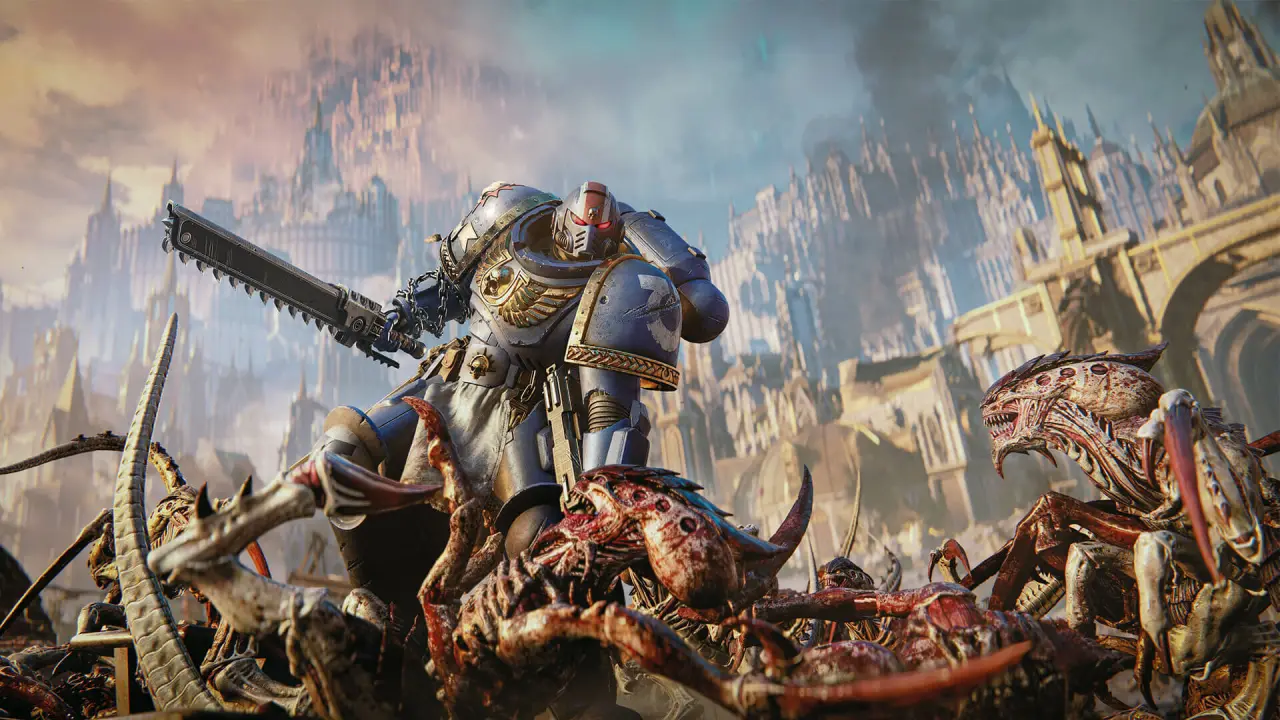
The campaign runs around ten hours across nine missions and three planets, and for the first stretch your enemy is the Tyranid swarm — that screaming, screen-filling tide that sets the whole "one against a hundred" tone. Then, somewhere past the midpoint, the opposition quietly changes hands to the Thousand Sons of Chaos. The swap is not cosmetic. The Thousand Sons do not pile onto you like the swarm; they hang back, they pressure you from range, and they force you to abandon the bulldozing rhythm the first half rewarded. The aesthetic shifts, the combat logic shifts, and a linear ten-hour run suddenly has a second flavour right when fatigue would otherwise creep in. The Thousand Sons also drag a thread of cosmic horror into what had been a straightforward bug hunt — warp sorcery, unnatural geometry, an enemy that schemes rather than merely swarms — and that tonal escalation gives the back half a sense of rising stakes the opening planets never quite promise. For a story this short, spending limited runtime on a genuine turn instead of more of the same is the smartest thing it does, and it is the difference between a campaign you finish and one you actually remember the shape of afterward.
Lore in service of the story, not stacked on top of it

The chronic disease of Warhammer adaptations is treating the setting as a flex — cramming in proper nouns to test how much codex you have memorised. Space Marine 2 is far more restrained. It lovingly renders the Imperial Guard, the Dreadnought walkers, the iconography — but every piece of it serves one goal: making you believe you are standing in the forty-first millennium, not quizzing you on it. For veterans the details are knowing winks; for newcomers they never become a wall. There is no homework before the cutscenes make sense. The harder truth to flag is the tone, which stays clenched the entire way through — grimly, relentlessly serious, with almost no room to breathe or crack a joke, and the story is a single straight line with no branches and no alternate endings. Set against the original from thirteen years ago, this is a clear step up in density and character work; judged against the narrative heavyweights of the genre, it is a sturdy war record rather than a writing masterclass. I score the story an 8.0 — faithful, grounded, genuinely felt, and best measured by the bar it actually set for itself.
Audio | 8.0/10
Dźwięk: 8/10A score that carries the dread instead of selling the hype

Nima Fakhrara handles the music, and he pointedly avoids the swelling, fist-pump theme you might expect from a power-fantasy shooter. Instead he lays down something heavy and oppressive, a low rumble that tightens your shoulders the moment a horizon's worth of enemies starts pouring toward you. The music here is not decoration; it is an amplifier bolted onto your nervous system. It suits the cold, enormous register of the Warhammer universe, rising with the worst of a battle and pulling back in the gaps so that you feel, accurately, like a small thing inside an enormous war. It is not a soundtrack you will queue up on its own — but inside the game it earns its keep many times over, chasing the right atmosphere rather than a memorable hook, which for a game built to bury you on a battlefield is the more important job. There is a particular cue that hits when you are left alone facing an oncoming wall of bodies, a slow, almost ceremonial figure that hoists the lonely defiance and the tragedy of the moment together, and it lands an emotional weight the visuals on their own could never supply. That restraint is a choice, and it is the right one; a more triumphant score would have sold the fantasy and undersold the horror, and this game has always understood that the horror is the fantasy.
Mandarin voice work that turns up as an actual selling point

For Chinese-speaking players the sleeper highlight is a full Mandarin dub, and a good one — the word choices land on the translations local audiences already know, so nothing snags or breaks immersion. Where it really shines is character: the dub gives each class a personality rather than just a line read. Reviewers keep singling out the Heavy's barks in Operations mode, that gravelly, gallows-humour cadence that builds a character in three sentences flat. You will pick a class partly to hear more of them talk. In too many big releases the local dub is the throwaway option you switch off in five minutes; this one is good enough to make you switch to it on purpose, and that sincerity is worth a mark on its own. The performances understand the source material, too — there is a difference between an actor reading sci-fi lines and an actor who grasps that these are zealots, sworn to a god-emperor and resigned to dying for him, and the cast plays the second register. That conviction bleeds into every grim aside and every clipped battlefield order, and it is a large part of why the squad chatter never tips into camp even when the dialogue veers toward the operatic. It is rare for a localisation to add character rather than merely preserve it, and this one does.
Impact feedback and the soundstage of scale
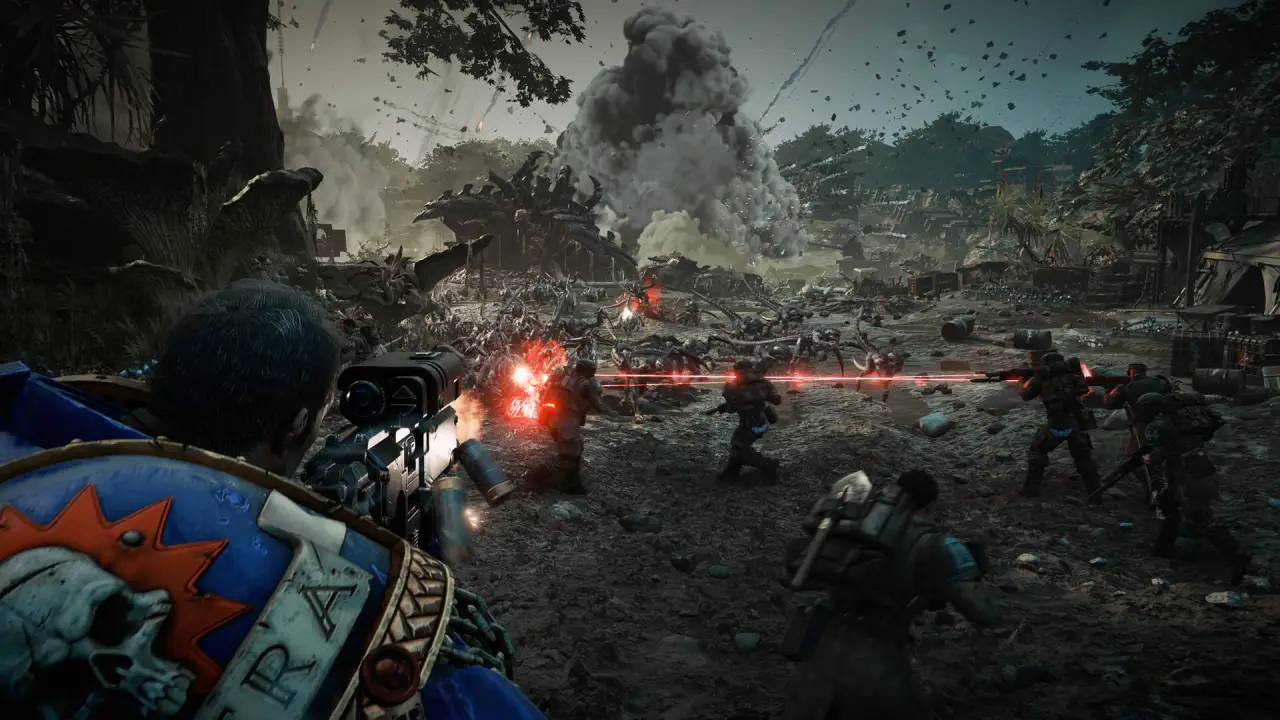
A large slice of the combat's punch is held up by sound. The thick report of ranged fire, the metallic bite of a melee swing, the muffled thud as a finisher lands — every hit is delivered with real heft, and the audio gives the violence a believable weight the visuals alone could not. The ambient soundstage does the other half of the work of scale: when hundreds of enemies churn on screen, that dense, all-directions wall of noise stacks another layer of pressure on top of the picture, and you can genuinely read where a threat is coming from in a chaotic melee. Play on PS5 and the controller's haptics push the force of every finisher and every parry straight into your palms, with different gear giving distinct feedback — a platform-exclusive layer that makes the simple fact of holding something heavy feel tangible. I score audio an 8.0: solid, well matched, generous in its localisation, held back only by a score that has not quite reached standalone-signature territory.
Visuals | 9.0/10
Grafika: 9/10The Swarm Engine puts "hundreds" into a single, honest frame
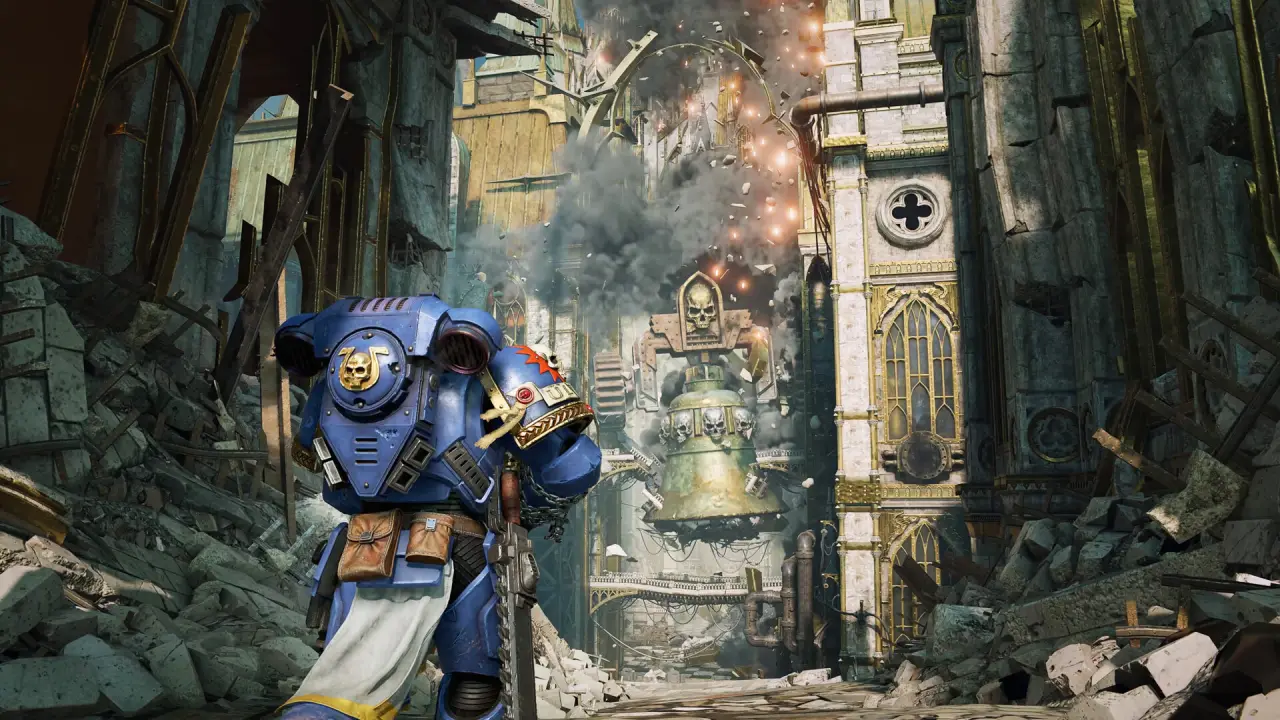
This is the visual trump card no rival can easily copy. Saber's proprietary Swarm Engine renders hundreds of enemies at once without dropping the frame or smearing them into mush. Tyranids spill over buildings and flood across open ground like surf, filling the screen and leaving you only a heartbeat to brace. The technology traces back to the studio's earlier work on massed-horde combat, but this time it is fused to the heavy, deliberate feel of a Space Marine. Each creature moves on its own, clambering over obstacles, climbing over one another to reach high ground, so the whole tide seems to breathe. Pull the camera back and what you see is not a skirmish but an entire front line buckling and reforming in front of you. The picture is not merely pretty here; it actively does the work of dread, and it is the literal cash-out of that "you are one cog in a vast war" promise. The first time a swarm genuinely fills the frame, the instinct is not to admire it but to flinch, and that flinch is the whole pitch — no screenshot, no trailer, no description quite prepares you for the moment the horizon itself starts moving. Plenty of games stage a big set-piece crowd once or twice; here it is the baseline, the resting state of a normal Tuesday afternoon mission, and the sheer normalisation of that scale is what nobody else has managed to replicate.
Art direction that trades the original's grey for genuine colour
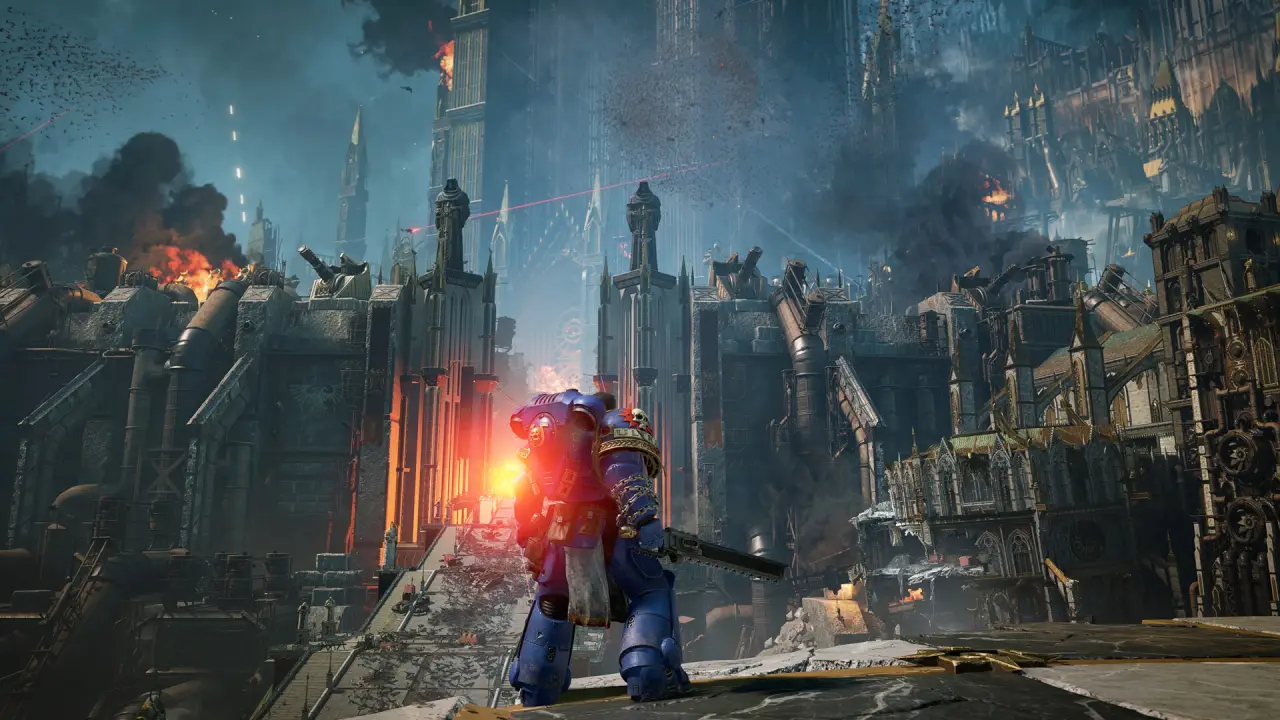
Where the first game leaned brown and grey, the sequel is markedly more vivid. You will walk worlds painted in greens and purples, choked with lush alien flora, and you will push through towering, stacked Gothic cities, their architecture receding into a deliberate sense of depth. That colour does real work — it spares you the visual fatigue that drags down so many military shooters, and it gives each mission its own palette so ten hours never blur into the same grimy battlefield twice. The look is recognisably descended from Gears of War and its heavy-armour, cover-and-advance lineage, but the marriage of Warhammer's Gothic excess to that swarm-scale spectacle takes the old subgenre somewhere its forebears never reached, repainting "heavy shooter" in the colours of the forty-first millennium. The texture work deserves a line too: every Marine looks battered and lived-in, every cathedral-spire and crashed cruiser carries the grime of a galaxy that has been at war for ten thousand years, and that weathered detail sells the setting's exhaustion far better than any cutscene exposition could. It is a world that looks tired in exactly the way the lore says it should, and the art team clearly knew the difference between clean sci-fi and grimdark.
Showpiece detail and how it holds up across platforms

The other place the spectacle lands is the finisher animations, which vary by enemy type and by the weapon in your hands rather than looping one canned clip, each shot framed with real cinematic weight. Add the fact that nearly every mission hands you a landmark vista that begs for photo mode, and the "unforgettable" quality of the visuals is the genuine article. Across PC, PS5 and Xbox Series, the PC ceiling is highest, able to max both the on-screen count and the fine detail, while the console builds make a sensible trade between fidelity and frame rate — and crucially the optimisation holds up under that horde load, with none of the "frame rate collapses the moment numbers spike" disasters the engine could so easily have produced. For sheer scale, art and showmanship, graphics earn a 9.0 — perhaps not the most technically explosive game on the market, but for making you believe you stand inside a war vast enough to swallow you, it sits in the top bracket, which is exactly what this setting most needs the visuals to deliver. There is a useful distinction between a game with impressive graphics and a game with an impressive sense of place, and this is firmly the latter; you could swap out a fancier renderer and lose nothing that matters, because the achievement here is compositional rather than raw horsepower. It looks like the box art of a hundred Black Library covers finally given motion, and for this audience that is the highest praise available.
Combat | 9.0/10
Rozgrywka: 9/10A core loop that slides between suppression and the close-up grind
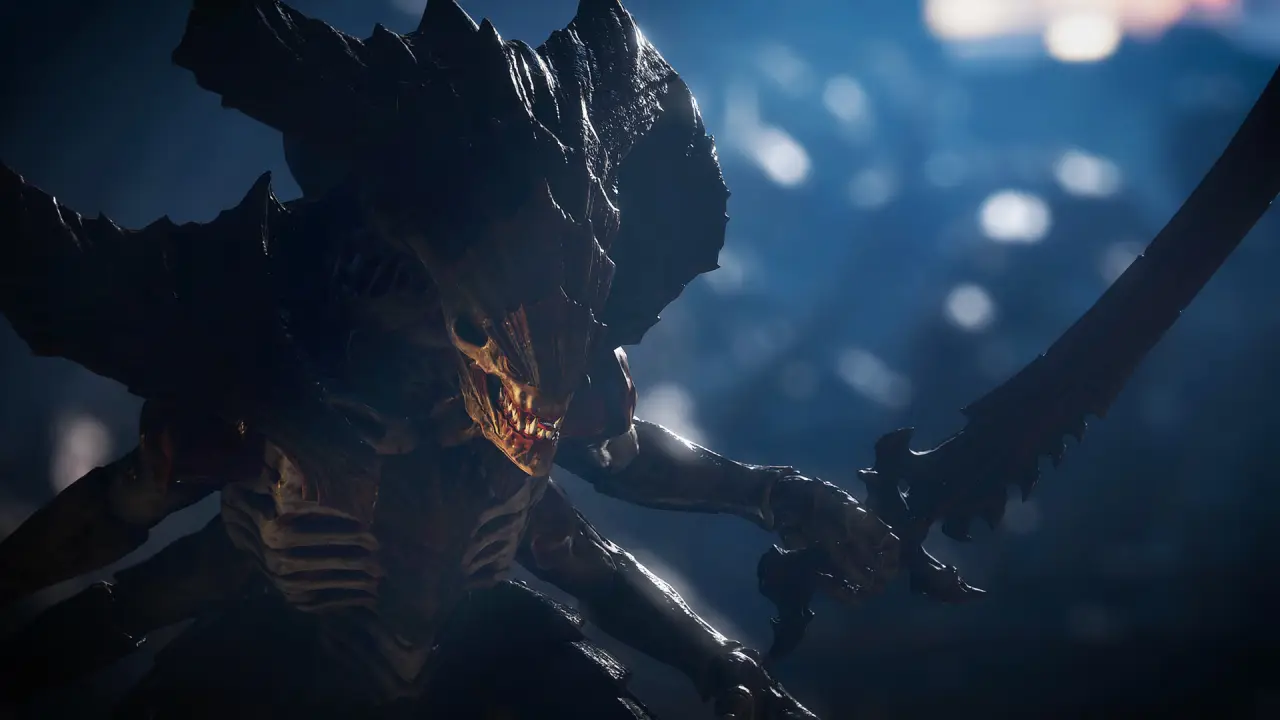
The skeleton of the combat is a real-time swap between ranged fire and a melee scrap. Far-off ranks get suppressed and thinned with ranged weapons; the instant they close, you switch to a melee weapon and carve the gap open. No pause, no menu — the whole job is reading the distance and type of what is in front of you and flowing between two toolsets on the fly. The elegance is that it forces you to keep moving and keep judging. Plant your feet and the tide drowns you; hug a single foe and the ranged enemies pick you off. You are constantly re-deciding who on the field needs handling first. Titus may be a two-and-a-half-metre slab, but he is nimbler than the original's lead, moving with weight without dragging — and that "heavy but never sluggish" feel is the bedrock the whole system stands on. The mass is the point; it keeps "one against a hundred" from sliding into mindless mowing and makes it a matter of footwork and tempo.
Armour-from-executions, the design that rewards aggression
If one mechanic defines this game's combat character, it is the finisher. Execute a staggered enemy and you recover not health but armour, and that small twist rewrites the entire risk calculus. It does not pay you to turtle; it pays you to dive into the mob and earn that armour back, swing by swing. Better still, the finisher animation carries a brief window of invulnerability, so it doubles as a way to dodge damage — the deeper you wade into the crowd, the safer you somehow become, and that counter-intuitive pull is where the loop gets its hooks in. Layered on top is the read-and-react rhythm: a blue flash demands a perfect parry, an orange one demands a perfect dodge, and a clean read lets you snap off a high-power ranged riposte. That read-parry-or-dodge-punish cycle gives the dedicated plenty to chew on. The one small wrinkle is that the ranged riposte itself has no invulnerability, so it can still be interrupted when you are boxed in on all sides — a deliberate risk to weigh, not a free win, and the higher the difficulty climbs the more that trade-off tests your judgement.
Six classes, three modes, and the one comparison that matters
Beyond the campaign, the breadth rests on six classes — Tactical, Assault, Vanguard, Heavy, Sniper, Bulwark — each with a signature ability: the Tactical's scan, the Sniper's cloak, the Heavy's shield recharge, the Vanguard's grapple, the Assault's jump pack, the Bulwark's barrier. These are not reskins; the ability genuinely changes your role in the squad, whether you are the eyes that mark targets, the shield up front, or the cold barrel reaping from the back, and a trio that complements one another clicks far harder than three lone wolves. The modes split three ways: a single-player or co-op campaign, three-player co-op Operations (PvE), and Eternal War (PvP). It is an architecture that covers everything from solo immersion to team competition, and while the depth of each slice is uneven — more on that under content — the framework itself is complete. Drop it into the 2024 co-op shooter lane and the obvious reference is Helldivers 2: a top-down galactic war won by stratagem and call-downs, cooler and more managerial by temperament. Space Marine 2 runs the opposite way entirely — it wants the close-up, the up-in-your-face, the menace of being a slab of armour that personally flattens everything in reach, the camera pinned at your back so you feel every impact against your plate. Neither replaces the other, but if what you want is heavy, intense close-quarters catharsis, this game has almost no peer in its year. The two designs are answering different questions — one asks how a coordinated team manages an impossible war from a distance, the other asks what it feels like to personally be the impossible thing the war is built around — and Space Marine 2 commits to its answer with a single-mindedness that is rare and admirable. For feel, mechanical depth and breadth, gameplay earns a 9.0 — at the one thing it does best, it is close to perfect, and it never once apologises for the things it chose not to be.
Content | 6.0/10
Zawartość: 6/10Ten hours of substance, twenty-five for the completionist
Start with the campaign. A first clear runs around ten hours; crank the difficulty and chase every achievement and collectible and it stretches toward twenty-five. For a game built around combat spectacle that is not stingy, though it is hardly lavish either. The density holds — nine missions across three planets, tightly paced, with almost no padding-out travel — and each mission has its own setting and combat focus rather than repainting one map and sending you back in. On the strength of that main line alone, it earns the dignity of a proper action release. The set-pieces are paced so that a quieter corridor stretch is always followed by a horizon opening onto a fresh kind of carnage, and that rhythm keeps even a second playthrough from feeling like a slog. The problem was never whether the campaign is good. The problem is what the game has to hold you once it ends. A premium-priced, co-op-forward title invites players to expect content worth grinding for, and that is precisely where launch left it awkward — and where its content score splits the room. The campaign is a finite thing you finish and remember; the live game around it is what was supposed to keep the disc in the drive, and at launch that surrounding structure was the thinnest part of the package by a wide margin.
Operations: six maps that cannot carry a long tail
The post-campaign workhorse is Operations, the three-player co-op PvE. Its design is clever: the missions are arranged as side-angles on the campaign story, letting you relive that war from other vantage points. But the catch is blunt — six maps at launch. The first run is a thrill; clear those six a handful of times and the repetition settles in. The maps do not differ enough to sustain long grinding sessions, and you quickly memorise the enemy placements and the flow. Reviewers landed on the same sore spot: progression is mostly stat stacking rather than mechanical change, so what you unlock are numbers that go up rather than new ways to play, and that starves the "one more run to try a new build" pull. It has the frame of a co-op grinder without, for now, the thickness a co-op grinder needs to actually keep people — a shortfall left for future updates to repair. The clever framing of the missions as story side-angles is genuinely worth something, and the moment-to-moment combat is still the best in its class, so the issue is never that an individual run feels bad; it is that the catalogue runs out long before your appetite does. A co-op game lives or dies by its rotation of things to do, and six maps is simply too short a rotation to survive the months of play these games are sold on.
Eternal War and the roadmap that bets value on the future
PvP's Eternal War is thin in the same way: capture-the-flag, control and deathmatch at launch, no skill-tree progression, gear unlocking by level. It plays, but it cannot yet anchor a lasting competitive scene. So the content value rests heavily on the published roadmap. The studio laid out seasons stretching across two years; Year 2 alone plans six free patches promising new PvE missions, new PvP modes and maps, fresh enemy types and even new sections of the Battle Barge, with the Anniversary Update its biggest expansion to date. The season pass keeps its paid offering tactfully to cosmetics rather than stats, so no power sits behind a paywall. By contrast Helldivers 2 ran a far more aggressive live cadence in the same year, lobbing new threats and server-wide events on a steady drumbeat, and that relentless rhythm only underlines how lean Space Marine 2 was out of the gate. If those updates land on time and in good shape, today's shortfall gets papered over in time. It is for that reason content can only take a 6.0 — a score for the thickness it has right now, not the potential it carries. It is not that the game is unfun today; it is that its capital for staying power is genuinely short, and the real payoff depends on how faithfully that roadmap is walked.




Komentarze 0
Chętnie poznamy Twoje zdanie
Dołącz do dyskusji i podziel się opinią o grze.
Nie ma jeszcze komentarzy. Napisz, co sądzisz o tej recenzji.