
Aktualność
Planet Zoo 2 Launch Listing Undercuts Steam by $6.10
Frontier Developments’ new zoo-building sequel is listed at $43.89 through Loaded, compared with $49.99 on US Steam. The
















What impressed me most wasn’t how ruthless the expansion could get, but that the act of “building a civilization” could actually be broken down into completely different kinds of fun. Some people love laying out industrial chains like building blocks, some prefer gambling their nation’s fate across a sea of stars, and some just want to mash fantasy races into a bizarre, richly flavored stew. That kind of divergence is exactly what has made the post-Civilization landscape so fascinating.
The appeal of Civilization as a 4X game, put simply, comes from a very complete sense of control: resource allocation, diplomatic tug-of-war, military expansion, technological progress, plus the satisfaction of watching cities and civilizations gradually take shape. It’s like the “master switch” of turn-based strategy—once you hit it, time just disappears.

If historical immersion matters more to you, then Anno 117: Pax Romana will probably be right up your alley. It locks the setting to the Roman Empire in 117 AD, not chasing giant leaps across eras, but instead focusing on depth and detail. Water supply systems, workshop transport routes, industrial chain balance—these are all visible, adjustable acts of governance. It feels a bit like Civilization colliding with Tropico, only with a much stronger sense of historical authenticity.
What makes it even more interesting is that even its religion system is tied to Roman polytheism. Deities like Epona, Cernunnos, Ceres, and Mars aren’t just decorative—different forms of worship and governance paths can steer your provinces in completely different directions. Add in a dual-campaign structure and dynamic random events, and the feedback from your decisions feels immediate.

Speaking of that, Humankind is actually the closest true rival to Civilization, but its smartest move is how it shatters the idea of a fixed “civilization identity.” You can journey from the Bronze Age all the way to the Space Age, switching civilizations and combining cultural traits across six key stages to ultimately shape your own “million civilizations.” The vibe is like Civilization meeting deckbuilding—suddenly the variables come alive.
Its cities also aren’t the traditional scattered flag-planting model, but instead emphasize district synergy and resource integration, building upward into sprawling metropolises. Combat also takes terrain seriously—high ground and cliffs can completely reshape a battle, giving strategy a stronger sense of depth.
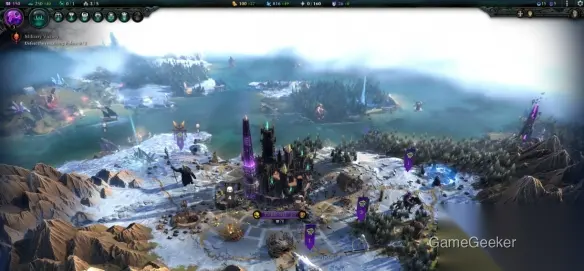
If you’re already feeling a bit aesthetically fatigued by real history, then Age of Wonders 4 will probably give you a real jolt. Developed by Triumph Studios, it jumps straight out of the historical framework and lets you play as a Wizard King, expanding your empire across randomly generated fantasy realms. Frozen wastelands, dragon ruins, astral wilds—just reading the map names already paints a vivid picture.
Its most brilliant feature is the combination of highly flexible faction customization and tactical turn-based combat. You’re not reenacting history—you’re creating a fantasy catastrophe entirely of your own making. It feels a lot like Heroes of Might and Magic and Civilization shaking hands and then deciding to go learn magic together.
But if you prefer grand-scale simulation, then Europa Universalis IV offers a completely different kind of thrill. It carries you from the Renaissance all the way to the Industrial Revolution, putting you in the shoes of a national ruler handling diplomacy, war, economics, and religion. It doesn’t deliver as much of that “building from scratch” pleasure; its core lies in the strategic contest between states within a web of complex international relations. That said, its barrier to entry is also much higher—it feels more like the deep end for strategy veterans.
Finally, there’s Stellaris. Taking the stage of Civilization and lifting it straight into the cosmos is honestly such an unfairly good move. You begin as a primitive interstellar civilization, then explore, research, make contact with alien species, and decide whether to pursue peaceful development or military conquest. The whole process makes it dangerously easy to fall into the black hole of “just one more turn.” It’s like Civilization meeting Endless Space, but with a much stronger sense of narrative immersion.

If I were to break down buying recommendations, I’d put it like this: if you want something closest to Civilization but with meaningful twists, go for Humankind first; if you want to sink into the details of historical governance, choose Anno 117: Pax Romana; if you love fantasy and customization, jump straight into Age of Wonders 4; if you prefer the machinery of the state on a grand scale, try Europa Universalis IV; and if you’re a space fan, it’s almost impossible to avoid Stellaris.
These 5 games share one thing in common: they all carry forward the core strategic essence of Civilization, yet none of them stop at imitation. For someone like me, who’s gotten a little numb from being bombarded by assembly-line blockbusters, this kind of design—where each game goes its own way in theme, scale, and mechanics—is actually far more exciting. Creativity isn’t about making systems bigger; it’s about giving “one more turn” a new flavor.





Komentarze 0
Chętnie poznamy Twoje zdanie
Dołącz do dyskusji i podziel się opinią o grze.
Brak komentarzy. Dodaj swoją opinię.