
Aktualność
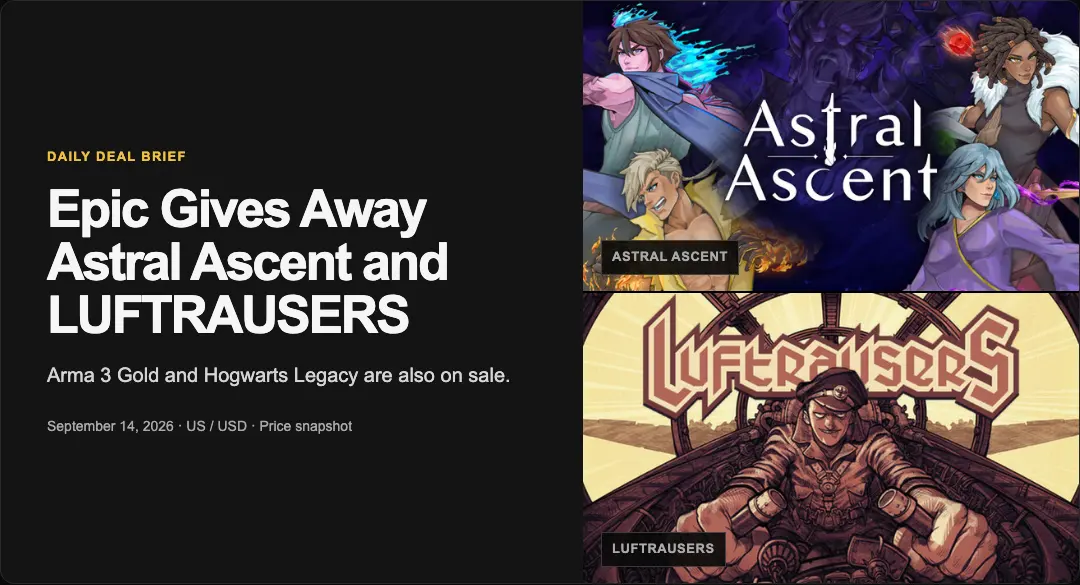
Grab two free PC games before Epic's clock runs out, while Undertale and Divinity: Original Sin 2 are 75% off
Astral Ascent and LUFTRAUSERS are free to keep today, while two of PC gaming's most celebrated RPGs cost less than $14 c
















At the HDC 2026 "Game Services" forum held in Dongguan Songshan Lake on the afternoon of June 14, Whale Engine used Doggo Escape: Giant Crisis as a case study to lay out a HarmonyOS-wide growth framework spanning pre-registration, launch, mature operations, and win-back. The company said its joint operation solution delivered tens of millions of exposures for the game, alongside a 600% revenue increase, a 25% lift in campaign ROI, and a 52% rise in ad eCPM. The session brought together game developers, publishing representatives, and HarmonyOS technical experts, and the broader pitch was clear: growth on HarmonyOS should function as a single connected chain rather than a series of disconnected steps.
More interesting than any one metric was the framing behind them. Whale Engine's pitch is that a game's path to the player should be linked from pre-registration to download, activation, payment, and eventual return, with as few drop-off points as possible. The original article sums up the industry's core pain points as "hard user acquisition, low retention, and unstable payment conversion," and the diagnosis is blunt but useful because it lines up with what many projects are dealing with now.
For new-game pre-registration, Whale Engine is pushing a mix of reservation OCPC and one-click reservation, using system-level entry points to reach high-value users. After a player signs up, the system can automatically issue coupons and then prompt users to redeem them through multiple touchpoints including the minus-one screen, state cards, and Push notifications. According to the original article, that toolset is expected to reduce reservation costs by 5%-10% while improving reservation conversion by 15%-25%, specifically targeting the familiar breaks where users "forget to install" or "install but never open the game."
This is also where growth talk can start to sound overly mechanical. It is easy to reduce players to funnel stages and call success moving them one step further along. That framing is always incomplete. Retention still depends on whether the game itself is worth caring about. What a platform can do is remove friction: Huawei Account one-click login to reduce churn, an aggregated ad SDK with no integration required, capabilities pushed down to the OS layer, and "develop once, deploy across multiple endpoints" to lower development costs. Those are practical advantages, but they cannot replace a game people actually want to keep playing.
Whale Engine also spent more time than usual outlining the launch and post-launch phases. During launch, it offers a cost-per-payment model, ROI bidding, and high-exposure placements tailored to games to help games scale quickly and push up the charts. On the AI bidding side, the NoBid intelligent bidding engine lets developers set only a budget, while the platform tests bids from low to high based on historical costs, aiming to spend as close to 100% of that budget as possible while maximizing conversions. The original article says this can lift first-day spend for a new launch by more than 200%.
In the mature operations phase, Whale Engine adds video slicing, advertorial seeding, real-time intent recommendation, and upgraded IAA monetization. That IAA upgrade includes an aggregated ad SDK that pulls together traffic across the HarmonyOS ecosystem, then pushes capabilities down to the OS layer to support "one development, multi-end deployment." For lapsed users, it layers in uninstall recall and reactivation attribution, then optimizes against long-cycle training samples including login, payment, playtime, and quality scores, with recall ROI as a key metric. In effect, the company is trying to build a repeatable system across the whole user lifecycle, from first contact to launch momentum, routine engagement, and attempted recovery.
A second case study, Three Kingdoms: Ice Age, makes the same argument from a different angle. Whale Engine says the game used end-to-end data integration to identify deep user value and achieved a performance jump from traditional media buying to a Joint Operation 3.0 model. The message is clear enough: this is not being pitched as a traffic source alone, but as the commercialization foundation of the HarmonyOS ecosystem, built around an integrated acquisition-and-monetization model.
Whale Engine says Huawei devices now have more than 300 million game players, with 70% classified as game-interested users. It also says action shooters and strategy games rank highest for user interest and payment intent. Add that to the upgraded ROI3.0 model, whose game-focused pLTV algorithm optimizes around user value and advertiser goals, and the company's positioning comes into focus. According to the original article, tests across 20 games showed spend growth of more than 100% and an ROI increase of 270%.
Whale Engine described itself as an all-scenario intelligent marketing platform based on the HarmonyOS ecosystem, backed by Huawei's 1+8+N full-scenario hardware ecosystem, media network, and content ecosystem, serving both advertisers and developers with ad marketing and traffic monetization. Across the whole stack, it says it can support games through three distribution channels — app, service, and content distribution — to build a full loop from acquisition to monetization. The platform also says default template rendering can be paired with industry-specific styles, while Huawei Account one-click login is meant to reduce user churn and improve monetization efficiency.
From the player’s perspective, though, the most important question is not whether the numbers look impressive. It is whether user experience really stays in first place. Whale Engine says it continues to prioritize that, expanding rewarded video scenarios that integrate more naturally with gameplay while also optimizing interstitial ad display strategy. That is the part worth watching closely. If ads are shown with some restraint, players may tolerate them. If they break pacing and break immersion, even the best ROI story will come at the cost of goodwill.
So the real significance of this forum is not that it tells players what to install tomorrow. It is that it marks Whale Engine's full-lifecycle growth plan for the game industry as, in its own framing, fully ready. Future releases across the HarmonyOS ecosystem may increasingly share the same backbone, from pre-registration reminder to login flow to monetization design. For developers, that is a practical industry signal. For players, the test has not changed: tools can bring people in, but only the game itself can make them stay.




Komentarze 0
Chętnie poznamy Twoje zdanie
Dołącz do dyskusji i podziel się opinią o grze.
Brak komentarzy. Dodaj swoją opinię.