
Aktualność
Grab two free PC games before Epic's clock runs out, while Undertale and Divinity: Original Sin 2 are 75% off
Astral Ascent and LUFTRAUSERS are free to keep today, while two of PC gaming's most celebrated RPGs cost less than $14 c
















A change in a single face often exposes problems more readily than a string of technical specs. After DLSS 5 was publicly showcased at GTC 2026, the controversy quickly zeroed in on character faces—the “optimized” smoothness and sameness triggered an instinctive unease in many players, like watching a film that should have had a rough texture but was polished in post into an overly smooth digital image.

What made the situation dramatic was that Jensen Huang’s initial response was anything but gentle. According to Kotaku, in a media interview after GTC 2026, he at one point directly declared that “the critics are all wrong.” That kind of statement is actually a familiar reflex for tech companies when facing aesthetic criticism: trying to use underlying logic to override intuitive feelings. But from another angle, players were never questioning your engineering capabilities—they were questioning whether the technology is crossing creative boundaries and making decisions about artistic style on behalf of artists.
Later, Huang’s tone clearly softened. In a blog program, he acknowledged that the critics’ concerns were understandable and frankly admitted that he also dislikes “AI slop.” At the very least, that statement shows Nvidia has realized the issue is not merely a PR-level misunderstanding, but a deeper anxiety among players over whether AI will rewrite the very nature of game visuals.

On the narrative level, this shift in tone is actually rewriting DLSS 5’s role. Huang emphasized that it is not a cheap AI filter, nor a post-processing tool used to touch things up after a game ships; rather, it is based on 3D conditions and 3D guidance, driven by real structural data, capable of preserving the geometric structures defined by artists and maintaining consistency in every frame. At the same time, he also noted that DLSS 5 is constrained by textures and the overall artistic style, meaning that at its core it enhances rather than replaces.
But the deeper issue is that ordinary players may not care how elegantly this technical documentation is written. In the end, what players see is simply the face on the screen—whether that skin, that expression, that aura has been quietly rewritten. You can explain that it respects structure, respects style, and may even allow users in the future to train their own models and control effects through prompts, but once the result looks like “beautiful visuals mass-produced by the same company,” that sense of dissonance is already there.
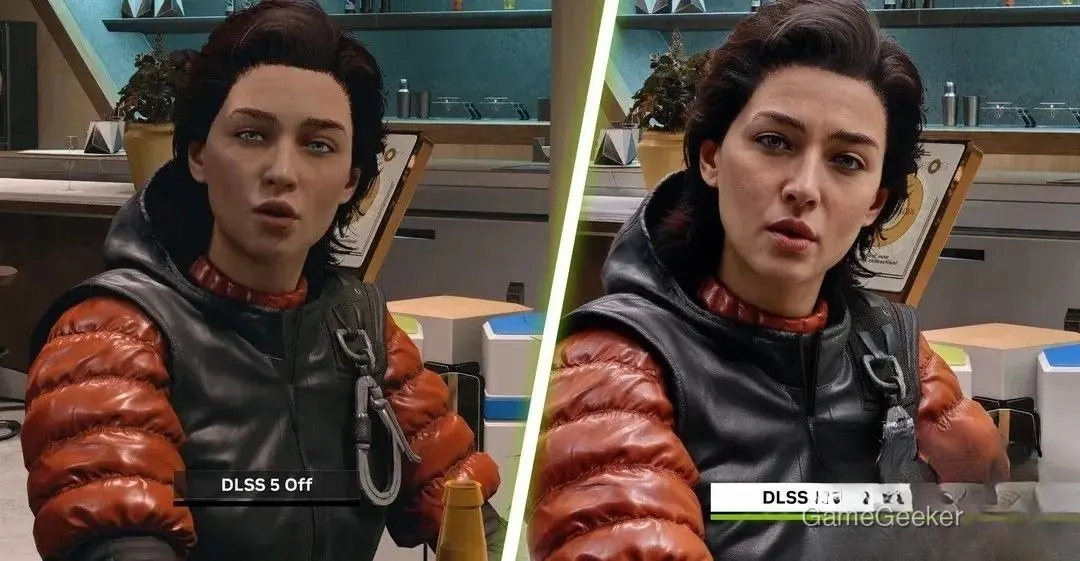
From an industry trend perspective, the original article argues that DLSS 5 will most likely lead the trend over the next 3 to 5 years, and I don’t find that surprising. The deep integration of generative AI with game art pipelines is already a clearly visible direction, and what Nvidia is doing now is pushing that reality to the forefront earlier and more aggressively. Unfortunately, technological leadership has never automatically translated into aesthetic persuasion. Whether a tool can truly be accepted depends on whether it knows how to maintain the right balance between “enhancement” and “tampering.”
For players, the most reasonable attitude to keep at this stage is probably still to wait and see. Not because DLSS 5 is necessarily flawed, but because controversies around this kind of technology must always be tested against the actual visuals. Huang has already moved from “you’re all wrong” to “I understand what you’re worried about,” and that is certainly a step back; but whether that step can earn trust will depend on what Nvidia delivers next—not explanations, but the work itself.





Komentarze 0
Chętnie poznamy Twoje zdanie
Dołącz do dyskusji i podziel się opinią o grze.
Brak komentarzy. Dodaj swoją opinię.