
Aktualność
Grab two free PC games before Epic's clock runs out, while Undertale and Divinity: Original Sin 2 are 75% off
Astral Ascent and LUFTRAUSERS are free to keep today, while two of PC gaming's most celebrated RPGs cost less than $14 c
















“Starfield” officially lands on PS5 today, and this step is pretty crucial for both Bethesda and the player community: it’s gone from being a “Microsoft flagship exclusive” to a massive sci‑fi RPG that both console camps can experience, effectively giving the game a new lifeline. But players who actually hold the wallet tend to care less about sentiment and more about a practical question: how big is the difference between the PS5 and PS5 Pro experience, especially with the Pro’s new “Enhanced Mode”? Is it a must‑have, or just a “psychological comfort pack”?

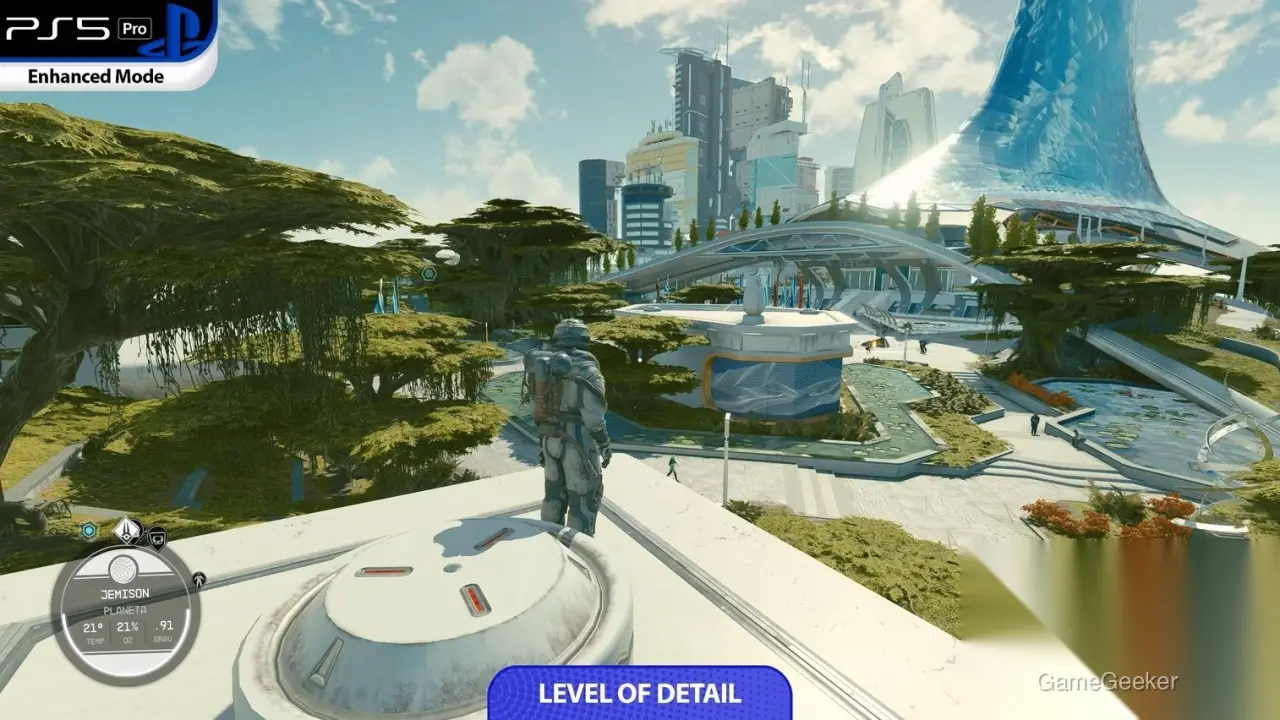
First, let’s sort out the versions. The standard PS5 is simple, with two graphics options: a “Quality Mode” that focuses on visual detail, and a “Performance Mode” that prioritizes smoothness—this classic either‑or setup is what most console players are used to. The PS5 Pro adds a third button—“Enhanced Mode.” Officially, this runs at 2160p, i.e., 4K resolution, with Quality Mode locked at 1440p and Performance Mode at 1080p. On the Pro, all three modes use Sony’s new PSSR AI upscaling technology for rendering, while the standard PS5 sticks with the familiar FSR. For players who like counting pixels, the comparison video from ElAnalistaDeBits is going to be very informative.

In actual play, PSSR’s advantage is a clearly visible, steady improvement in sharpness, not the kind of “you only see it if you zoom screenshots 400%” pseudo‑mystical upgrade. Enhanced Mode brings modest improvements in shadow gradation and ambient occlusion, with cleaner edges on distant objects. City night scenes, metal structures, and many high‑contrast environments hold up better against blur. But if you’re expecting a leap “like switching to a new console generation,” you’ll need to dial those expectations back: compared with Quality Mode, the overall image is more finely polished rather than dramatically transformed. It’s more like further refining and sharpening visuals that were already good. That’s actually very friendly for strategy‑leaning, slow‑paced exploration players, since you tend to stop and observe details—and those details really are clearer this time.

What really bottlenecks “Starfield” is still the old topic of CPU limitations. The developers have openly admitted that this game is extremely CPU‑demanding, so whether you’re on PS5 or PS5 Pro, it’s impossible to hold a perfectly locked 60 fps in cities—areas dense with assets and crowded with NPCs. The PS5 Pro’s advantage is more about a “higher ceiling”: in lighter‑load scenes like open planets or surface exploration, with Variable Refresh Rate enabled and framerate unlocked, the Pro can push close to 90 fps, while the standard PS5 tops out around 70 fps in the same situations. Moreover, the Pro can disable V‑Sync and unlock the framerate in all graphics modes, while the standard model only allows that in Performance Mode. For players who care about responsiveness and want to fine‑tune their own experience, this is actually the most practical bonus.
Some buying advice from a purely strategic perspective. If you happen to be a PS5 Pro user and care a lot about image sharpness and input latency, I’d recommend first trying Enhanced Mode paired with VRR and an unlocked framerate, then switching between Enhanced and Performance based on how much framerate fluctuation you personally tolerate. If you prefer sightseeing, soaking in the story, and aren’t sensitive to moment‑to‑moment framerate changes, Enhanced Mode is a solid middle ground.
If you’re on a standard PS5 and not fixated on a rock‑solid 60 fps, either Quality or Performance Mode will give you a relatively stable, well‑balanced experience in terms of visuals and smoothness—there’s no need to stress over the Pro’s marginally higher ceiling. As for whether you “should be disappointed” that “even on PS5 Pro, cities don’t hold a stable 60 fps,” I’m more inclined to see this as a preview of reality for future large‑scale open worlds: under the current console generation’s CPU constraints, developers will increasingly rely on upscaling, unlocked framerates, and VRR as “patches,” rather than hoping some hardware magic will remove every bottleneck. You can understand this, and you’re also entirely justified in feeling somewhat disappointed; that attitude alone will shape how you prioritize platforms in the future.





Komentarze 0
Chętnie poznamy Twoje zdanie
Dołącz do dyskusji i podziel się opinią o grze.
Brak komentarzy. Dodaj swoją opinię.