























Opening
Some games never reach for a villain or a plot twist. They just hand you the keys to a combine harvester the size of a small house and let the engine growl as you cut a clean line through an acre of wheat, the grain hissing into the trailer behind you. Farming Simulator 19 is one of those games. There is no final boss, no ending screen — only the slow, stubborn story of turning an empty plot of dirt into a working farm, one machine and one field at a time.
The critics were never kind to it. A 73 on Metacritic, a 70 on OpenCritic — squarely middling numbers. And yet it sold a million copies in ten days, cleared two million before long, and still carries a 94 percent rating across more than sixty thousand Steam reviews. That gap between a lukewarm press and a devoted crowd is the whole key to understanding this game. It was never built to win over a jury. It was built for the people willing to pour a hundred hours into the soil.
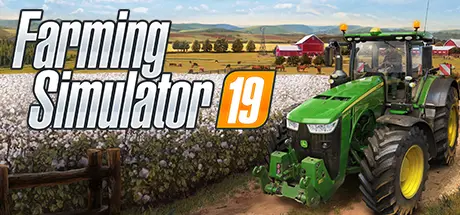
What no rival can copy is sitting right there in the driver's seat: John Deere and a roster of real brands, hundreds of authentic machines, all dropped into the game exactly as they exist in the field. This review takes the whole thing apart, layer by layer, to tell you whether a farming sandbox this honest about its own grind is one you actually want to live in, or one best admired from a safe distance.
Story | 5.0/10
História: 5/10No script, no narrator — the farm is the story
Reviewing Farming Simulator 19 under a "story" heading is a slightly absurd exercise, because there is no story in any conventional sense. No opening cinematic lays out a world. No pivotal character asks you to make a choice. No credits roll. The narrative, such as it is, begins with a bare patch of land, a second-hand tractor you can barely afford, the first furrow you plough, the first trailer of grain you sell, and the modest sum that lets you buy the next machine.

That self-authored history is the real heart of the thing. You remember the nervous moment you took out a loan for your first big harvester. You remember the season you misjudged your expenses and nearly went broke. You remember the quiet satisfaction of looking out over a valley you have entirely filled with fields, a shed full of machines parked behind you. No writer handed you those beats. You earned every one of them, furrow by furrow — and for the right player, that lands harder than any cutscene could.
Three maps give that personal saga three very different stages. Ravenport draws on the American west coast: wide, flat, built for big mechanised sweeps. Felsbrunn is the European option, all broken hillsides and tight, irregular plots that force you to count every cent. The reworked South American map carries a rougher, dustier character of its own. The map you pick at the start more or less sets the tone of the farming life you are about to live.
An empty world where the land outweighs the people
To be honest, though, the game has a real weakness in atmosphere, and it is the reason its story marks sit so low. More than one critic landed on the same word: empty. The world beyond your fences feels destitute and hollow, missing the kind of people and community that keep a player rooted. The land outside your farm is a handsome backdrop, the odd car rolling past, but the towns hold no living soul you will ever form a bond with.

Set it beside Stardew Valley and the difference is stark. Stardew keeps you with dozens of flesh-and-blood townsfolk and the slow unfurling of small-town lives; the farming is merely the vessel. Farming Simulator 19 pours every drop of emotional investment into the machinery and the dirt instead. Neither approach is wrong, but this one chose the colder, harder road. What you love here is the work, not the neighbours.
The contract jobs and transport tasks do supply a thread of purpose — harvest a neighbour's field, haul a load to a drop-off, collect your fee. But they are business nodes, not plot points. They move your bank balance and your expansion plan, never your feelings. Once that clicks, you stop walking in with the wrong expectations. This was never a game about being told a story. It is a game about growing one out of the ground yourself.
When purpose replaces plot
So if no writer is setting your goals, what keeps you here for hundreds of hours? The answer is that the game hands the whole job of goal-setting back to you. You set yourself one small target after another: save enough this season for the big harvester you have been eyeing, buy up those three weedy plots to the north and stitch them into one field, then weigh whether to take a punt on a herd of dairy cows and stand up a milk line. Each goal you clear is a tangible jolt of reward, and strung end to end those goals become a farming chronicle that belongs to you alone.
It is that self-driven structure that leaves Farming Simulator 19 with a strange double character on the story front. On the traditional narrative axis it is close to a blank page, yet in the mind of every player who sinks into it, it grows a memory of running a farm that is singular and oddly lingering. It does not tell you a tale. It hands you a patch of land and lets you plant one — and for anyone who can appreciate that kind of negative space, that is precisely where its quiet charm lives.
Audio | 7.0/10
Áudio: 7/10The machines, not the music, carry the soundtrack
Most games hand their audio spotlight to a score or a voice cast. Farming Simulator 19 hands it, without question, to the machinery. The low diesel rumble of an engine, the whine of a harvester header spinning up to speed, the dense clatter of grain cascading into a trailer — these are the sounds that hold the whole experience together. Each brand, each weight class of machine, carries a distinguishable engine note, and that fidelity to the noise of real equipment is one of the quiet ways the game flatters its core crowd.

Because the loop itself is long stretches of repetitive labour, those mechanical sounds end up working like a metronome. You learn what each vehicle is supposed to sound like, and the moment something is off — a header running empty, the chime of a full trailer — your ears catch it before your eyes do. That feedback turns dull back-and-forth work into something rhythmic enough to lose yourself in.
There is a craft to it that is easy to overlook. A heavy tractor labouring uphill under load sounds nothing like the same tractor idling at the silo, and a harvester biting into dense wheat carries a different strain than one rolling over a thin patch. Over enough hours, your ear starts reading the work through sound alone, almost the way a real operator would — and that is a far subtler kind of immersion than any orchestral swell could buy.
Ambience and score: a competent backdrop that knows its place
Beyond the farm, the ambient design pulls its weight too. Birdsong drifting over the fields, wind brushing through the crops, the shifting tone of different weather — all of it answers the visual touches, like the flocks that settle on your land and scatter as you approach, so the place never feels stone dead. None of it is built to dazzle. It is built to slowly prop up the sense that you are standing in a real stretch of countryside.

The music keeps to a gentle, rural register, low in the mix and content to stay there, serving a relaxed working pace rather than any emotional crescendo. It is much the same philosophy that drives Euro Truck Simulator 2 — another long-haul driving sim that leans on engine noise and unobtrusive background tracks to keep you company through a slow, repetitive journey, letting you slip into a clean flow state.
Taken as a whole, the audio is neither a liability nor a highlight. It nails the mechanical and ambient work it needs to, but offers no single melody you would ever pull out to listen to on its own. It is a competent, unremarkable scorecard — and it suits the game's middling overall standing exactly. The restraint is a choice rather than a shortfall: a louder, busier score would only get in the way of the very flow state the game is built to protect.
Visuals | 7.5/10
Gráficos: 7.5/10A rebuilt engine, and a genuine leap
The loudest thing the marketing promised was a ground-up rebuild of the underlying GIANTS engine, and the upgrade shows. Lighting carries more depth, the sky actually moves, and — the detail that makes veterans grin — the crop physics finally behave. Drive a vehicle through a wheat field and the stalks bend aside instead of clipping straight through it the way they did in earlier entries. It sounds trivial. It does real work in selling the feeling that you are truly out there, farming.

The rebuild also makes the world feel more alive than any previous installment. The detail critics kept singling out was the wildlife: flocks of birds settle across your fields to feed, then erupt into the air the moment your tractor draws near. That kind of small, reactive touch breathes life into a static field far better than raw resolution ever could.
The lighting changes earn their own mention. The way light shifts across the day, the morning mist hanging over a field, the long shadows at dusk — they all give the same patch of land a different texture depending on the hour. Paired with the dynamic sky and weather, no two hours in the field look quite alike, and for a game built on long bouts of repetition, that subtle variation does a lot to fight off visual fatigue.
A last-gen foundation — don't bring a AAA yardstick
Just don't oversell it. Honestly, the overall look sits closer to the previous console generation than to the period's best. The most glaring holdover is object pop-in: terrain, trees, and distant props tend to surface their detail a beat too late, only once you have driven up close, and it chips away at the immersion.

Screen Rant put it plainly — anyone hunting for Red Dead Redemption 2-tier fidelity here will walk away disappointed. But the same review conceded that in the places the game genuinely cares about, like harvesting grain and tipping a load into a silo, it has never looked or felt better. The budget didn't go on showpiece vistas. It went on the core farming moments you stare at every single day.
The three maps show a fair spread of art direction too. Ravenport is bright and wide open, Felsbrunn broken and hilly, the South American map rough and earthy, each with its own identity in terrain, foliage, and architecture. The regional variety is hardly jaw-dropping, but it is enough to keep things fresh as you move between maps, and it props up the urge to start a whole new farm from scratch.
Machine modelling: spending the budget where your eyes live
Where the art team's real care shows is in the hundreds of machines. Every tractor, harvester, and seeder is modelled one-to-one against its real counterpart, from the paint and tyre tread to the gauges and levers inside the cab, and the detail holds up under close inspection. Given that you spend most of the game pressed right up against this equipment — often sitting inside it in a first-person view — pouring the modelling budget into the vehicles is about as smart a trade-off as the developers could have made.
The crops earn that effort as well. From the tender green shoots after sowing, through the slow rise and the turn from green to gold, to the stubble and churned soil a harvest leaves behind, every farming stage has its matching visual change. You are not working a texture that never moves. You are watching a season of crop run its full cycle, from nothing to a trailer of grain — and that visible growth is the plainest, sturdiest visual pleasure a farming sim has to offer.
It helps, too, that the cabs are not just modelled but functional to look at. Mirrors track what is behind you, indicator lights blink, dashboards register the load. None of it is photoreal, but it is consistent, and consistency is what sells a working machine far more than any single hero shot ever could. The game understands that its visuals live in repetition, and it dresses that repetition with just enough small, reactive detail to keep it from going stale.
Combat | 8.0/10
Jogabilidade: 8/10The core loop: turning dirt into an agricultural empire
Strip away every layer and Farming Simulator 19 runs on a loop almost pure in its clarity. Till, sow, fertilise, clear the unwanted growth, then harvest, haul, and sell. Spend the proceeds on better machines, more land, bigger fields, and start a larger turn of the same wheel. It reads as tedium on paper. In practice that interlocking chain of positive feedback is exactly what plants players in their chairs for hours — you keep telling yourself you'll quit after this one harvest, and then the sun is coming up.
The loop holds up because every link in it has been cut fine and given room to breathe. Crop destruction is a proper mechanic now: drive across a field and the crop is genuinely ruined, forcing you to plan your routes. Invasive growth springs up in two distinct stages and demands a dedicated cutter or a dose of lime to deal with. Most of these systems toggle freely, so a hardcore player can switch everything on for maximum realism while a casual one strips it back to lighten the load. The same game, as a result, runs at wildly different tempos in different hands.
Driving the real thing: the one trick nobody can copy
If the game gets to keep a single reason for existing, it is the vehicle roster. More than three hundred machines and implements, every one of them faithfully recreated from a real-world model — and the headline of this generation is that John Deere, the largest farm-equipment maker on earth, joins the series for the first time, arriving alongside a long list of named brands like Case IH, New Holland, and Fendt.
For the players who actually care about agricultural machinery, that authenticity is something no other game offers, and it is the charm nobody can knock off. Plenty of machines accept add-on upgrades that change their shape and function, and many can swap tyres to handle muddy ground. You are not pressing an abstract "harvest" button. You are driving a genuine behemoth with weight, momentum, and a working logic all its own.
The way machines pair and attach pushes that realism deeper still. Which plough, which seeder, which fertiliser rig hangs off the back of a tractor is yours to judge and swap as the work demands, and sometimes one implement needs a second implement bolted onto it, the whole chain reading like an engineering puzzle. For the hardcore, that interlocking authenticity is the whole point — it takes the daily grind a real farmer faces and turns it, unedited, into depth worth studying.
The wall at the door: a missing tutorial and a rushed horse
But the hardcore streak brings its most lethal flaw — the barrier to entry. The tutorial covers only the basics of planting and forestry. Climb into a machine and prompts appear in the top-left corner; step into proper career mode and those prompts simply vanish. The trouble is that many machines need a whole sequence of unfolding, lowering, and switching on, and a newcomer staring at an unfamiliar rig is often left with no idea where to begin. Game Rant said it flatly: even a little simple instruction would have gone a long way.
The newly added horses are the other obvious patch of rushed work. Raising, riding, and eventually selling a horse should have been a charming new strand, but the riding itself is crude — the animal moves in stiff jerks, teleports without warning, and clips straight through bridges, feeling less like a finished system than something wedged in at the last minute.
On the multiplayer front, the PC version supports up to sixteen players running a farm together, and you can hire AI workers to chase down contracts and tend the chores so a solo player can stay focused on the main operation. The catch is connection stability, a long-standing headache — players outside the West often need a VPN, and even then a failed connection is never far off.
None of these flaws are dealbreakers on their own, but stacked together they form the price of admission. The game asks for patience before it gives anything back, and how you feel about that toll decides almost entirely whether the loop ahead reads as meditative or as a second job. It is a wall worth being honest about before you climb it.
Content | 8.0/10
Conteúdo: 8/10A generous sandbox built on three maps
For sheer breadth, Farming Simulator 19 is open-handed. Three maps of very different character — Ravenport in North America, Felsbrunn in western Europe, and the reworked South American estate — each offer enough land and enough terrain variety to keep you busy, and the farm system itself is wide open. Houses, stables, silos, workshops: you buy them, place them, and build them yourself, and the old fixed fields give way to far more flexible land parcels. You are not filling in a preset farm template. You are laying out your own agricultural empire on a blank canvas.
That sandbox structure means there is no "completion time" to speak of. You can run one small farm at a leisurely pace for a few dozen hours, or you can blanket an entire map and sink a hundred-plus hours into a sprawling operation. The ceiling is set, more or less, by your own ambition.
And ambition here is rarely capped by the game itself. Run out of room on one map and there is always another waiting, another crop you have not tried, another machine you have not saved up for. The content does not gate you behind progress bars so much as behind your own appetite for more.
The crop list adds real thickness too. Two new crops, cotton and oats, join more than a dozen returnees like wheat, barley, corn, sugar beet, and sugarcane, each with its own planting, management, and harvesting routine, and each tied to dedicated machinery and sales channels. Cotton wants expensive specialist gear and pays back modestly, reading more like a flex for a rich late-game farm; oats, meanwhile, are bound to the new horses as their required feed, neatly stitching two fresh content strands together.
DLC and mods: keeping a 2018 game alive today
Official support didn't sit idle either. Beyond the base game came the Anderson equipment pack and the larger Platinum expansion — the latter bringing the full Claas lineup of machinery and adding a forestry-focused Silverrun woodland map, opening a new front for players who want to lean into logging. These add-ons stack several more layers of play onto the base experience and give veterans who have wrung out the starting maps a fresh reason to come back.
But the thing that truly keeps this game from fading is its mod scene. The official ModHub is open on both PC and console, and the maps, vehicles, and automation tools the community turns out can practically rebuild the whole experience. The Seasons mod layers spring, summer, autumn, and winter onto the calendar, so crops grow in their season and prices swing with the temperature, pushing realism another notch higher. Guidance Steering lets machines follow custom paths on their own, cutting deep into the repetitive labour. Happy Animals auto-replenishes feed and water, freeing livestock players from the daily chores. Their mere existence is close to giving the base game several extra lives for free.
Longevity: a single-player game you keep coming back to
Judging a farming sim's content can't stop at how much there is; it has to ask how long it keeps you. Here the game answers well. Multiplayer lets you pull in friends to run a farm together, turning lonely labour into a shared project with someone to split the work and someone to grumble at, and the depth of it doubles on the spot. The three development paths — livestock, crops, forestry — guarantee a fresh direction to dig into even after you have mastered one style of play.
More to the point, it never forces a pace on you. You can log on daily for weeks expanding an empire, or drift back after half a year to lazily tend a few fields and patch up the animal pens, treating it as a digital countryside you can return to whenever. That pressure-free, endpoint-free structure, paired with a never-ending supply of community mods, is what lets it genuinely deliver on "buy once, keep forever" — and for a single-player game, that staying power is the most concrete content value of all.
Compared with the series' earlier entries, this one clearly grew in map and vehicle count, while the official seasons system only arrived properly in the sequel that followed — which means, in a sense, players here already tasted that extra layer of depth ahead of time through the Seasons mod. That community-driven ability to renew itself is, quietly, the single most underrated piece of the whole content package.






Comentários 0
Queremos saber sua opinião
Participe da discussão e compartilhe sua opinião sobre este jogo.
Ainda não há comentários. Conte o que você achou desta análise.