























Opening
Most shooters want to be your friend. Insurgency: Sandstorm wants to be your reckoning. It strips the crosshair, the health bar, and the minimap off your screen, then hands you a pair of eyes, a pair of ears, and a squad of strangers who had better start talking. Your first hour will be a parade of deaths you never saw coming — you will hit the ground without ever learning who put you there.
And then something clicks. You learn to hug the cover, to read a staircase by the weight of a footstep, to assemble the whole shape of a firefight out of nothing but radio chatter and the hush before contact. That is when the game finally shows its real face: a machine for compressing the tension and the weight of modern conflict into every single engagement. It does not want to thrill you. It wants to wind you tight.
This is a hardcore, realism-first team shooter built by a small studio on Unreal Engine 4. It sits at 85% Very Positive on Steam across more than a hundred thousand reviews, with a Metacritic of 78 and an OpenCritic of 79 — not a masterpiece on the numbers, yet a quietly enduring landmark on the narrow road of realism. The pages that follow take it apart layer by layer: why sound is its soul, why brutal lethality is the source of its immersion rather than its frustration, and exactly who should walk in — and who should walk away.
Story | 6.0/10
História: 6/10Come here for a sweeping plot and you will leave empty-handed. Insurgency: Sandstorm has almost no story in the conventional sense — no protagonist arc carried by cutscenes, no twist you will recount to a friend, no name you will remember. Its narrative does not live in dialogue. It lives in the battlefield itself, and you have to be willing to read it that way. We landed on a 6.0 here, and the number deserves an honest explanation rather than a shrug.
The campaign that never shipped, and the trade it forced
There was, once, a blueprint for a single-player campaign. It would have followed a squad through the long shadow of real conflict, reaching for the human cost behind modern warfare. That campaign was cut, and for a fair number of players the loss still stings. The decision also settled the question of where this game would spend its narrative budget: developer New World Interactive poured everything into the realism of its multiplayer and cooperative play, and storytelling simply stopped being where it pushed.

So you will not find a linear thread. What replaces it is a kind of functional storytelling — the setting supplies a recognizable backdrop of modern conflict, with locations, gear, and factions all grounded in something you can identify, while the specifics of any given moment are left for you to live out match by match. It is not telling one person's story. It is telling you what modern warfare feels like, and that ambition is narrower and more honest than the box-art bombast its rivals chase. The 6.0 is not a failure. It is the price of a bet placed somewhere else entirely.
Asymmetry as the only thread worth following
If you insist on a storyline, the closest thing is the asymmetry baked into its two factions. Security and the Insurgents are not mirror images. One side is regimented and uniformly equipped; the other improvises, scavenges, and fights with whatever is at hand. That imbalance is not just a balancing lever — it is, in itself, a quiet argument about how asymmetric modern conflict actually unfolds.
Which side you play changes the texture of everything: the rhythm, the posture, the kind of caution each demands. The regimented side leans on coordination and planned support; the irregular side trades on flexibility and sudden pressure. Their gear, their soundscape, even their tactical habits diverge, and across enough matches you begin to understand a single conflict from two opposing vantage points. Play long enough and you stop thinking of one side as the heroes and the other as the obstacle; both become simply people fighting the way their circumstances allow. No line of dialogue lectures you about it. The mechanics do the talking, and they say more than a cutscene ever could. That is the cleverest thing this game does with narrative — it welds worldview into play rather than into a script, and it trusts you to notice.
Mood and structure where a plot used to be
With no campaign to lean on, the game finds other ways to give you the sense of having been somewhere. The cooperative Checkpoint mode marches you and your squad from point to point, seizing objectives or destroying caches, and the forward crawl becomes a lightweight story of its own: you feel the line move, the pressure stack, the choice between holding and falling back creep closer. Structure stands in for the rise and fall a plot would have provided.
More affecting still is the atmosphere. Under Unreal Engine 4, the scarred districts, the distant rattle of contact, the clipped commands in your headset — together they drag you into a state of genuinely being there. The game never reaches for sentiment through a cutscene; it lets the environment and the sound conjure the feeling for you. That mood-as-narrative posture runs in a straight line from the original Insurgency, and it is exactly what sets the series apart from the mainstream of military fiction. You will not remember a plot. You will remember the dread, the held breath, the teammate's voice steadying you before a push — and that, perhaps, is the only story it ever meant to tell, and the only one that could survive being told the same way twice.
Audio | 9.5/10
Áudio: 9.5/10If you allowed me one word for what Insurgency: Sandstorm does best, it would be sound. Audio here is not decoration draped over the action. It is a full-blown intelligence system, and it is strong enough to carry a 9.5 on its own. Strip everything else away and the ears would still be the reason to play.
Spatial audio turns your ears into the radar
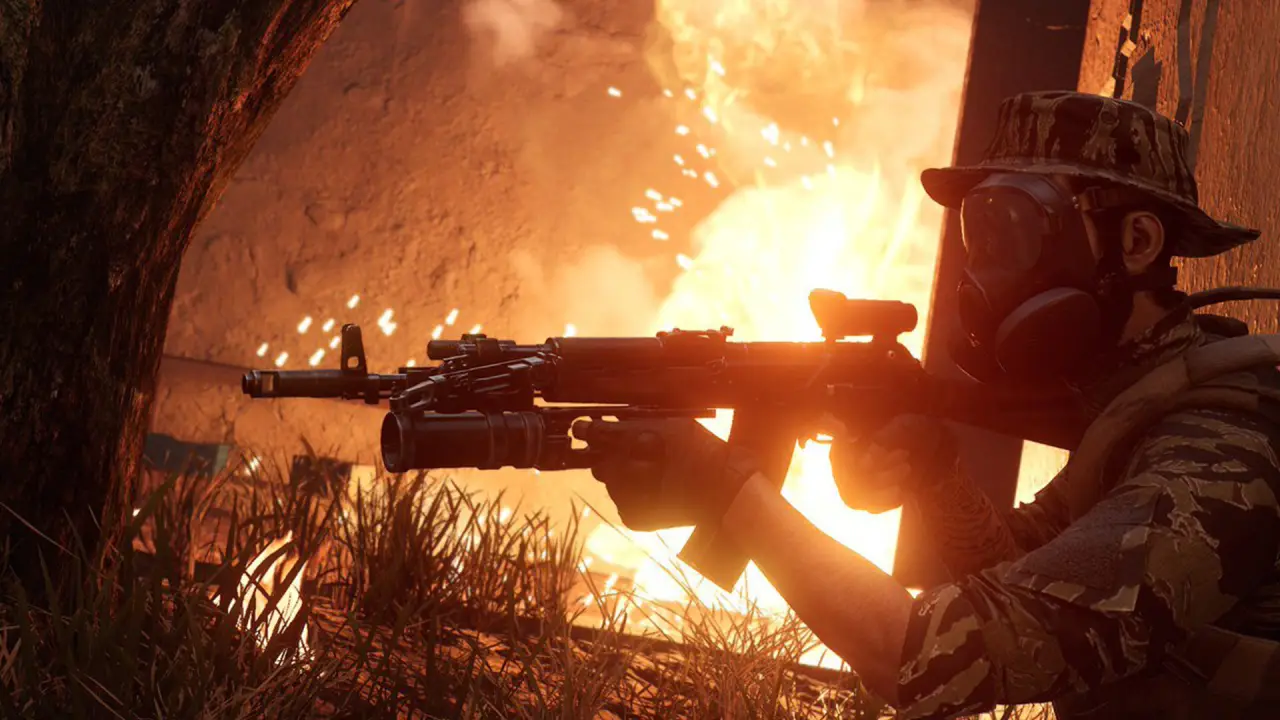
Because the interface has been deliberately gutted — no minimap, no markers floating over opponents — the entire job of reading the battlefield falls to your hearing, and the game is generous enough to make that fair. The spatial audio is startlingly precise. A burst of contact across the map gives you a rough bearing and distance. Footsteps overhead tell you whether someone is directly above you or angling in from the side. Even the kind of hardware an opponent is carrying bleeds through in the texture of the sound.

Reviewers kept circling back to this — those spatial noises hand you every scrap of information about position, above or below, while also telling you what an opponent is using. Which means that listening, headset on, becomes a core mechanic rather than a flourish. You stop reading red dots on a screen and start assembling the shape of the fight in your head, the way you would if you were actually standing in it. A scrape of movement on the second floor and you reposition before you have consciously decided to. That choice to let sound replace the interface is the sharpest line this game draws against the mainstream of the genre, and it is why people reach for the phrase "combat simulator" instead of "shooter."
Texture and voice, pressing in from every side
Beyond locating people, sound is also how the game keeps you under constant pressure. A footfall on concrete, on timber, on sheet metal — each carries its own grain. Reloads, the clack of mechanisms, the way distant fire decays as it travels, all of it is rendered with care. Layer on the distorted crackle of radio comms, the slam of a breach, the ringing aftermath of a blast, and the soundscape fills to the brim. You catch yourself softening your own steps and holding your breath, because you know the other side is listening for you just as hard.
What pushes the whole experience over the top is positional voice. A teammate's call arrives from a specific direction, and you can place him — back-left, front-right — by ear alone, which means a calm caller doubles as a second set of eyes you never have to look at.
Better yet, when a careless opponent leaves his microphone live, you can overhear the conversation he never meant to share, adding a layer of espionage to the standoff. There is a small, mean thrill in knowing exactly where the other team is regrouping because one of them forgot to mute himself, and an equal terror in wondering whether you are the careless one this time.
This pairing of sound-as-intel and voice coordination turns teamwork from an abstract slogan into a tactical resource you can physically hear. It also changes how you behave: you move quieter, you call cleaner, you treat silence as a weapon. Small wonder the most common verdict you read is that this is the genre's busiest game for the ears. Here, listening well matters more than aiming fast, and the players who internalize that are the ones who climb.
Visuals | 7.5/10
Gráficos: 7.5/10Visuals are the most underrated layer of Insurgency: Sandstorm. It chases no spectacle. Instead it uses a plain, grounded realism to render the texture and the pressure of a war zone with conviction. We landed on 7.5 here — the tech is not cutting-edge, but the direction it serves is crystal clear, and that clarity counts for a lot, because a game that knows exactly what it wants its image to do will always outlast one that merely wants to look expensive.
Unreal Engine 4 texture and the craft of the maps
Moving from the original's Source engine to Unreal Engine 4 was the single biggest visual leap the series made. The newer engine brings sturdier material work: walls bitten by gunfire, dust kicked into the air, the murky interior light, a window frame shot through. None of it shows off. All of it serves immersion, and the restraint is the point. There is a grime to these places — a sense that they were lived in before they were fought over — that a flashier engine chasing spectacle would have scrubbed away. The palette is muted, the surfaces are tired, and the whole thing reads as a war zone rather than a theme park dressed as one.
The map design earns its own paragraph. Chokepoint-heavy, close-quarters layouts are where the game lives — tight streets, buildings you can thread through, lanes for holding and for flanking, all of it deliberately placed. Every map plays like a puzzle: where the throat of the fight is, which alley loops behind an opponent, which window makes a clean support position. Veterans build a private memory of each one, a mental floor plan of pinch points and sightlines that turns raw reflex into something closer to chess. That depth is why the same handful of maps can hold up over hundreds of hours without feeling exhausted.
Some maps even rotate through day and night stages, and visibility, light, and tactics shift completely between them. A night fight leans on sound and a teammate's call; a single moving silhouette in the dark is enough to spike your pulse. Daylight tests your read of the open ground, where the seam between glare and shadow hides a dozen risks. Same map, different hour, entirely new pressure — it is one of the cheapest tricks a designer has for doubling content, and the game spends it well.
The visual language of restraint, and the rough edges
The boldest visual decision this game makes is everything it refuses to show. No crosshair, no health bar, no minimap — it turns "you cannot see it" into an aesthetic. The screen sits almost empty, and your full attention is forced back onto the real battlefield at its center. That restrained visual language reinforces the realist posture: nobody walks around with a health bar over their head, so there is none here. Stripped of clutter, the image takes on a rare cleanliness — you see what a soldier would actually see, and nothing more. The absence is not laziness; it is a designed silence, and it does more for immersion than any particle effect could.

There are, of course, honest shortcomings. Optimization and performance are unavoidable topics: frame pacing wobbles in busy scenes, the console versions arrived only after repeated delays, and for a game that lives on precision and reaction, an unstable frame rate can blunt a crucial read. That is the most regrettable thing about it. The good news is that the current-gen versions, on PS5 and Xbox Series X|S, brought clear gains in frame rate and fidelity, hauling much of that deficit back and finally giving console players something close to the PC's smoothness. It took years to get there, and the wait was a genuine sore point for the people who bought in early on console, but the destination is solid. Taken together, the visuals are not built to dazzle you. They are built to make you believe the battlefield is real — and against that goal, the 7.5 is an honest balance between what the tech can do and what the art is reaching for. A prettier game might have impressed you for an evening; this one convinces you for a campaign, and conviction is the harder thing to buy.
Combat | 9.0/10
Jogabilidade: 9/10Gameplay is the foundation Insurgency: Sandstorm stands on, and it is also the most divisive thing about it. We landed on a 9.0 — it pushes realism-first team combat about as far as the road goes, but that extremity carries a cost, and it is emphatically not for everyone. The score is a celebration with an asterisk, and the asterisk matters.
Lethality rewrites the rhythm of every engagement
To understand this game you have to accept its founding premise: you are fragile, and so is everyone across from you. One or two effective hits is enough to take a person out of the round, with placement and your choice of protection deciding whether you survive a beat longer. That high lethality is not there to punish you. It is there to remake the tempo of the entire fight.
In a mainstream shooter you can trade on a health pool and raw reaction. Not here. One reckless push and you are simply gone. So you slow down by instinct: hug the cover, listen before you move, pause at the corner, wait for the squad to set before pressing in. Every step counts; every decision carries weight. The shift is genuinely subversive — it redefines the shooter from "who is faster" into "who is steadier, smarter, and better at coordinating." You feel real fear before an unknown room, a palm gone damp, and then real relief when a flank lands clean. That emotional honesty is what makes each round feel like a test rather than a toy.
The supply-point loadout, an equation you cannot fully solve
If lethality defines the tempo, the supply-point loadout defines the depth. Each round, working from the class you chose, you assemble your kit from a fixed pool of points. The catch is that the points are never enough, and so you are forced to choose, every single time you spawn.

Take more protection and you can absorb a hit longer, but you move slower and tire faster. Carry more throwables and you stay flexible, but the attachments you can bolt onto your main gear thin out. Optics, red dots, suppression hardware, grips, an auxiliary launcher, magazines — almost all of it mixes and matches onto nearly every piece of primary gear, and the freedom is enormous, but you cannot have all of it. The economy makes you commit to a real plan before the round even starts: what position am I playing, does the squad lack mobility or firepower? That discipline of counting every point is what lifts the loadout from a cosmetic shuffle into a meaningful decision, and it gives team roles a mechanical spine — one player runs light and fast, another loads up as a support anchor, and the division of labor is written straight into the system.
A clean mode matrix and a precise place in the field
The mode matrix splits cleanly into two halves. On the versus side, Push has attackers seize objectives in sequence while defenders give ground floor by floor — tight, escalating, the purest expression of attack-and-hold. Firefight has both teams contest three objectives, and once you are out, only retaking ground brings you back, making it one of the lowest-margin, most coordination-dependent modes around; a single lapse can sink the whole team. On the cooperative side, Checkpoint marches you and your squad against AI, the after-work decompression room for a lot of players, gentler at the door yet just as tense inside; Hardcore Checkpoint tightens the margin further, Outpost defends waves, and Survival leans on staying alive.
On scale, the game supports low-double-digit versus counts and eight-player co-op — never huge, which is precisely why each person's role swells. You are not a bolt in some vast machine. Every hold, every flank, every voice call can tilt a round outright. That "everyone matters" sizing is what maxes out the value of cooperation, and it is the quiet reason the game's teamwork feels so heavy.
A brutal curve and the sweet spot it occupies
Honesty demands the caveat: the barrier to entry is steep. There is almost no hand-holding here; the tutorial is repeated elimination teaching you humility. For the first few hours a newcomer gets dropped by opponents they never saw, dies again and again for not yet reading sound, and feels unmoored without a crosshair or a health bar. That is the root of its unfriendliness to solo and casual players — it never panders, it only rewards understanding.
Cross that threshold, though, and its position becomes singular. Set it against its peers: it lacks the spectacle and vehicle circus of the Battlefield line, it does not punish you into bouncing off the way Escape from Tarkov can, and it does not chase the vast command chains of Squad. It found a sweet spot on the line marked "approachable realism" — hardcore enough to keep you tense, compact enough to keep you queuing one more round. For the players it is built for, that balance is the thing nobody else has managed to copy.
Content | 7.0/10
Conteúdo: 7/10Content is the hurdle Insurgency: Sandstorm cannot step around. The 7.0 acknowledges both how thin it was at launch and how patiently it clawed that deficit back through years of support. The number is a journey, not a snapshot.
Thin at launch, and the price of that
In fairness, this game arrived light. The roster of maps and modes was limited, and the cancelled campaign left anyone who came for "lots of stuff" feeling shortchanged. The cooperative side, too, drew the word "bare bones" from reviewers at the time, with neither local nor online co-op offering much to chew on. For players raised on mainstream blockbusters that open with an avalanche of content, that lean starting menu read as a shortfall of ambition.
That thinness had a cost — it dragged the content score down and turned away a slice of curious newcomers. For a small studio it was a near-inevitable trade: pour the limited resources into polishing the core experience, and let the breadth come later. There is no version of this game where a team that size ships both a flawless core and a sprawling launch menu; something had to give, and they chose to give on breadth rather than on feel. Understand that and you understand its content strategy — not big-and-broad on day one, but one thing done to perfection first, then time traded for breadth. The bet was that the core would be sturdy enough to hold the first players willing to grow with it, and that bet paid off: those early adopters became the bedrock of the community and the nerve behind everything that followed.
How long-tail updates clawed it back
What truly kept this game standing was years of free content updates. Maps, modes, and limited-time playlists came in waves: update 1.4 alone delivered new free maps and a fresh game mode, and the cadence afterward held to a line of ongoing operation and free expansion. The limited-time playlists are a particularly neat idea — temporary, rule-bent casual variants that give the hardcore main experience room to breathe. For returning players it meant a single purchase kept growing into a larger and larger library; the more you played, the more it was worth. That cadence rewarded loyalty in a way the sparse launch never could, and it slowly rewrote the game's reputation from "thin" to "generous." This curve of narrow-then-broad sits in a straight line with the game's whole restrained temperament — it earns your trust before it spends it.

Cooperative depth filled out over the same stretch. Checkpoint walks you and your squad forward against AI, seizing objectives or destroying caches; Outpost defends against successive waves; Survival leans on resource management and staying alive. All of them carry high replay value, and with a few teammates willing to talk, they hold up for a long time. They became the buffer zone where newcomers learn the ropes and veterans unwind, the low-stakes room you drop into when the competitive grind has wrung you out, and they are a big part of why people stay long after the novelty fades.
Community ecosystem and the content model
Beyond the official updates, the community is the other pillar holding up the content. Mods and custom servers stretched the game's lifespan dramatically — player-made modes, maps, and rule sets push the boundary far past anything the studio shipped. For a realism-first team shooter built for the long haul, that community-driven regeneration often proves more resilient than any official DLC.
On the commercial side, it runs a deliberate split: free play, paid looks. The content that touches fairness stays largely free, while the paid layer concentrates on cosmetics and accessories that never bend the balance. That restraint sidestepped the "pay to win" outcry and helped sustain a relatively healthy community over the long operation. It is a quietly principled stance in a market that often does the opposite, and players noticed. Taken whole, its content does not win on arrival — it wins slowly, through time and through its players. The hundred-thousand-plus Steam reviews at 85% Very Positive are the most direct dividend that long-game strategy ever paid out, and they are the clearest sign the patience was worth it.





Comentários 0
Queremos saber sua opinião
Participe da discussão e compartilhe sua opinião sobre este jogo.
Ainda não há comentários. Conte o que você achou desta análise.