 Em promoçãoWallpaper EngineCarregando ofertas das lojas~ €3.99-16%
Seleções popularesVer tudo
123456789101112
10 Best Single-Player Pirate Games on Steam (2026)
10 Best Steam Autumn Sale 2026 Games by Budget and Play Style
10 Best Rhythm Games on Steam (2026)
10 Best RTS Games on Steam (2026)
10 Best CRPGs on Steam (2026)
10 Best 4X Strategy Games on Steam (2026)
10 Best Platformer Games on Steam (2026)
10 Best Metroidvania Games on Steam (2026)
10 Best FPS Games on Steam (2026)
10 Best Co-op Survival Games on Steam (2026)
10 Best Simulation Games With Mod Support (2026)
10 Best Point and Click Adventure Games on Steam (2026)
Jogos parecidos popularesVer tudo
Games Like PowerWash Simulator - 12 Best Relaxing Cleaning and Restoration PicksGames Like ARC Raiders - 12 Best Extraction and Co-op Survival ShootersGames Like PEAK - 12 Best Co-op Climbing and Survival PicksGames Like R.E.P.O. - 12 Best Co-op Horror PicksGames Like Clair Obscur: Expedition 33 - 12 Best Turn-Based RPG PicksGames Like Path of Exile 2 - 12 Best Action RPG and Loot PicksGames Like Road to Vostok - 12 Best Hardcore Survival Shooter PicksGames Like Mina the Hollower - 12 Best Top-Down Action and Zelda-Like PicksGames Like Slay the Spire 2 - 12 Best Roguelike Deckbuilders to Play NextGames Like Resident Evil Requiem - 12 Best Survival Horror PicksGames Like Baldur's Gate 3 - 12 Best CRPGs and Turn-Based RPGsGames Like Monster Hunter Wilds - 12 Best Co-op Hunting and Action RPG PicksGames Like Hollow Knight: Silksong - 12 Best Metroidvania Picks (2026)Games Like Dead by Daylight - 12 Best Asymmetric & Co-op Horror PicksGames Like Final Fantasy VII Rebirth - 12 Best Action RPG & JRPG PicksGames Like Forza Horizon 6 - 12 Best Open-World Racing & Driving Picks (2026)Games Like Solarpunk - 12 Best Cozy Survival and Crafting GamesGames Like 007 First Light - 12 Best Stealth and Spy GamesGames Like Subnautica 2 - 12 Best Underwater and Alien-World Survival GamesGames Like Hell Let Loose - 12 Best Tactical Milsim Shooters
Análises popularesVer tudo

Hades II — Análise

Clair Obscur: Expedition 33 — Análise

Katana ZERO — Análise

The Long Dark — Análise

Shift At Midnight — Análise

Middle-earth™: Shadow of Mordor™ — Análise

The Mermaid Mask — Análise

Killing Floor 2 — Análise

The Outlast Trials — Análise

American Truck Simulator — Análise

Voidling Bound — Análise

Go-Go Town! — Análise

Desktop Explorer — Análise

Dead as Disco — Análise

Crushed In Time — Análise

Beastro — Análise
Wallpaper Engine Fixed the Domain Issue but Why Did It Blow Up?
Wallpaper Engine has fixed the bug that briefly sent parts of the app to a GoDaddy domain purchase page, according to official posts on Reddit and the Steam Community. The developers had previously gone as far as recommending that users temporarily uninstall the software after they lost control of a related domain. The current advice is simpler: update the app, and if the fix does not appear immediately, restart Steam to pull the latest version.
What made the issue spread so quickly was not just that Wallpaper Engine had broken. It broke in a way that looked alarming. The problem appeared in the app's Discover tab, where a background request was redirected from HTTP to HTTPS a few hours before the incident. Through a chain of bad coincidences, that request ended up at the GoDaddy purchase page for wpx.app. For most users, a familiar app suddenly opening a domain sales page does not look like an obscure technical fault. It looks like a security scare.
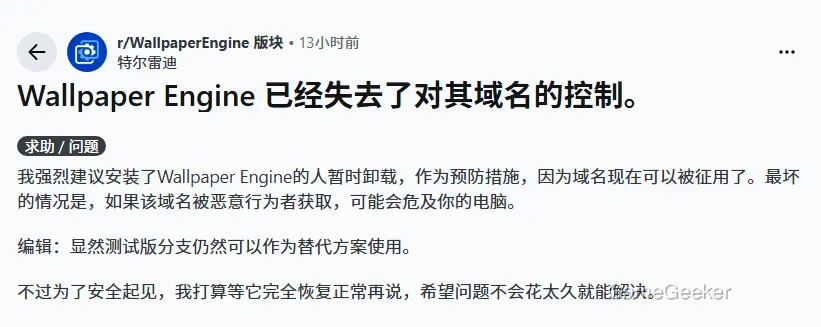
In its longer Steam Community explanation, the Wallpaper Engine team stressed two points. First, this was not caused by a forgotten renewal, and it was not a hacker attack. The post puts it plainly: this was neither a forgotten renewal nor a hack. Second, the root cause was an older workaround. To deal with YouTube blocking applications that do not identify the originating website, Wallpaper Engine had been sending the spoofed domain wpx.app in some web requests, even though that domain was never owned by the team.
More important is what caused it. The bug itself was unusual, but the larger lesson is familiar: temporary workarounds have a habit of becoming permanent liabilities. A compatibility fix can sit quietly for ages, look harmless, and survive because nothing around it forces a change. Then a redirect changes, a platform policy shifts, and the old logic suddenly becomes the problem.
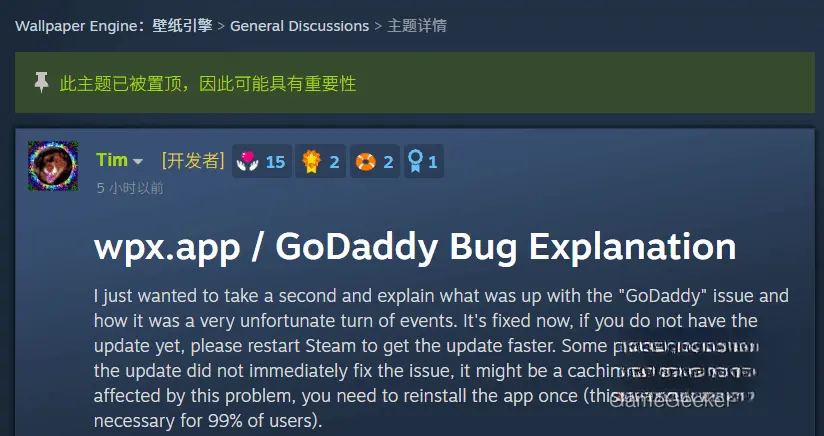
It also explains why the developers kept emphasizing that the beta version had already moved to a better solution. According to the team, they had not pushed that build live because they did not believe the release version faced any immediate risk, the beta might still contain other bugs, and the person responsible was close to a holiday, so the release was delayed. When the problem finally erupted, that same person was abroad and unable to receive the Steam SMS verification code required to switch the beta into the main version.
Then the timing got worse. Another developer, Kris, was under heavy stress that day because his dog was undergoing surgery, then powered down for the night. The team did not reconnect with him until 5:30 a.m. German time. The details are ordinary, but they help explain why the fix was not immediate. Players see a broken app and ask why the fix was not pushed immediately. Developers, meanwhile, run into platform security rules, access permissions, and the simple fact that small teams are still made of people.
The Steam team, according to Wallpaper Engine, also refused a request to promote the beta to the main version early. The reason was security: the switch had to be completed through the developer's phone verification code. That is frustrating for users, but understandable from Steam's side. Once a platform relaxes that kind of control in an emergency, it becomes much harder to justify strict enforcement the next time.
For users, the practical takeaway is straightforward. Update Wallpaper Engine first. If the issue remains, restart Steam so the update can be fetched properly. If it still persists after updating, the developers believe caching is the most likely reason. In a small number of cases, a full uninstall and reinstall may be necessary, but the team says that for 99% of users, that step is usually unnecessary.
Just as importantly, the developers say the underlying faulty code has been removed entirely, along with the older workaround. Before this, the actual risk was considered relatively low because the domain was mainly used to send spoofed domain information to YouTube and Wallpaper Engine's internal servers. So while the incident looked dramatic, it was not presented as a full-scale compromise.
The bigger takeaway here is maintenance debt. This was not as direct as an account breach or as obvious as a server outage, but it is a reminder for any always-on PC tool that relies on web requests: if old compatibility logic is still hanging around, even low-risk code can turn into a visible failure the moment external rules change. For Wallpaper Engine users, the sensible move now is to confirm the app version, watch future patch notes, and watch whether the team makes this recovery process more transparent in future updates.
Em promoçãoWallpaper EngineCarregando ofertas das lojas~ €3.99-16%



Comentários 0
Queremos saber sua opinião
Participe da discussão e compartilhe sua opinião sobre este jogo.
Ainda não há comentários. Seja o primeiro.