
























Opening
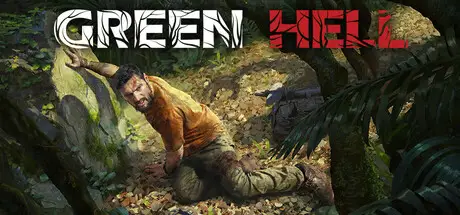
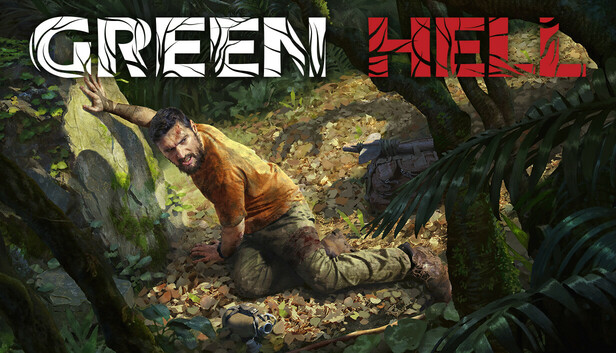
In most survival games, a wound is just a number sliding toward zero. Eat something, sleep it off, watch the bar refill, move on. Green Hell refuses you that comfort. It kneels you down in the Amazonian mud, has you peel back your own forearm, and makes you watch something move under the skin before you dig the leech out with your fingers. Dawdle, and that cut festers, reeks, and eventually grows maggots.

That is the whole pitch from Creepy Jar, a small Polish studio that looked at a genre drowning in tree-chopping sandboxes and decided, pointedly, not to make another one. Instead they took the single act of staying alive in a jungle and broke it into something close to a medical procedure. You are not fighting monsters here. You are fighting your own body, your own slowly cracking mind, and a rainforest that gets more frightening the deeper you push into it. The threat is never a creature lunging from the dark; it is the slow, grinding accumulation of small failures — a missed meal, an untreated scratch, one bad night's sleep on the wrong patch of ground.
Critics landed it around the high seventies, Steam keeps it pinned at 85 percent positive across seventy-five thousand reviews, and sales have run past twelve million copies. Those numbers describe a strange kind of success: a game that turns away most of the people who try it and still thrives, because the ones it keeps it keeps for hundreds of hours.
It does not pretend to be for everyone, and it never apologizes for that. But the people it is for tend to disappear into this jungle for a very, very long time, and they come back out talking about it like a place they actually survived.
Story | 6.5/10
劇情: 6.5/10A marriage held together by a two-way radio
Green Hell opens in the dark, with a blank where your memory should be. Anthropologist Jake Higgins wakes deep in the jungle with a radio and nothing else, and his wife Mia is gone. For the next thirty-odd hours that radio is your lifeline and hers is the only voice you get. She reads the map for you, calls out directions, talks you through a forest that wants you dead. It is a cruel piece of design: you can hear the person you love, you can never see her, and every transmission quietly reminds you why you are bothering to survive a place this hostile in the first place.

The bones of the story run heavy. Jake and Mia first came to the Amazon to study a lost tribe, the Yabahuaca, and Jake wrote a book about them. Then Mia was diagnosed with terminal lung cancer, the kind with a price tag nobody can pay, and a Brazilian pharmaceutical outfit called Omolu Corp took a sudden interest in his research into the tribe's immunity. They offered to fund a second trip. The surface reading is a desperate search for a cure. Underneath it is a corporation trying to convert a people's secret into a patentable drug, and that rot seeps into everything you do out here.
Nobody is pretending the plot is the draw. The Sixth Axis and the rest will tell you the writing is workmanlike at best, and the Chinese outlet 3DM listed the story outright as a weakness. There is no grand twist machine, no setpiece spectacle. The campaign keeps getting elbowed aside by the sheer admin of staying alive — you are mid-confession with Mia and suddenly a leech is the only thing that matters.
And yet that constant interruption ends up reinforcing the very thing the game wants to say. In real desperation, lofty feeling and private obsession always yield to the bare business of not dying. Your love for your wife is real, but a rotting arm is more urgent, and Green Hell never flinches from that arithmetic. The more frantically you ping-pong between surviving and searching, the more you feel the weight pressing down on Jake. The script is plain, but the predicament is not, and the predicament is what carries it.
Where the sanity meter rescues the writing
What pulls the narrative back from the brink is the Sanity system, and it is genuinely clever. Solitude here is not a theme you read about; it is a resource you watch drain. Spend too long alone, sleep on bare ground, witness something horrible, and your sanity drops. Low enough and a voice starts in on you, jeering, telling you to quit. Hit zero and you start hallucinating tribesmen who may or may not be there. The title is a pun the game earns twice over: the green hell is the rainforest that can kill your body, and it is also the inside of Jake's head as it caves in.

There is also a real darkness to the framing that elevates the whole thing. This is not a tale of plucky wilderness adventure; it is a story about a man bargaining with grief, chasing a cure across a continent because the alternative is accepting a death he cannot face. The corporate angle gives it teeth — the idea that a people's generosity could be strip-mined for profit hangs over every village you stumble into. None of this is delivered with great subtlety, but the ambition to even attempt these themes inside a hardcore survival sim deserves credit on its own.
The branching endings give you a reason to come back, and one of them lands a real gut-punch. In the so-called good ending you learn that Mia died back at the airstrip — meaning the voice steering you through the worst days of your life was something else entirely. Jake survives with his cure and a goodbye to a ghost. Set that against a peer like Don't Starve, which runs almost purely on systems with no emotional thread to speak of, and Green Hell's ambition stands out. The script is no triumph. But the willingness to wrap a story about grief and obsession around a survival sim is rare enough that it counts for plenty.
Audio | 8.0/10
音效: 8/10The voice you never see, and the one that turns on you
The most important instrument in Green Hell's mix is Mia's voice. She lives entirely inside the static of the radio — you catch her breath, her worry, her attempts to keep you going — and you never once see her face. That present-but-absent trick is what gives a mechanically-driven survival game an emotional spine. Plenty of nights you push on through the muck not because a quest marker told you to, but because you want to hear that voice say one more thing.

And then your sanity slips, and the audio turns into a weapon pointed at you. Drop low enough and a voice that belongs to no one starts up — mocking, goading, telling you to give it up already. This is not background score; it is narration. The game lets you literally hear your own mind coming apart. Wiring the soundtrack straight into the sanity system, so that listening becomes a source of dread rather than a mood-setter, is a sharper move than cueing scary strings on a timer. The first time it happens, most players genuinely cannot tell whether the voice is a scripted event or something gone wrong with their own headphones, and that uncertainty is precisely the point. The jungle has gotten inside your head, and the sound design is how it announces the breach.
Sound you survive by, not just listen to
The quieter triumph is how much survival information the soundscape carries. In a jungle where you can barely see past the next fern, your ears outperform your eyes. You learn to read the direction of a river from running water you cannot see, to clock a predator from one specific call, to read the coming rainy season in the shifting weather. Sound is not a cheap jump-scare tool here; it is the intelligence you stay alive on, and the game trusts you to use it.

That design makes Green Hell a completely different experience on headphones. Through speakers it is mostly noise. Sealed in, the rainforest wraps around you and every faint rustle becomes a question of life or death. The footsteps, the wet chop of a blade, the feedback of crafting — all of it serves the simulation rather than showing off. There is no orchestral flexing here, and there does not need to be; every sound is load-bearing, every cue earning its place by telling you something true about the world or about the state of your own fraying nerves.
It is worth saying how rare that discipline is. A lot of survival games reach for a dramatic score to manufacture tension; Green Hell mostly withholds music and lets the jungle's own racket do the work. The silence between sounds is as deliberate as the sounds themselves, and that confidence — trusting ambience and a single human voice to carry an entire mood — is what separates it from louder, busier peers. An 8.0 is the reward for restraint that knows exactly what it is for.
Visuals | 7.0/10
畫面: 7/10A first-person jungle built to suffocate, not to dazzle
Green Hell never sells you a vista. It sells you claustrophobia. The first-person camera buries you in the Amazon under layers of vine, wet earth, and a canopy that strangles the daylight, and the goal is not beauty — it is the feeling of not being able to breathe. Where Subnautica hooks you on the wonder of an unknown ocean, Green Hell does the opposite: it earns its atmosphere by hemming you in. You cannot see far, you cannot tell which way is out, you cannot work out what is hiding three feet of foliage away. That visual chokehold is precisely where the immersion comes from. The art does not flatter you; it traps you.

The image that actually sticks, though, is not a landscape. It is the body inspection screen. Lift your own forearm and watch a parasite ripple beneath the skin, or a cut go from clean to suppurating to fly-blown, and you get a physical revulsion almost no other survival game bothers to reach for. The graphics here are not chasing prettiness; they are chasing disgust, and they get it. That nausea is the visual foundation the entire damage-management system rests on — without it, treating a wound would just be numbers.
The building that lets the side down, and the platforms that vary
The visuals do stumble, and the stumble is obvious. Base-building looks plainly underdone next to everything around it. Go from a lean-to up to a proper fortress and the detail and texture work never rises to the bar the rest of the simulation sets. Several outlets flagged it, and they were right: the whole world is sweating the small stuff while the construction looks borrowed from a different, less careful game. It is a strange dissonance, given how much of the late game revolves around building, and it is the one place where the seams of an indie budget show through plainly rather than being hidden by atmosphere.

On platforms, Green Hell turned up on PC, PS4 and PS5, Xbox One and Series, and Nintendo Switch. On PC and current consoles it holds up fine; the visual density and the frame rate are enough to make the rainforest read as genuinely lethal, and the controller layouts survive the transition from mouse and keyboard better than you might fear for a game this fiddly. The Switch port draws the short straw, squeezed by the handheld's limits into the most compromised version of the lot, with the foliage thinned and the draw distance pulled in. None of it is a dealbreaker, but if you have a choice, this is a game that wants the horsepower of a real machine behind it.
Scenes that stay with you, and honest optimization
Set the flaws aside and there are moments that lodge in the memory. Morning mist crawling along a river while sunlight slices through the canopy into a clearing. A downpour that smears the whole jungle into static and drops your visibility to nothing, the sheer scale of nature pressing down on you. The instant you finally crest a ridge and the green you have been clawing through unfurls below in a way that is almost cruelly vast. None of it is effects-driven; it is observation, a real rainforest rendered with care. You get the sense the team actually looked hard at how light behaves under a canopy, how water moves, how a storm changes the color of everything, and then rebuilt those observations rather than reaching for a preset. That patience is why the jungle reads as a place rather than a backdrop, and why the few weak spots stand out so sharply against it.
Optimization, for an indie studio, is reassuringly solid. There is no top-tier graphical spec melting your GPU, but that buys broad accessibility, and a mainstream rig runs that jungle at the density it needs. Loading is smooth and the game is stable, with none of the stutter or crashing that would shatter the immersion this whole thing leans on. For a game that lives or dies on atmosphere, that stability is a quiet virtue in its own right — the scariest forest in the world stops being scary the moment it starts hitching. Weigh the clear weak spot of the building against the dependable strengths everywhere else, and 7.0 is an honest number rather than a generous one.
Combat | 9.5/10
玩法: 9.5/10Damage management: turning "getting hurt" into a procedure
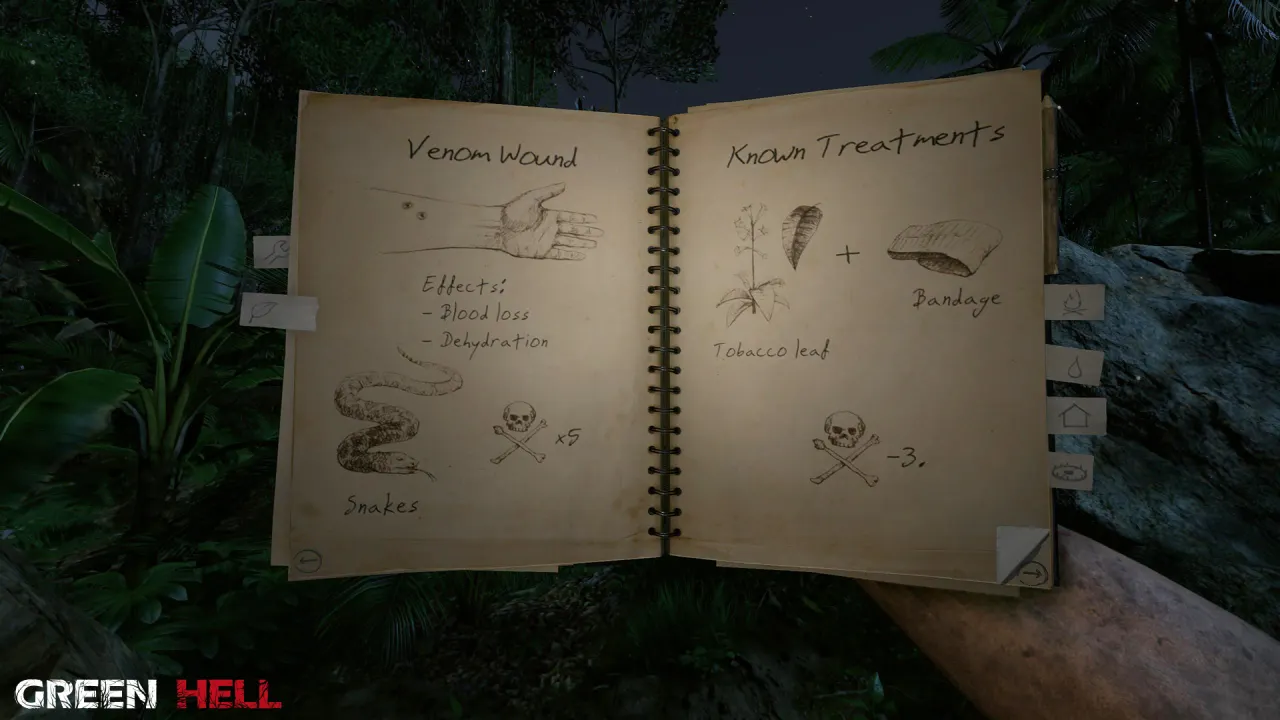
If you have to explain in one line why Green Hell is Green Hell, it is damage management. Most survival games flatten injury into lost health you top up with a meal and a nap. Green Hell goes the other way and hands you a body-inspection screen you can pull up at any moment to check every limb and your torso, one by one. A leech needs pulling out by hand. A cut wants a bandage or a leaf before it bleeds you down. Leave a wound and it infects, suppurates, breeds maggots, and yes, it can genuinely end your run for good.

The horror does not come from a monster. It comes from your own body slipping out of your control. The design converts "getting hurt" from a digit into a chain of things you have to notice, diagnose, and treat with the right plant. You have to recognize which leaf brings inflammation down, remember what dirty water gives you, sometimes read a vague ache with no prompt at all and work out what it means. That knowledge barrier turns plenty of people away, and it is also the purest source of the game's hardcore pleasure. Surviving, for once, has weight.
What makes it land rather than frustrate is how legible the cause and effect stays once you have done the homework. Nothing is random cruelty; every infection traces back to a choice — the raw meat you risked, the puddle you drank, the bandage you skipped. The game is hard, but it is fair, and that fairness is what keeps the brutal early hours feeling like a puzzle you can crack rather than a slot machine you cannot beat.
Parasites, sanity, energy: a noose of interlocking systems
Bolted to all that is the parasite and disease layer. Eat undercooked meat, drink unboiled water, shovel food into your mouth with filthy hands, and you pick up different illnesses — none of which clear up on their own, all of which burn through your nutrients faster. It forces the wariness of an actual survivor onto every bite you take.

Sanity is the third strand of the noose, the loneliness made numeric, fraying into voices and hallucinations the longer you go untended, so that mental upkeep becomes as much a chore as feeding yourself. Stack energy on top — every action costs it, and hunger and thirst quietly lower the ceiling on how much you can recover — and four systems lock together into something that squeezes the air out of your early hours. The difficulty curve is brutal and the tutorialization is sparse, so newcomers learn by dying on a loop: which mushrooms are poison, how to dress a wound, how to raise a shelter before the rains come, all of it paid for in lives. That early helplessness is the exact price of the mastery that comes later.
Co-op that splits the solitude, and why it beats The Forest
Green Hell's smartest move arrived after launch: four-player online co-op. Better still, it is not walled off in the freeform survival mode — the story campaign supports it too. That means the punishingly lonely experience can be shared out among friends, one foraging, one hunting, one watching everyone's wounds and sanity. It does not water down the difficulty to make room for company; it just spreads the load, and the barrier to entry drops hard. This is the engine behind its long tail of new players.

Stand it next to its most direct rival, the equally jungle-bound The Forest, and the verdict is plain. The Forest leans on horror atmosphere and the satisfaction of building, runs closer to an action game, and is frankly the easier, breezier sit. Green Hell flattens it on realism and on the sheer depth of damage management — in The Forest a wound is still mostly bleed-and-regen logic, while Green Hell has you yanking leeches, scraping out maggots, treating infection. One is a jungle thriller; the other is a jungle survival simulator. If what you want is the tension and the cost of genuine survival skill, The Forest cannot match this level of obsessive care. That is the spine under a 9.5.
Content | 8.5/10
內容: 8.5/10A campaign, a survival mode, and a prequel that costs nothing
Length alone keeps Green Hell from feeling thin. Follow the radio straight down the main line and you are looking at roughly twenty-five to forty hours. Come in new to the genre, or take the slow road and learn by trial and error, and fifty is well within reach. Chase every secret and side thread to the floor and a completionist run comfortably doubles past fifty hours. For a survival game out of a single indie studio, that baseline is already substantial — this is not a two-hour novelty that runs dry by the afternoon.
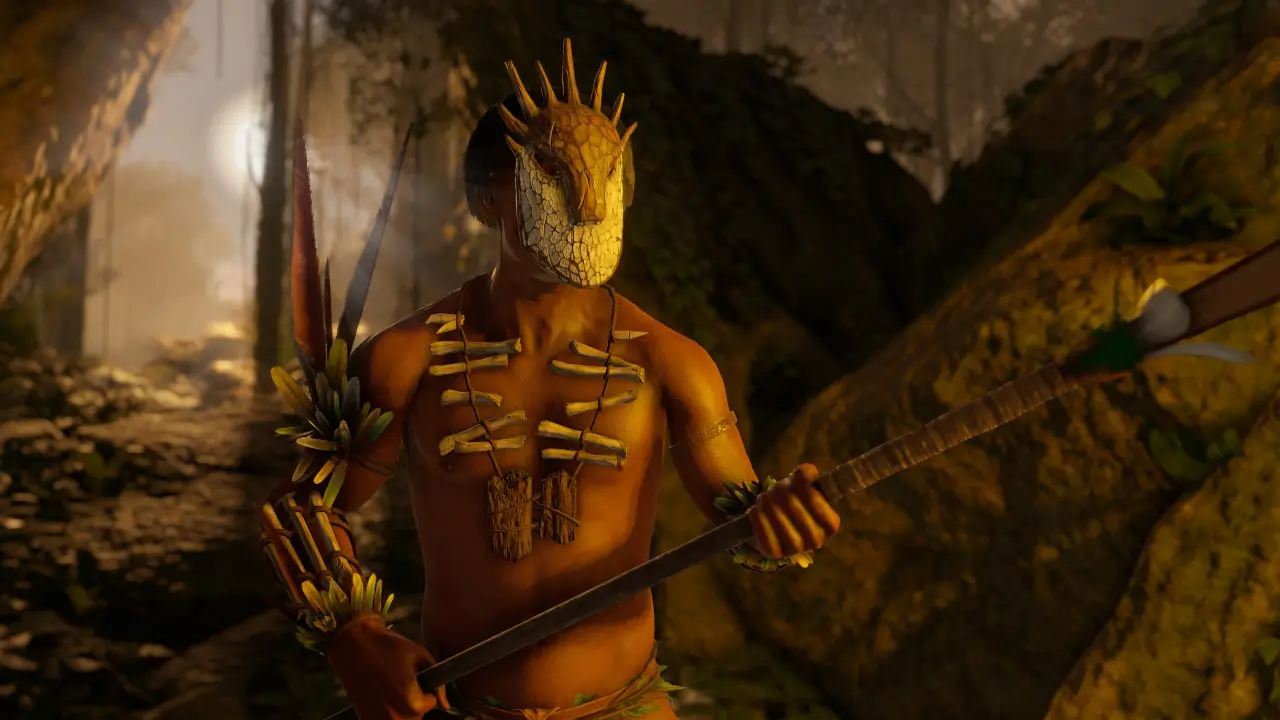
The part that really moves the needle is Spirits of Amazonia — not one expansion but a full trilogy, and free top to bottom. It is a prequel that rewinds you to Jake's first trip into the rainforest, to the origins of everything that later goes wrong. This is no token patch; it is a substantial slab of fresh campaign and new map, with the trilogy's final part opening to all PC players in 2022. That free content props the whole package up another notch, and it does it without the season-pass nickel-and-diming that has become the genre's default. Buy the game once and you own all of it, which in 2026 feels almost quaint.
Two modes, steady updates, and the answer in the sales figures
Shape-wise the game forks. Story mode is the search for Mia, with a proper arc and a destination. Survival mode strips the plot out and drops you into the jungle to do as you please — raise a fortress, or simply see how many days you can last in hell. Both support up to four-player co-op, which neatly covers the two kinds of player here: the ones who want a story, and the ones who only want to stay alive. It is a smart split, because the two audiences rarely overlap — the narrative crowd wants the radio and the mystery, while the sandbox crowd wants an empty map and total freedom — and rather than compromise one for the other, Green Hell simply builds both and lets you pick.

The update cadence earns the "evergreen" label. Co-op came after launch, the Spirits of Amazonia trilogy rolled out free in installments, and this small Polish studio has quietly kept feeding the game for years. Set against a peer like The Long Dark, which wins on stark, deliberately spare isolation, Green Hell is far more willing to keep stacking value with free expansions. And the most persuasive evidence is the numbers: seventy-five thousand-plus Steam reviews holding at 85 percent positive, and sales past twelve million copies. A game that launched well and only got thicker — running a long tail like that in a genre this crowded owes a real debt to its sheer volume of content.
Replay value: every run is a fresh gamble
A good chunk of the game's lifespan hides in its replayability. Because the survival systems are so granular and so unforgiving of randomness, no two runs play out the same. One time you catch an infection in the opening hour and scramble through the brush for the right herb; the next, your shelter is not up before the rains hit and you are staring down disaster. Every run is a fresh gamble that drags you back to adjust and adapt.
Add the branching endings as a narrative reason to return, the freedom of custom difficulty in survival mode, and the entirely different rhythm of teaming with different friends, and Green Hell hands you no shortage of reasons to start over.
For hardcore players the real fun often begins after the credits. Chasing extreme survival-day records, attempting a vegetarian run, building an actual rainforest fortress with a friend — these are the goals you set for yourself once the game has stopped telling you what to do. They are also where the community lives, trading shelter blueprints and disease-management tricks long after the story is a memory. Those self-set goals stretch the content well past the official runtime, and they are what underwrites the retention behind those twelve million sales — a number you do not reach on a campaign alone, but on a game people keep reinstalling for years.



留言 0
期待聽到你的聲音
歡迎來到評論區!說說你對這款遊戲的看法,第一個發言說不定有驚喜~
還沒有留言,來聊聊你對這篇評測的看法吧!