


















Opening
The single best thing you can do for Inscryption is walk in knowing nothing.
It opens in a cabin lit by one guttering candle. A wooden table. Across from you, a figure whose face never quite resolves out of the dark, who pulls out a deck and asks you to sit and play a hand. You decide what this is — a moody little deckbuilding roguelike, draw cards, climb a difficulty curve, done. And then, quietly, it begins dismantling that decision. The trick that makes Inscryption great is not that any one system is best in class. It is that the game treats your assumptions about what a card game is supposed to be as raw material it gets to build with.
So this review keeps its hands where you can see them. Daniel Mullins and his publisher spent the launch hiding the back half of the game from every trailer, terrified that a spoiler would gut a surprise you can only feel once. We hold the same line here: what it does well, whether it is worth your money, who it is for — all fair game.
The cards it keeps face down stay face down. Eighty-six on the critic aggregates, a ninety-six percent recommend rate, Game of the Year at the developers' own awards and the top indie prize in the same season, a million copies sold inside three months. Those are facts, and they are the game's weight class, not its flavor. The flavor lives in the slow dawning unease that creeps over you somewhere in the second hour, when the table starts behaving in ways no card game has any right to. The rest you find out by sitting down.
Fair warning on the verdict, since it cuts both ways: this lands at 8.5. The story and the sound are nearly faultless, the design is bristling with ideas, and the two soft spots — raw card depth and a replay value that deflates the moment the surprise is spent — are real, not nitpicks. This is a game with a sharp personality, sharp enough that its flaws and its virtues turn out to be the same coin. If all you want is a thousand-hour duelling engine, look elsewhere. If you want an oddity you will still be thinking about years from now, pull up a chair.
Story | 9.5/10
劇情: 9.5/10A card game that knows you are holding the controller
The story is the soul of Inscryption, and the one thing nobody has managed to copy: it folds the fact that you are playing a game into the plot itself.
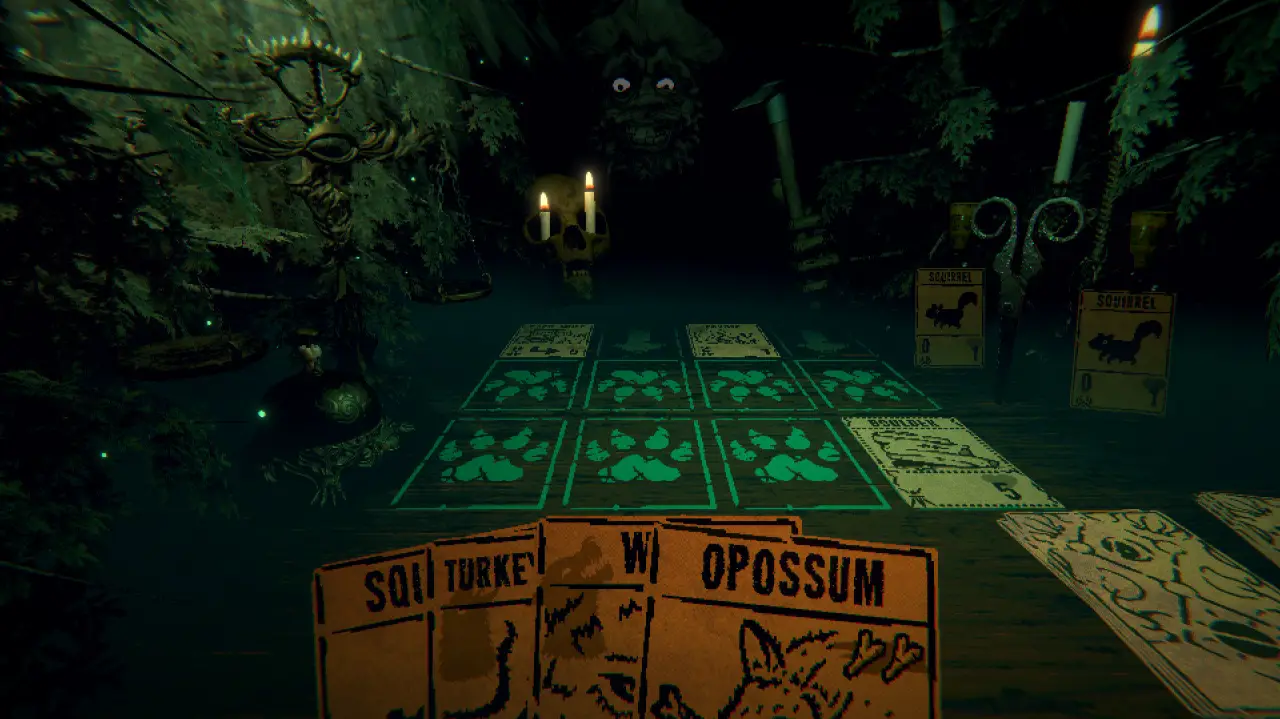
On the surface you are just trading hands with a shadowy host, round after round. Then a pawn stands up and walks off the board. A drawer in the cabin slides open. Something is wedged behind a painting on the wall. This is not only a card game — it is a locked room you are expected to root through with your own hands. Solve a mechanism and the host's manner toward you shifts a degree colder, or warmer, and the larger story creeps forward between hands. There are barely any cutscenes. The narrative is broken into pieces and tucked into corners you assumed were decoration, and it makes you do the assembling.
The crucial part: as you go, the game keeps yanking the rug you only just learned to stand on. Out of respect for what makes this work, not a word here about how it does that — only this much, that every shift resets the little verdict in your head, the one that goes "oh, so this is a such-and-such game," and smashes it again.
Resetting your own understanding, over and over, is the engine of its narrative sleight of hand. You never get to feel settled, and that is entirely the point. Most games want you to master them; Inscryption wants you perpetually off balance, always one beat behind a host who knows exactly where this is going and is enjoying watching you not.
The fourth wall has a crack in it
If the main story is a maze, Inscryption deliberately knocks a hole in one wall and lets the maze spill out past the screen.

It threads an alternate-reality puzzle through the whole thing, the kind where a few answers genuinely live outside the match, somewhere you have to go looking once you stand up from the table. That instinct — the story does not only live inside the game — is what lifts its ambition clear of an ordinary deckbuilder. It taps, gently and repeatedly, on the pane of glass between you and the screen, until you can no longer say cleanly whether you are playing the hand or the hand is playing you.
None of this arrived from nowhere. Mullins built his name on Pony Island and The Hex, two earlier games that delighted in breaking the fourth wall and toying with what a player expects. Inscryption is that authorial streak finally grown up. The scattered, occasionally show-offish meta experiments of those two get sewn, for the first time, into a card battler that is genuinely fun and stands up on its own legs. The method did not change. This time it has muscle and blood under it — the earlier games were a magician rehearsing the same trick on scratch paper, and here he has finally found a stage worth emptying his whole hand for.
Why everyone tells you not to spoil it
The strangest thing about Inscryption's reputation is that nearly everyone who recommends it grabs your shoulder first and says: don't read a guide, don't get spoiled.

That is not players being precious. It is baked into how the game stores its value. The bulk of its impact rests on a handful of "wait, what" moments, and the instant you know they are coming, the charge that can only land once leaks away. A Chinese outlet titled its review, flatly, "The Maker Fooled Everyone" — which says it all: you think you are playing one thing, and it was steering you toward another the whole time. That con is the most precious thing it owns.
So a quiet conspiracy holds, from publisher down to forums. The marketing simply refused to show the back half, content to let you arrive with a head full of question marks. A whole audience agreeing to keep its mouth shut is its own kind of endorsement — people guard the surprise because they know it is worth guarding. Set it in the wider lineage and it shares blood with works like The Stanley Parable and Doki Doki Literature Club, games that make the medium itself the subject. But where those lean toward pure concept, Inscryption stitches the meta and a solid card battler together more completely than any of them. It can make you slap the table over a plot beat and sweat the odds on a single hand. You are not admiring a clever installation. You are playing a good game that happens to run far deeper than you bargained for. That is the part no one has managed to copy.
Audio | 9.0/10
音效: 9/10Jonah Senzel's score, and the prize it earned
Strip away the visuals and the systems, leave only the sound, and Inscryption could still pin you to the chair.

Jonah Senzel wrote the music — thirty tracks that took Excellence in Audio at the Independent Games Festival, which is the hardest credential the audio side can show. His work resists easy filing: part post-rock, part warped Americana, part musique concrète, people keep saying, and the plain version is that it is neither sweet nor soothing. It works a strange, unplaceable tonality that nails you to the feeling that something here is slightly, persistently wrong. This is not background you put on to relax. It is load-bearing dread.
Better still, the score quietly retunes itself as the game moves through its phases. When the rules get overturned and the look of the thing changes, the music puts on a different face too, always biting down on whatever suspense the moment is selling.
It dares to go fully silent when silence does more, letting one thin environmental sound drag your heart into your throat; it can flood a whole room in an instant when the beat needs to land. Swap this score for anything more conventionally "game music" and it is hard to imagine the cabin keeping much of its spell. The sound is not decoration. It is the breath the story takes, and it does as much narrative lifting as any line of dialogue in the game.
The thing actually holding the room up is your ears
More than half of Inscryption's atmosphere is built in the ears, not the eyes.
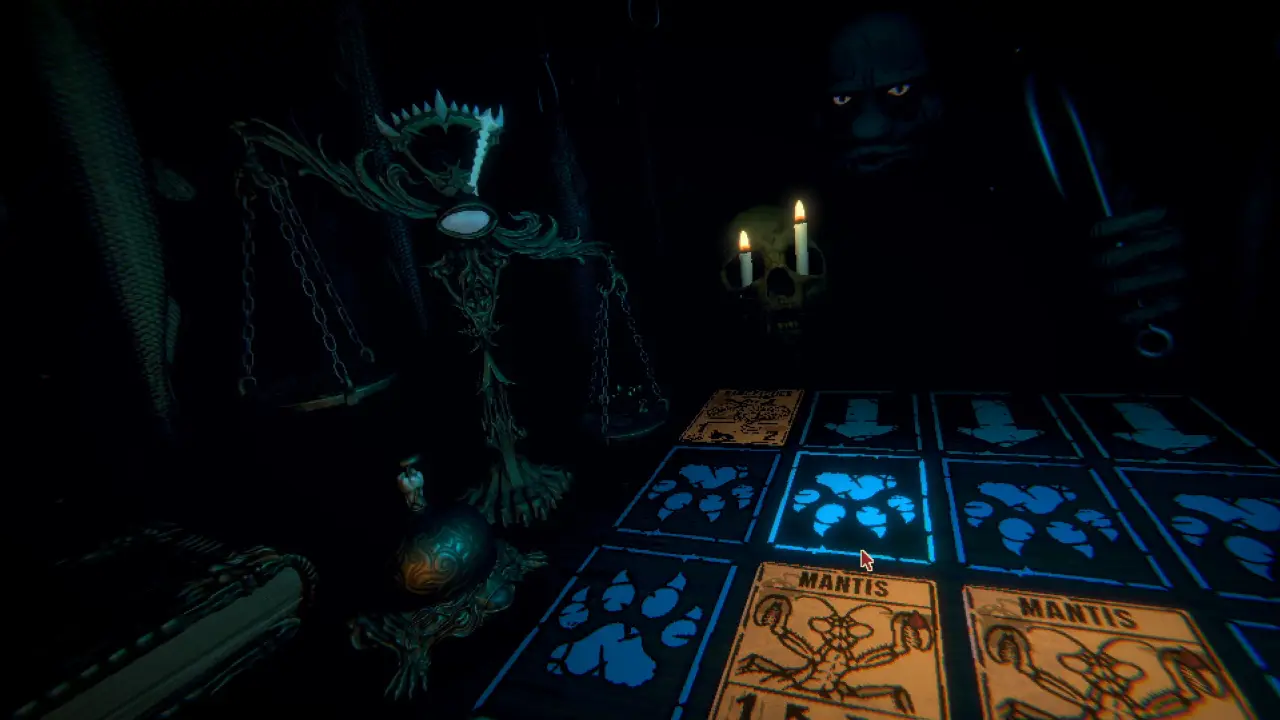
The candle spits and crackles. A card hits the wooden table with a flat, heavy knock. The host murmurs, now near, now far. A drawer drags open with a complaint. Layer those small sounds and you get the airless pressure of a sealed room with no exit. You cannot make out the figure across the table, but you can hear that he is there, and that sense of being watched rides almost entirely on the audio. Mute it and play again — half the cabin collapses on the spot.
Senzel was not a one-off contractor brought in for a single job. He has scored every Mullins game, Pony Island through The Hex, author and composer a standing partnership, and that long-worn rapport lets the sound interlock with Mullins's meta sleight of hand without a seam. Plenty of the turns get telegraphed by sound first; your ears tend to catch the wrongness before your eyes do. On console the audio also leaks out of the controller's own speaker, so the host's voice seems to surface in your palm — a slab of plastic in your hand, and still it raises the hair on your neck. Inscryption sounds first-rate not because its specs are high but because every sound serves one job: to keep you uneasy, to keep you in that "there is someone else in this room" tension. It is a restrained, exact piece of audio design, and it earned that trophy.
Visuals | 6.5/10
畫面: 6.5/10Not a benchmark — a thing you cannot un-see
Let us be clear up front: Inscryption is no graphical showpiece, the sort you run to flex ray tracing. It will not trouble your GPU. Its visual worth lives entirely in art direction, not engine tech.
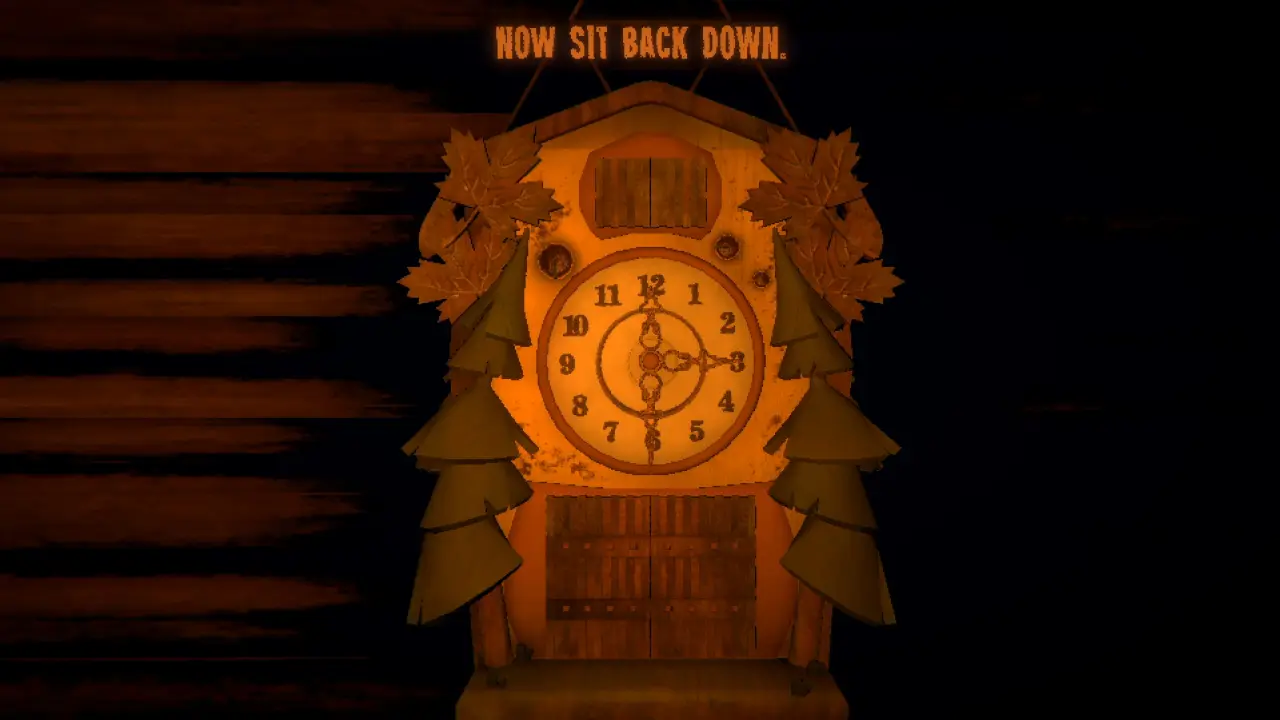
Its signature image is that table in the candlelit cabin. A low pool of warm light reaches only the middle of the surface; everything around it is light-swallowing black, and the opponent's face stays tucked in shadow, never quite legible. That lighting — illuminate only what must be lit, hide the rest — turns an ordinary card table into a stage that crawls up your back. It does not win on polygon counts. It wins on a precise grip of mood, on knowing that a single warm light against a wall of black does more work than a thousand particles ever could. You may not recall how many effects it ran, but you will not forget that candle and that table, and you will picture them again the next time someone says a card game cannot be frightening.
Because the art is simple and the play uncomplicated, it runs rock-steady on nearly every platform, fussing over no hardware and throwing no tantrums. For a game leaning on immersion, "never stutters" is its own courtesy — you are never wrenched out of the cabin by a dropped frame or a fan spinning up. Atmosphere bruises easily when tech interrupts it, and here the tech barely puts a foot wrong. There is a lesson buried in that smoothness: a game does not need a heavy engine to feel heavy, and Inscryption carries more dread on a near-empty technical budget than plenty of photoreal blockbusters manage with everything switched on.
Worth noting too is how boldly it weaponizes not being able to see. Most games dread a player squinting and floodlight every corner; Inscryption does the reverse, deliberately drowning whole regions in dark so that "I can't make out who is across from me" becomes the source of the fear. The candle gives you just enough and no more, and your eye keeps straining toward the black for a face that never arrives. That command of negative space — knowing precisely what to withhold — outclasses any pile of effects, and it is the kind of restraint money cannot buy, only taste.
Two viewpoints, and the art that argues for the plot
Inscryption's picture is not a fixed table. Now and then it stands you up to search the room with your own hands.

The game swings between two viewpoints: a hunched, top-down duelling angle where attention narrows to a dozen cards, and a first-person cabin crawl where you rise, move, open drawers, check corners. That rhythm — play a while, then get up and hunt for a clue — keeps the image from stagnating and grounds the escape-room structure in something you can actually see. You are not watching a story through glass. You are in the room.
And in the back stretch, the art style takes one — really, more than one — fairly violent turn, echoing the way the play overturns itself. What it becomes stays sealed here; only this, that the visual sense of "the world just changed under you" is itself part of the gut-punch. Each shift in style tells you, without a word, that the game you thought you were in no longer exists. Using art style itself to narrate means the visuals stop being mere wrapping and become a moving part of the plot. Every card, every object scattered on the table, that perpetually absent face — none of it is placed at random. They keep up a fine, unnameable unease, and the game even leans on a deliberately aged, dredged-from-old-media texture to hint that this match has a deeper history behind it. Look closer and you read more between the frames. Against a peer like Slay the Spire — another card game that never traded on visuals — Inscryption wins not on resolution but on a mood you clock in one glance and never shake. It proves a point: what makes a game look good was never the number your card spits out, but whether the art has an idea. The 6.5 docks the specs. The artistry sits well above that score.
Combat | 9.0/10
玩法: 9/10Sacrifice, bone, and a tipping scale
Peel off the narrative shell and Inscryption's table holds up on its own — and holds up with character.
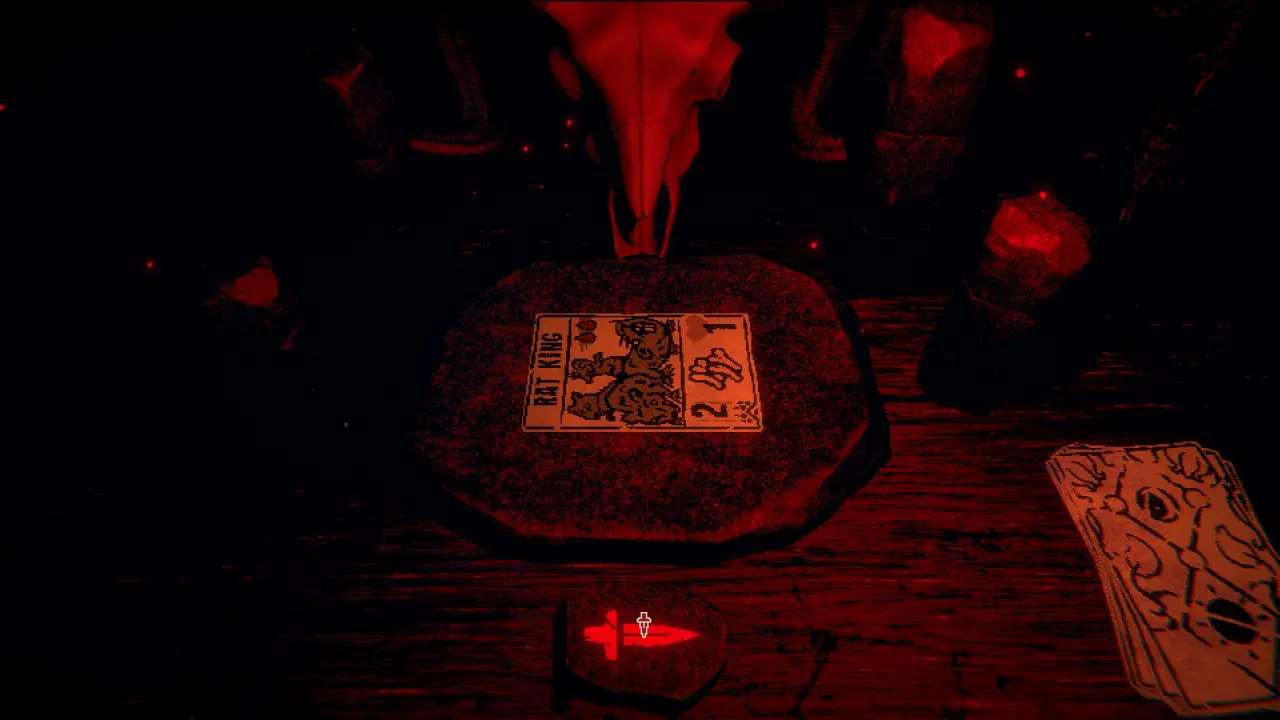
At its heart sits a two-resource economy built on hard choices. Want to summon something strong? You usually have to sacrifice another creature already on the board as the price — and that cut both empowers and stings, forcing you to reckon, every time, whether the trade pays. The second thread is bone: creatures that die leave bone behind, and bank enough of it and you unlock plays that need no sacrifice at all. The two resources pull against each other, so deckbuilding is freighted from the first turn with the question of what to spend and what to keep.
The win condition has its own shape too. You are not grinding a health bar; you are loading a balance scale. Damage from you and your opponent presses on opposite pans, and whoever tips the scale fully to their side first takes the hand. That makes a single round taut — a couple of key cards can lurch the scale in an instant, and the jolt of it is real. It also means comebacks are always live: you are never quite dead until the scale bottoms out, and neither is the host, which keeps every hand honest right to the last draw.
A game that keeps rewriting its own rules
What makes Inscryption leap out of the card-game pack is its habit of changing the rules on itself.
The build depth comes mainly from sigils on the cards — flight, a double strike, assorted buffs, stuck on like stickers to chain into combinations. Just arranging those sigils gives you plenty of dirty tricks to scheme up, and the better ones reward a player who can read two turns ahead and set a board up to spring. But the genuinely unusual part is that the rules will not sit still: as you progress, the game keeps flipping over the loop you only just got comfortable with. The difficulty curve is not paved with dreary stat inflation but dragged forward by one "wait, it can do that?" after another. You almost never get to feel you have solved this table.
An honest line is owed here: for pure card depth and long-haul staying power, it cannot match a specialist like Slay the Spire, which polishes its building to something you could almost diagram as math and which holds up over hundreds of hours. Inscryption's hands serve story and surprise. They want to clock you, once, at the right moment, with a great draw or a sudden rule break — not to feed you two years of optimization. If you came for a thousand-hour building engine, know that going in: the table is fun, but stamina was never its ambition.
A whole room to take apart, between the hands
Inscryption's play does not stop at the table. It packs a full escape room into the seams between matches.
Mid-session you are let up to rummage the cabin — pull drawers, work mechanisms, find hidden compartments — and those puzzles braid into the card strategy until the whole thing thickens. It is not "card game" and "puzzle game" bolted together as two modules; it makes you switch between two kinds of brain, the one that just finished pricing out a hand's odds and the one that now has to figure out what that string of symbols on the wall means. That give-and-take of pace is something a lot of pure card games simply cannot offer. As for longevity, the free Kaycee's Mod that the studio added later carves out the beloved first act and reworks it into an endlessly replayable building mode, piling in new cards, fresh challenges, and unlocks. In there you can finally play the sacrifice-and-sigil engine for proper depth, climbing the difficulty in tiers and testing archetypes the way you would in a serious builder. It catches, precisely, the crowd that only ever wanted to keep playing Act One, and it shoulders nearly all the replay pull outside the campaign. The main story hands you one unforgettable run; this free mode makes sure you still have cards to play after it.
Content | 7.5/10
內容: 7.5/10An eight-hour story people still chew on years later
Inscryption is not a game that bludgeons you with bulk. Its idea of content is short, dense, no padding.
The campaign wraps in around eight hours; mop up most of what is there and you are near eighteen. Newcomers to the genre, chewing slowly through its shifting rules, can stretch to thirty or forty. But whichever bracket you land in, almost nobody calls it bloated — every hour goes to the cutting edge, the pace tight, the information packed, with none of that filler shoveled in to pad a runtime. Eight hours does not sound long, yet it is exactly that restraint that lets its twists land one after another, clean and hard, and leaves so many people still muttering about that cabin years after the credits.
Put another way, it is not selling hours. It is selling density. In an age of hundred-hour open worlds, Inscryption runs the other way and proves a carefully staged eight hours can carry far more weight than a watered-down eighty. There is a confidence in that math — the studio trusts its peaks enough not to bury them under busywork, and you feel that trust returned every time a beat lands without a single wasted minute leading up to it.
The free mod, and a community that won't quit
Finish it still hungry and Inscryption has somewhere to send you — mostly for free.
Kaycee's Mod, the studio's own add-on, is the most substantial slab: it turns the well-loved first act into an endless gauntlet that sharpens the further you push, unlocking new cards, new rules, and the journal fragments of a late character named Kaycee Hobbes along the way. That promotes the most popular stretch of candlelit duelling from a one-time story beat into a long-haul loop you can grind, and it costs nothing. For anyone who is here purely to play cards, that slab rivals the campaign for value. Past the official content, the player-made mod scene on third-party platforms stays lively, popular downloads running high, everything from new cards to whole new rule sets, stretching the game's life out a good way further. For players willing to tinker, it means that even when the official content runs dry, the community keeps feeding you new things. Buy once and you get far more than the campaign's eight hours — it behaves more like a small, watered ecosystem than a one-and-done.
A one-time wonder, or an endless grind — does it actually hold up
There is no dodging the honest topic when you talk content: Inscryption's main story has limited replay value.
The reason is already on the table — it leans so hard on the "didn't see that coming" charge, and that charge deflates once it has gone off. So the campaign reads more like a wonder you walk through once than a tower you re-climb. A second run can still be lovely, the way revisiting a favorite film is lovely, but the floor-dropping shock that defined the first time simply will not detonate twice; you become the host now, watching from outside, no longer the one being fooled. That is the flip side of its narrative design, no cheap flaw, but worth knowing before you put money down: you are buying an unforgettable trip, not a duelling tool to keep you company for two long years. Which is exactly why the long-haul replay weight falls almost wholly on Kaycee's Mod. Set it beside Slay the Spire — a pure builder born for infinite replay, every run a fresh roll of the dice — and the difference is plain. The Spire hands you an engine you will never wear out; Inscryption hands you a story you will never forget, plus a free mode to keep the lights on. No higher and lower in that, just two philosophies of content: one banks value on the repeatable, the other on the unrepeatable. Decide which you actually want before you call it short on legs — because for a lot of people, an eight-hour run you cannot forget is worth more than an engine you cannot exhaust.




留言 0
歡迎發表遊戲評價
歡迎參與討論,分享對這款遊戲的評價。
暫無留言,歡迎分享對本篇評測的看法。