



















Opening
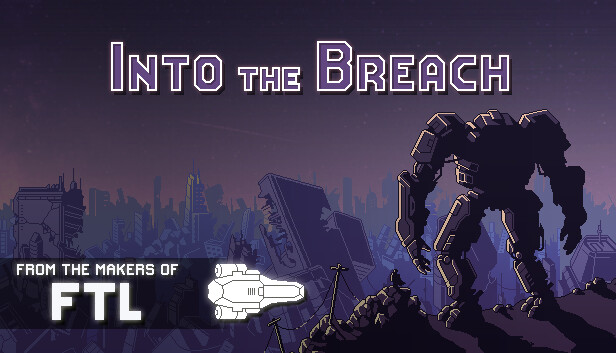
Into the Breach, released by Subset Games on 2018-02-27, is a tactics game that turns every move into a problem with teeth. The core loop is brutal in the best way: defend buildings, manage enemies, and leave yourself an escape route, all within a small number of turns. That pressure is exactly why it works. Based on the scores cited here, it remains deeply divisive, with an overall 6.7/10.
It’s easy to understand the appeal. The first time you force an enemy to the edge of a bridge, watch the terrain shove it off balance, and then make it change position against its own interests, Into the Breach makes its identity clear. This is not a game about flashy mechs or monstrous insects, even if both are present. It is about restraint, precision, and surviving the consequences of your own choices.
The catch is that not everyone found that elegance compelling. Rock Paper Shotgun gave it 1/10, and so did Eurogamer, Youyanshe, 3DM, and Chuapp. At the other end, PC Gamer and IGN both scored it 9/10, while GCORES landed at 8/10. That spread says as much about the game as the numbers do: this is a beautifully compact strategy game, but one that clearly asks a lot of its players.
For the right audience, that demand is the point. For everyone else, the narrow room for error may feel less like tension and more like punishment.
Gameplay | 9.5/10
The strength of this turn-based tactics game lies in how it makes “prediction” the main course. Enemy actions are readable, the terrain is usable, and once push-and-pull movement clicks into place, it creates that rare kind of satisfaction: you’re not dealing damage, you’re rewriting the situation. One second it still feels like a dead end; the next, it suddenly comes alive. Short. Precise. Ruthless.
Its difficulty is equally clear — the margin for error is low. You often feel like you’re just one step away from saving everything, but that one step is exactly the turning point for the whole board. The problem is sharp, and the impact on the experience is immediate: mistakes will make your heart ache, and can even waste an entire run. — But that’s not fatal; in fact, it’s the core charm. Because every recovery isn’t about “smoothing it over,” but about forcing you to calculate everything again.
What’s even more brilliant is that it isn’t the kind of depth built by piling on complicated systems. It’s like a Swiss Army knife: not many functions, but each button is tightly interconnected. After a dozen or so runs, you’ll start actively watching where enemies will land, instead of fixating on your own attack power. That’s when the game truly begins.
Content volume | 8.5/10
內容: 8.5/10The semi-roguelike structure turns replaying into a driving force, not a burden. The fact that each run features different enemy situations and battlefield conditions sounds like a cliché, but you only realize its value when you actually play: you can never simply copy the answer from the previous round. New situations force you to change your approach. It’s annoying. And addictive. The design of multiple mech squads further makes the idea of “one more run” feel real. Different teams have clearly different skill combinations and tactical approaches, which means you’re not repeating the same path to victory—you’re switching to a different problem-solving language. It’s like changing instruments to practice the same piece: the melody stays the same, but the feel changes. The problem is that the content’s appeal comes more from systemic recombination than from narrative progression or scene building. In other words, it excels at repeated simulation, but is weaker at making you feel like “why do I have to keep watching?” But that’s not a fatal flaw. For a high-pressure tactical game, simply getting players willing to think repeatedly is valuable enough.
Image | 6.8/10
畫面: 6.8/10Its visuals are not attention-grabbing at first glance, and it would even be easy to mistake it for a lightweight title. The checkerboard battlefield, the clean and distinct unit silhouettes, the clearly defined attack ranges—these design choices are all telling you: don’t look at the spectacle, look at the information. The colors are highly distinguishable, which matters a lot, because in a game like this, the last thing you want is to misread the situation in a critical turn. That doesn’t happen here. Clean. Direct.
This kind of presentation doesn’t rely on flashy visuals to carry it; it wins through readability. You won’t be staring blankly at the special effects, but you will quickly realize that your ability to keep a clear judgment under pressure is tied to how the screen is organized. It’s like a menu with excellent layout, not meant to move you, but to keep you from ordering the wrong dish.
Of course, its sense of scale is indeed not large, and that also makes it easy to underestimate how complete it is. The impact of this issue is that the “first impression feels light,” but it doesn’t really hurt the actual experience. Once you get into it, you’ll find that it lays out every combat detail very clearly, which suits its gameplay better than simply piling on more detail ever could.
Plot | 4.6/10
劇情: 4.6/10This part is basically not a selling point. The world is built around mechs fighting the underground insect swarm Vek, and the objective is very clear: protect the buildings and the power grid. The setting is not hard to understand, but it also rarely takes things one step further. The main storyline feels weak, with the characters and the story serving more as background elements. The problem is not that it is poorly told, but that it says too little, making it hard for the plot to leave much of an impression. In practice, you know what you are defending and who the enemy is, but you rarely stop because of the “story itself.” It does not hold the experience back, but it does not elevate it either. It is understandable for a work like this to place its focus on gameplay. — But if you are expecting strong narrative drive, this will probably be disappointing. The plot is not a fatal weakness, but it clearly lacks presence. After finishing it, what you usually remember are a few desperate turnarounds, not a particular character or a line of dialogue.
Audio | 4.0/10
As for the audio, the available information is not solid enough, and media discussions rarely single it out on its own. What can be determined is that it has not become a frequently mentioned highlight of this game. In other words, at least in most people’s actual experience, the sound has not taken center stage.
That is not to say it is necessarily bad, but its presence is rather low. The issue is that if a work emphasizes high-pressure decision-making and turn-based pacing, and the audio does not provide clear feedback, a sense of rhythm, or something memorable, it can feel a bit quiet. Being quiet is not itself a flaw. It just does not leave the impression that it deserves a separate compliment.
So this part feels more like competent background than a key module that elevates the overall atmosphere. The impact is not fatal, because the real focus of this game is not here; but if you place a lot of importance on the soundtrack and sound effects, it will probably not be the reason you want to own it.


留言 0
期待聽到你的聲音
歡迎來到評論區!說說你對這款遊戲的看法,第一個發言說不定有驚喜~
還沒有留言,來聊聊你對這篇評測的看法吧!