



















Opening
No Rest for the Wicked plays a trick almost nobody else has pulled off: it hangs a Souls brain inside a Diablo body. The camera floats overhead the way it does in any loot-grinder, but lean on the attack button like you would in Diablo and the game will hand you your head. Every swing has weight, every guard drains stamina, and survival is a question of reading an enemy's wind-up rather than out-clicking it.
That this comes from Moon Studios — the Ori people, masters of the gliding hand-painted platformer — is the first surprise. Dark fantasy ARPG is a long way from a luminous metroidvania, and the studio went independent to make it on its own terms. The bet shows. As of this writing it sits at 72.9 on OpenCritic across 18 reviews, recommended by just 47 percent, while Steam reads a steadier 80 percent positive from north of sixty thousand players — a number that cratered below 60 at launch over performance and clawed back up through patches.
One thing has to be said before any verdict lands: this is Early Access. You are buying an unfinished, evolving thing whose main story stops mid-sentence, sold by a studio that has, so far, kept showing up to finish it. Read the six dimensions below with that split in mind — what you can play now, and what it is plainly still becoming.
Story | 7.5/10
劇情: 7.5/10A plague returns, and the tale stops mid-breath
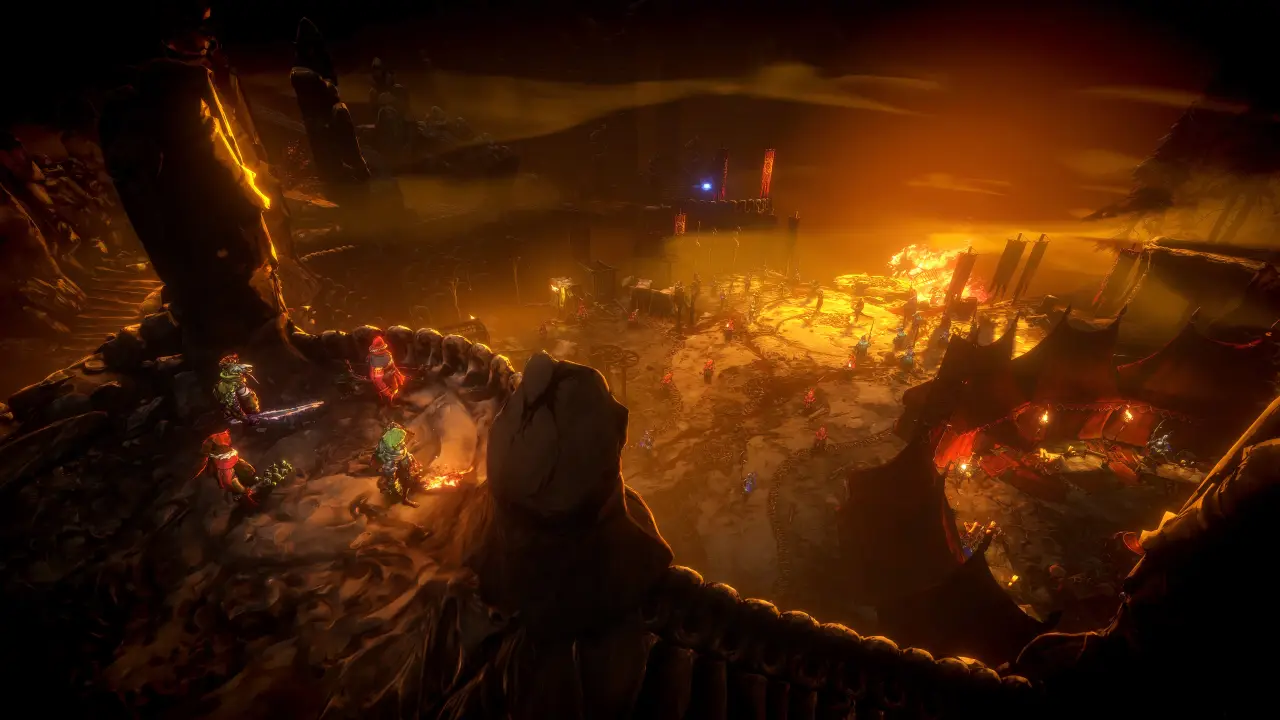
The year is 841. King Harold is dead, a plague that once nearly ended the world is stirring again, and you are Ellsworth — a holy warrior of the ancient Cerim race, dragged into the storm to find the rot at its root. The opening hours set their tone in a low, grim key: shipwreck, sickness, villages going to ruin. No rousing speeches, no chosen-one fanfare, just a man pushed to the center of a catastrophe with a question to answer.
The setup is genuinely well-built. Worldbuilding, motive, the shape of the threat — all laid out cleanly, paced with restraint, never dumped through cutscene monologue. The opening island of Sancra does a lot of quiet heavy lifting here: it teaches you the world's mood before it teaches you its rules, so by the time you reach Sacrament you already feel the weight of what's been lost. There is craft in that ordering, and it's the kind of craft Moon Studios has always had — a sense of place that arrives through atmosphere first and exposition a distant second.
And then it ends. The current Early Access main path runs roughly ten hours and breaks off at a moment that matters, right after you have finally learned the world's temper and started to care about a handful of faces. That is not artful ambiguity. That is unfinished, the price of the Early Access tag, and it deserves to be named plainly. To the game's credit, the cut-off isn't lazy — the suspense, the turns, the emotional groundwork across those ten hours are all there. The thread simply hasn't been written to the length it needs. You get fully invested, and then discover the rest is waiting on a patch.
Show, don't shout — the writing trusts you to look

What gives the storytelling its texture is how little it explains. The game buries information in environments, overheard exchanges, and the half-said lines of people who have other things on their minds, then trusts you to assemble it. That fragmentary, withholding approach marries beautifully to the oppressive mood, but it asks something of you in return: come looking. Stand around waiting to be narrated at, and you will feel underserved.
The emotional anchor arrived with the Breach update, which carries the story past Ellsworth's return to Sacrament and digs into his relationship with his daughter, Odessa. It is a small, vital pivot. It turns the protagonist from a task-doer into a man with something to lose, and it hands the whole bleak march a point of warmth. Dark fantasy curdles when it forgets to be human; this father and daughter are where the game remembers to be human.
That pivot also tells you something about how the studio is building the narrative — outward from a personal core rather than down from a grand prophecy. Plenty of genre stories start enormous and stay cold. This one starts intimate and trusts the world to widen around it. Whether the larger plot eventually justifies the patience is still an open question, because so much of it is yet to ship. But the instinct is right: give us a person to hold onto first, and the apocalypse around him will mean more.
Measured against Hades — a different kind of memorable

Set it beside Hades and the trade-off snaps into focus. Hades writes its cast loud — dense banter, fast turnover, emotion worn on the sleeve, characters you grin at on every run. No Rest for the Wicked goes the other way: quieter, slower, leaning on voice work and setting rather than sheer dialogue volume. It would rather you read a person from a tired sigh or a worn keepsake than have them narrate themselves.
The result is two opposite flavors of "memorable." Hades makes you laugh and remember a god; this game makes you go quiet and remember a few ordinary people the world has bent. Neither approach is wrong, but they aim at different feelings, and it's worth knowing which one you're signing up for. If you want a cast that performs for you, the slow burn here may read as cold. If you want characters who feel like they existed before you arrived and will carry on after you leave, this is closer to what you're after.
The characterization is solid and credible, and Sacrament's lived-in hum is the storytelling's real strength — the single thing the writing does that nothing about the Early Access scope can take away. But the playable arc, right now, still can't carry the larger tale it so obviously intends to tell. What it offers today is a deeply convincing prologue, not a finished book. Judge the prose, not the page count, and it's some of the most assured writing the genre has produced lately; judge the whole, and it's a story you'll have to keep coming back to as the updates land.
Audio | 7.5/10
音效: 7.5/10Sound as undercoat — the score knows when to vanish

The audio here is not trying to steal the scene; it is laying down the base coat the rest of the game paints over. Wind, a distant bell, the low moan of the plague-sick — the ambient layer sits muted and close, and it lands exactly on the wavelength of a world chewed up by disease and war. Walking a gutted village, what you hear is closer to silence than to swelling strings, and that restraint unsettles more than any wall of music could.
The score follows the same discipline. It serves the rhythm of the story and the fight instead of pouring emotion into your ears nonstop. During exploration it retreats almost out of earshot, ceding the floor to ambience; the moment a fight breaks, percussion and strings step up to carry the taut, half-beat-late melee. Crucially, that quiet is functional. Read-and-react combat lives on tiny audio tells of an enemy's wind-up, and a wall-to-wall score would bury them. The game turns itself down so you can hear the things that keep you alive — a piece of sound design that clearly understands its own game.
There's a confidence in that choice that a lot of bigger productions never reach. The easy move is to score every minute, to never risk a silent stretch that a player might read as "nothing happening." No Rest for the Wicked trusts silence to do work, and it pays off: the hush of a ruined chapel or a fog-bound road is doing as much for the dread as any cue could. When the music does arrive, it arrives meaning something, because you've been let breathe in the quiet first.
Voice work and impact — the town breathes, the blows land

Voice acting is the most concrete win on the audio sheet. The performances given to Sacrament's residents are what make the hub feel like a place where people actually live rather than a cold transaction post. Earlier I credited the writing's floor to environment and dialogue; this is the engine under it. The fatigue in a delivery, a pause, a swallowed word — they carry more than the lines themselves, and that is the backbone of the game's immersion.
Combat audio is just as deliberate. The crunch of a blade biting home, the brittle clack of a parry, the thin, draining feel of a stamina bar bottoming out — each strike is a confirmation of whether you hit the beat.
It is the mirror image of Hades, whose dense percussion makes you giddier the longer you swing; here, the longer you swing, the tighter you wind. And the gap lives in the same place: the audio is solid and dutiful throughout, but it has yet to produce a single theme you'd hum away from the screen. Its sound design is a first-rate supporting act that hasn't found its lead melody — though with the game still in Early Access and the soundtrack set to grow alongside the story, that lead may yet arrive. For now, the audio is the part of the package that asks for the least attention and rewards it quietly: you won't talk about it the way you'll talk about the art or the combat, but you would feel its absence in a heartbeat.
Visuals | 8.5/10
畫面: 8.5/10A moving oil painting — Moon Studios' signature, dressed in black

If anything in No Rest for the Wicked already earns full marks, it is the art. The hand-painted craft Moon Studios carried over from Ori has swapped its luminous fairy-tale skin for dark fantasy and lost none of its edge. Every frame reads like an oil painting that happens to move — visible brushwork, light and shadow set in hard warm-cold contrast, surfaces gnawed by plague and fire into a texture that won't age out of fashion the way polygon counts do.
The payoff is recognition. Most action RPGs pile into 3D realism and end up looking like one another; this one is identifiable at a glance. GameSpace handed it a 9 and kept circling back to the visuals as the thing it remembered, and the reason is precisely that "moving oil painting" quality — it wins on taste and brushstroke, not on material fidelity. That distinction matters more than it sounds. Fidelity ages; a higher-resolution texture always comes along to make last year's look dated. A point of view does not. The painterly approach here is the kind of stylistic choice that will still read as deliberate and handsome a decade from now, the same way the Ori games still do, long after their technical specs stopped being remarkable.
Better still, the style isn't merely pretty; it does emotional work. Plague greens, ember reds, the cold blue of fog — each dominant hue speaks for a despairing world, and the lighting exists to press desolation into the image rather than to show off. Stand before a ruin and the decay and the beauty hit at once. That is "suffering made gorgeous" rendered directly into pixels. The art and the tone are not two separate achievements; they are the same achievement, which is rarer than it should be in a genre that often treats visuals as a coat of paint over the mechanics rather than a voice of their own. You could mute the game, strip the text, and still read its grief straight off the screen — and very few of its peers can claim that. It is the kind of art direction that makes you stop, mid-fight sometimes, just to look at where you're standing.
Hand-built spaces and a rocky road to stable frames
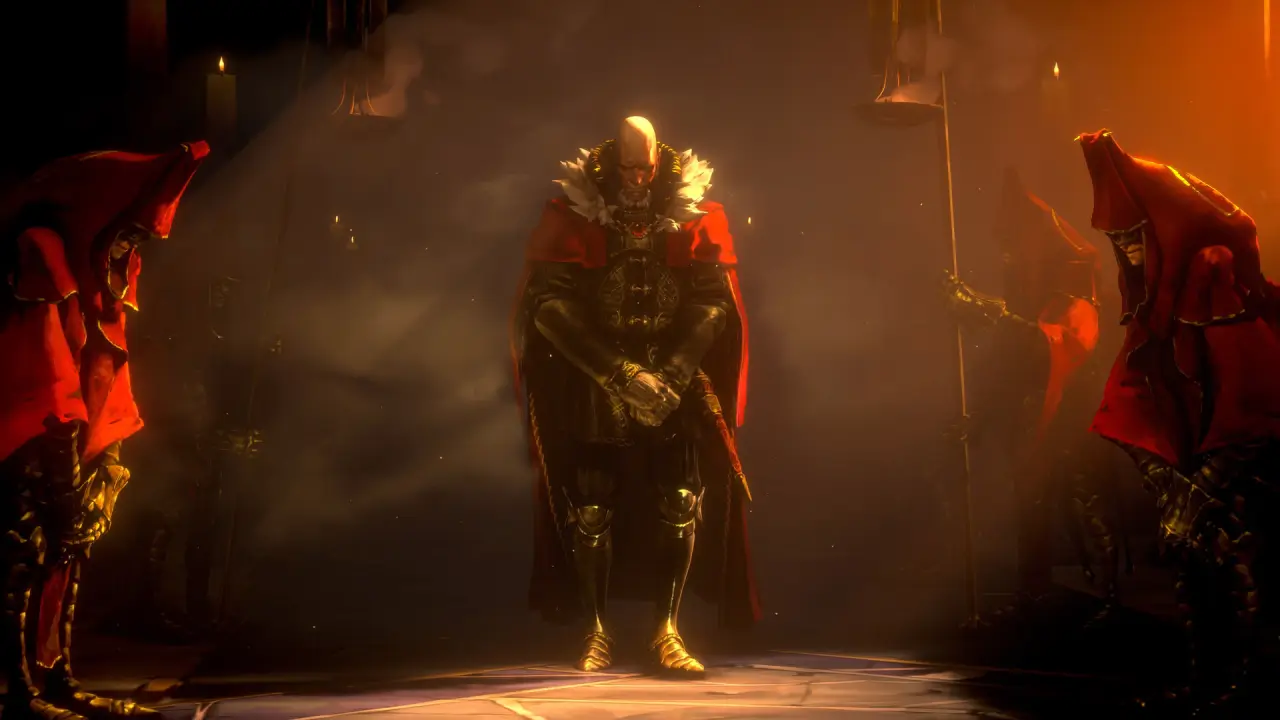
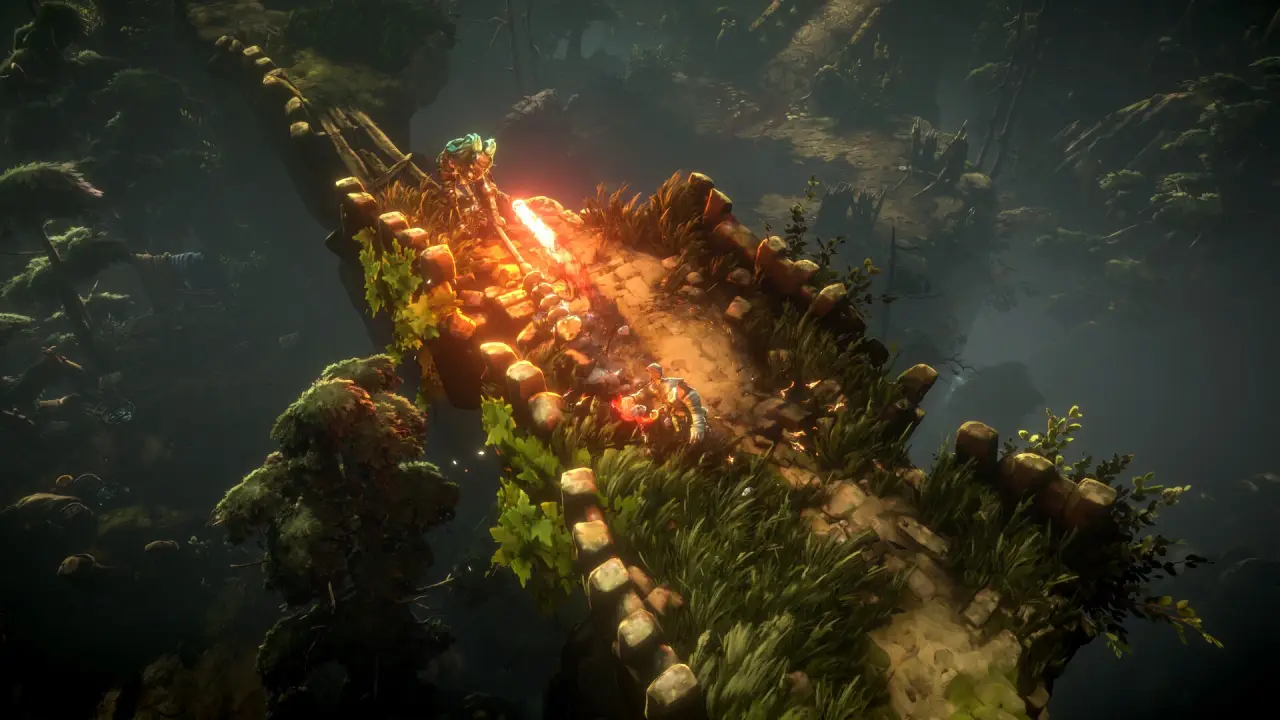
The maps are not randomized kill-corridors. They are hand-built, fixed spaces obsessed with verticality and hidden routes. You climb from a wrecked village into a fog-choked forest gorge, up to the top of a derelict windmill for the long view, then down into Sacrament's stacked, tangled lanes. Shortcuts, ropes and breakable passages stitch the spaces together and reward you for circling back — a very Zelda-like loop. The catch is that the isometric angle cuts both ways. The framing wrings real menace out of the composition, but when terrain gets layered and the foreground swallows the background, you sometimes can't read what's walkable from what's a dead end, and the flow of exploration stutters while you nudge the camera and trial-and-error your way through.
Looking good is one thing; running well is another, and here the game took an ugly detour. Day one shipped with unstable frame rates, stutter and overheating on some rigs, and Steam approval dropped under 60 percent with the bulk of the complaints aimed at performance — a brutal own-goal for a game whose whole pitch is how it looks. There is a bitter irony in a title this visually ambitious tripping over the very thing meant to showcase it, and the early reviews reflected the frustration of people who could see the beauty through the stutter and were furious about it.
The turn came from relentless hotfixes. Moon Studios patched hard and fast, performance cleared up within weeks, and approval climbed back toward 78 and now sits around 80 percent across sixty-thousand-plus reviews. That recovery arc is itself a small portrait of the whole "build-it-in-public" bargain: an unlovely starting line, followed by a team that visibly heard the complaints and went to work. Against the silken polish of Ori and the Will of the Wisps — Moon's own benchmark — the ceiling here is just as high, but the floor is still being shored up, one patch at a time.
Combat | 9.0/10
玩法: 9/10Half a beat slow — Souls reads under an overhead camera

Gameplay is the strongest card in the deck and the reason the 9.0 sits where it does. The combat is deliberately a half-beat slow. Each weapon's light and heavy attacks have their own animation frames and recovery, every swing telegraphs, and you read an enemy's opening before deciding to poke with a jab or commit to a punishing heavy. The masterstroke is putting stamina on the block as well as the attack: you cannot turtle behind a raised shield, so you are forced to read, to find the rhythm, to spend resource at the right instant. Death rarely comes from slow hands. It comes from not having read the room.
That depth is backed by a wide armory — well over a hundred weapons, and even within a type the lights, heavies, dash attacks and follow-ups differ outright. Swapping weapons isn't swapping a stat line; it's swapping an entire cadence of openings and punishes you have to relearn. For the hardcore, that's the dig site: you don't get stronger by inflating numbers, you get stronger by learning the temper of the thing in your hands. It also means the difficulty has a teachable shape. When you die, the game is almost always telling you something specific — you committed to a heavy you couldn't recover from, you blocked when you had no stamina to spend, you stood where the second enemy could reach you. Lessons, not lottery.
PC Gamer called it "not a Diablo, but maybe the smartest soulslike I've played in a long time," and GameRant put it bluntly — "it's better once you stop playing it like Diablo." Both are right, and both point at the same misunderstanding that trips up newcomers. Players arrive expecting to wade into a horde and click it apart, and the game patiently, repeatedly kills them for it. It borrows the overhead loot shell and runs Souls philosophy underneath, rather than bolting difficulty onto an ARPG. The moment that clicks — the moment you stop charging and start spacing, baiting, reading — is the moment the combat flips from punishing to genuinely thrilling, and it's the single most important thing to understand before you buy.
Durability, the grind, and a multiplayer road yet to be built

The loot loop is real and it drives the hours. Sacrament's Cerim Crucible throws you into brutal back-to-back fights for currency you trade up into better gear, while glyph-like Cerim Whispers act as death-and-respawn points, knitting drops, scavenging and progression into the engine that keeps you swinging. Sit it between its rivals and the position is clear: Elden Ring wins on read-and-react suffering, Diablo 4 wins on a flood of loot, and this lands between them — deeper reads than Diablo, thicker grind than Elden Ring — without yet matching either at its own peak.
Then there's the lightning rod: weapon durability, lifted straight from Breath of the Wild. Gear wears with use, death chips it further, and you trek back to Sacrament to repair. Defenders say it adds resource tension and gives every good drop real weight; detractors say it keeps breaking the flow — you're in the groove, the blade goes red, and back you go. It's a love-it-or-hate-it call, but it does make the return trip a recurring bit of friction in the rhythm. The cleaner version of this idea would let the tension live in the fight rather than in the commute, and that's the note the system hasn't quite hit yet — it manufactures stakes by making you stop playing, which is exactly the kind of trade-off a slower combat game can least afford. On the multiplayer front, the Early Access roadmap slots online co-op and PvP into the first major update, with up to four-player co-op. Picture four players spacing and splitting aggro inside this read-heavy system and the strategic layer cracks wide open. The foundation is rock solid; the upper floors are still under construction, and that 9.0 grades the core, not the finished building. Even unfinished, though, this is the most distinctive combat system to land in the isometric space in years, and it alone is reason enough that the game keeps its grip on the people it grabs.
Content | 5.5/10
內容: 5.5/10Roughly ten hours, and the floor drops out
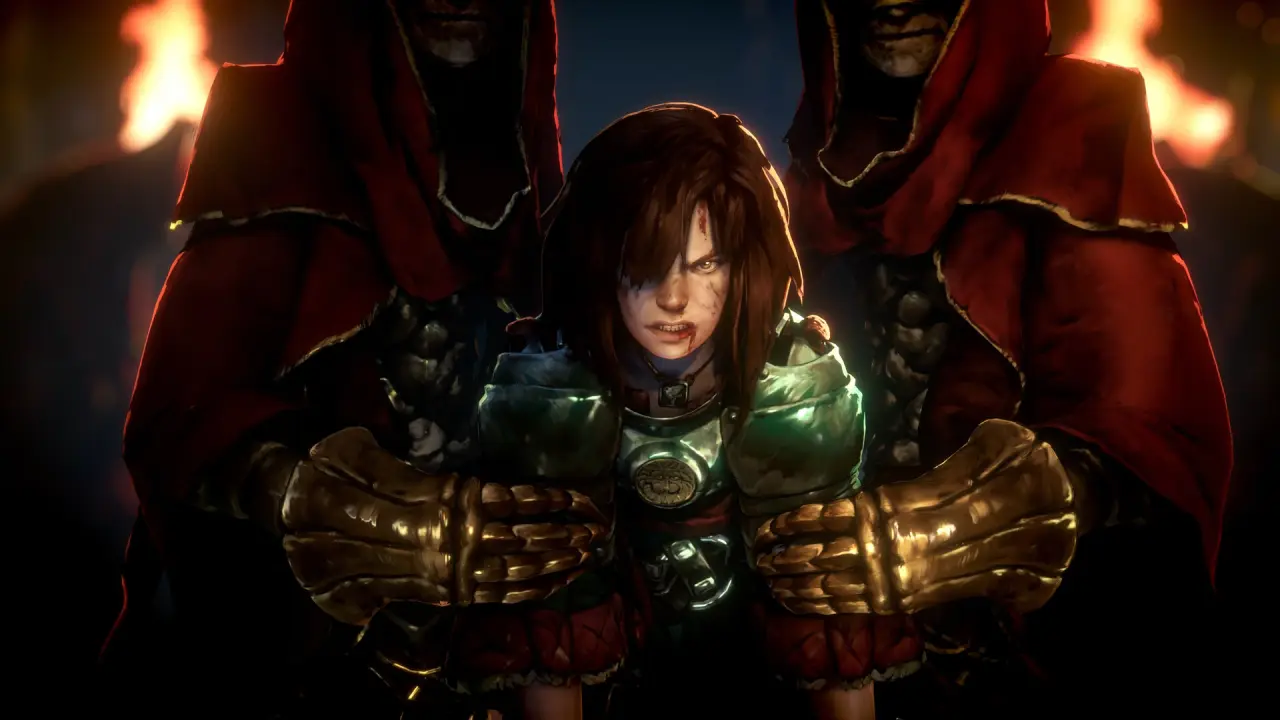
Content is the dimension that drags, and the 5.5 sits low on purpose — it's pricing the "unfinished" of Early Access. The current main path runs about ten hours and, as noted, snaps off at a pivotal beat, leaving the loud regret of being yanked out just as you've settled in. Ten hours isn't short for an action RPG on paper, but the story it tells and the world it builds are plainly aimed at something far larger; what's here is an opening chapter, not a body of work.
Worse, those ten hours keep getting interrupted. Durability sends you trekking back to repair, inventory housekeeping eats real time, and both thin out an already lean content density, so the genuine "hours of play" land below the headline figure. It's a strange thing to flag against a game that is otherwise so good at respecting your time in combat, but the content layer hasn't yet learned the same lesson the fighting has — that friction is only worth it when it's interesting, and trekking back to a repair bench is not interesting. The gap between how thoughtful the combat is and how thoughtless some of the busywork is can be jarring, like two different design teams shipped the same disc.
For the hardcore, the staying power runs higher than the number suggests — read-and-react difficulty means you'll retry and refine, and the Cerim Crucible offers brutal extra gauntlets to grind outside the story for currency and gear. But that's depth, not breadth. It holds the players willing to dig in and master the systems; for anyone who wants sheer volume to fill the calendar, the plate is still too small. The honest summary is that there is a lot of game in these ten hours for a certain kind of player, and very little for another, and which one you are decides almost everything about whether the current build is worth your money.
Fiddly systems, a roadmap that delivers, and the price you're paying
Inventory and loot management is the loudest complaint. Kill, scavenge, crack a chest, and you quickly drown in gear and materials whose sorting feels like chores. The most telling detail: early chests stacked items only 99 high, forcing constant shuffling, until Hotfix #4 took community feedback and raised the cap to 999. That tiny 99-to-999 fix cuts both ways — it exposes that the early systems weren't polished, and it stands as proof the team is actually listening. Other friction piles on: muddy affix presentation, clunky item comparison, no quick on-ramp for repair and resupply. None is fatal alone, but stacked together they turn managing gear — which should be a treat in a loot game — into a tax.
The good news is the curve climbs, and it climbs steeply. The Breach update, live on April 30, 2025, bundled what Moon Studios pegs at over 11,000 changes: new regions, a new enemy faction called the Harvesters, two fresh weapon archetypes in gauntlets and wands, a reworked loot drop system and more story. That's no drip-fed patch; it's hard evidence the studio executes on its roadmap, and it reframes the whole value proposition. An Early Access game's worth isn't a fixed point — it's a rising line, and every update on the scale of the Breach drags that line upward. The reworked drops answered the early "loot's too shallow" complaints directly; the new weapons thicken build variety; the new faction and zones push the content ceiling higher.
Which sets the buying frame plainly: Early Access is sold at a discount that rises once it hits 1.0 — plain notice that you're funding an unfinished, evolving product. Against the bottomless affix sprawl of Diablo 4 and Path of Exile, the build depth here stays restrained and the content ends early. So the decision splits cleanly. If you can accept a half-built game and want to grow with it, buying in at the discount and unlocking content as it lands is a reasonable bet. If you only want a complete, cleanly capped experience, the rational move is to wait for 1.0 — even at the higher price. Whichever you choose, "this is Early Access, the story cuts off, but the updates are real" are the three facts that have to come first, before any score, before any recommendation, before you spend a cent.





留言 0
歡迎發表遊戲評價
歡迎參與討論,分享對這款遊戲的評價。
暫無留言,歡迎分享對本篇評測的看法。