


















Opening
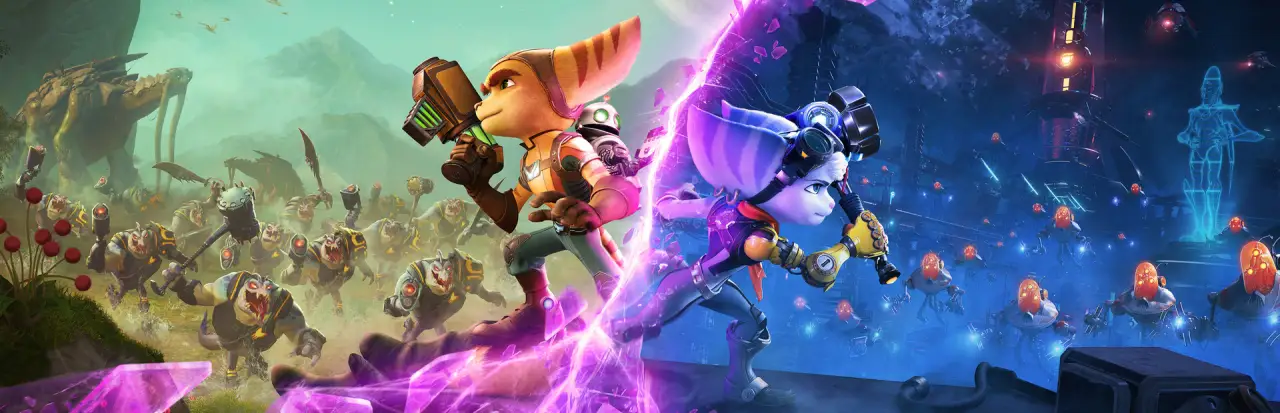
The hero comes screaming out along a rail, a giant mech's laser sweeping in from ahead while the path under his feet fractures with almost no room to hesitate. In that single moment my strongest feeling was not "this game must have cost a fortune." It was that the game understands, better than almost anything else in its genre, how to pack speed, color, and explosions into the same shot without the frame ever turning to mush. Then it cuts to another world entirely, and Rivet throws herself headfirst through a purple rift in spacetime, the picture looking like a sci-fi cartoon yanked straight into a playable state. It feels full. It also feels smooth.
The best part of Rift Apart, honestly, is not the multiverse premise. It is that relentless forward pace that almost never lets you space out. Shooting, jumping, traversal, character swaps — pull any of these apart on its own and none of them is new, but strung together they play like a sharply edited blockbuster with very few slack stretches in the middle. That does not mean it has no problems. The story runs light, and the content volume cannot go toe to toe with the hundred-hour behemoths. But if what you want is a high-quality, low-barrier, high-completion adventure, its hit rate is remarkably steady.
Across this review I will walk through every dimension that matters: how the visuals hold layered chaos together, how the gameplay loop stays accessible without going shallow, how the cast carries a light story, how the audio props up the whole ride, and where the content thickness quietly runs thin. By the end you should know exactly what kind of adventure you are buying — and, just as importantly, what kind of adventure you are not.
Story | 7.2/10
劇情: 7.2/10The multiverse-crisis setup is plenty direct, and its upside is how fast it lets you settle in. You do not have to cram a pile of backstory first, and you are not blocked at the door by some overcomplicated narrative threshold. You step in, you get it, and you are moving.

A cast that carries the whole arc
The likability of Ratchet, Clank, Rivet, and Kit is the key to why the story flows the whole way through. Especially in this kind of light adventure register, a charming cast matters more than a sprawling premise. These characters bounce off one another with an easy warmth, and the script trusts that chemistry to do the heavy lifting rather than reaching for grand stakes it has no intention of honoring. Rivet in particular is a genuinely strong addition — her debut, diving headfirst through the purple rift, sets the multiverse tone immediately and gives the game a second perspective that feels earned rather than tacked on. The shot of Rivet and her robot companion glancing back at each other against a sunset captures this work's emotional register perfectly: it does not dig deep, it does not weigh heavy, but the atmosphere is exactly where it needs to be. What makes the cast work is that the writing never overreaches for them. The jokes are paced to land, the quieter beats are short enough to feel sincere rather than maudlin, and every character is given just enough room to be memorable without demanding a full arc the runtime cannot support. It is an ensemble built for momentum, and on that count it succeeds completely, giving you a group you are happy to spend the whole journey alongside.
Clear conflict, modest depth
The problem is just as clear-cut. This plays more like a family-friendly sci-fi animated feature than the kind of story that has you turning it over and over after the ending. The villain scientist, standing before the experiment pod in his glowing helmet, has a striking enough look, and the conflict is legible — you always know what is at stake and who wants what. But the overall depth is genuinely limited. There is no rug-pull, no late reversal that recontextualizes what came before, no theme that lingers uncomfortably once the credits roll. The writing is competent and pleasant; it is simply not trying to be profound. The beats arrive exactly where you expect them to, the emotional swings are gentle and well-telegraphed, and the resolution ties everything off with a tidy bow. For a younger audience or anyone who simply wants a clean throughline to hang the action on, that predictability is a feature rather than a flaw. It means you are never confused, never stalled, and never asked to do narrative homework between set-pieces. The cost is that nothing about the plot will surprise a seasoned player, but the game seems entirely at peace with that bargain, and so, mostly, was I.
What that actually costs you
So what is the experiential impact? While you are playing, you feel relaxed and at ease, and the drive to push forward stays online the entire time. The moment-to-moment never drags because the characters are good company and the plot keeps handing you a clear next objective. But the instant you set the controller down, the story does not linger in your head all that long. Is that fatal? It is not. Because from start to finish this game never presented itself as a serious narrative-ambition piece in the first place. It cares about keeping you company as you run the whole adventure to its end — and running it happily. Judged against that intent rather than against a prestige drama it never wanted to be, the story does precisely the job it set for itself, which is to be a warm, frictionless throughline for everything else the game does better. Think of it less as the reason you are here and more as the connective tissue that keeps the spectacle coherent, the glue that lets one dazzling planet flow into the next with a why attached. On those modest terms it is a clear success, and asking it to be anything more would be missing the point of what Insomniac actually set out to build here.
Audio | 8.0/10
音效: 8/10The good thing about the audio is not the kind that leaps out to steal the scene the second you boot up. It is the kind you only notice mid-play, when it dawns on you that this audiovisual partnership is simply too well-rehearsed to be an accident.

Sound that rides the rhythm
Weapon fire, explosion feedback, the cues that mark a scene switch — all of them know how to ride the rhythm, nudging the satisfaction of combat up another notch. In fast-paced forward play especially, good sound design works like a drumbeat: its job is to pin your attention to the action right in front of you. It has no need to upstage anything, but it does need to be precise. And here it is precise. Each shot lands with a weight that matches its visual punch, each explosion confirms a hit before your eyes have fully caught up, and the transitions between worlds are scored with just enough sonic flourish to feel like an event rather than a load screen. That tight coupling between what you hear and what you do is the quiet engine under the whole experience, and it almost never misfires. The mix is layered with real care, too: in a crowded battlefield you can still pick out the specific audio cue that tells you a particular threat is winding up, which means the sound is not just atmosphere but functional information feeding straight back into how you play. That is the mark of design that was tuned by people who understood the game as a system, not just a spectacle, and it is why the moment-to-moment never devolves into undifferentiated chaos no matter how busy the screen gets.
Performances that interlock
Voice acting and performance follow the same logic. The way the characters speak, their emotional swings, the lighthearted, humorous baseline — they all mesh, and nobody comes across as particularly jarring. You very readily accept that this is a bright, boisterous adventure rather than a deliberately po-faced space opera. The delivery is warm and well-timed, the comic beats land without straining, and the ensemble feels like a cast that actually enjoys sharing scenes. There is a shortfall, though: the music and sound design are high in overall craft, yet they lack that absolute, one-ear-and-you-remember signature. No single theme burns itself into memory the way a genre-defining score might. You will not walk away humming a motif, and weeks later you would be hard pressed to whistle a single bar of it. The orchestration is lush and the cues are perfectly functional, but they serve the scene rather than standing apart from it, which is a reasonable trade for a game this propulsive yet still leaves a small gap where a truly iconic theme could have lived. It is the one place where competence outruns inspiration.
Comfort over instant canonization
The experiential impact shows up more as "consistently comfortable" than "instantly legendary." That is not a regret so much as a genre choice. The soundtrack knows its assignment is to hold up the atmosphere of the entire adventure, not to muscle its way to relevance on the strength of one theme song. It is the difference between a score that wins awards on its own and a score that simply makes every minute of play feel right — and Rift Apart, very deliberately, chose the second. Heard in isolation you might not single any track out; heard in motion, underneath the gunfire and the rift-jumps, it is doing exactly what the game needs it to do, which is to keep the whole ride feeling buoyant and alive. The DualSense support on the original platform deserves a nod here as well, with haptics and adaptive triggers folding the sense of touch into the same sensory weave, so that firing a weapon or skidding along a rail registers in your hands as clearly as it does in your ears. On PC much of that tactile layer depends on your controller, but the core audio mix carries the load regardless. Taken as a whole, this is sound design that knows its supporting role and plays it with total professionalism, which is exactly the right call for an adventure this bright and this fast.
Visuals | 8.8/10
畫面: 8.8/10The first time I saw the robot melee in a neon-soaked rainy night, I understood that this game's visual edge is not just "vivid." It is vivid with layers. Purple energy, metallic reflection, and explosion glow all crowd into one frame, which by rights should look filthy — and yet it stays controlled. You can tell friend from foe at a glance, and you can feel that genuine next-generation showcase quality. This is not a matter of stacking polygons; it is a matter of fusing character models, scene density, and color design into a single unified style.

Layered color that refuses to go muddy
The shot of Rivet squaring off against a giant orange mech on a neon battlefield says it all: the menace lands, and the lighthearted cartoon-sci-fi energy is still intact. That balance is harder than it looks. Most games chasing this level of on-screen chaos either wash the palette out into grey soup or let the effects swallow every readable silhouette. Rift Apart does neither. The saturation is cranked, almost aggressively so, but the art direction keeps a strict hierarchy of what your eye should land on first. Enemy tells stay legible. Your own position stays obvious. The explosions read as feedback rather than noise. It is the kind of color discipline you usually only see praised in retrospect, and here it is doing load-bearing work in every single firefight, frame after frame, without ever tipping over into visual exhaustion. Look closer and you notice how the lighting is doing the heavy lifting: warm key lights pull your protagonist forward off the background while cooler ambient tones push the hazards into their own readable band, so even at peak chaos the frame has a clear figure-and-ground structure. That is not luck. That is a deliberate, repeatable system applied across wildly different biomes, from rain-slicked cities to bioluminescent swamps, and it is the single biggest reason the spectacle never collapses into the muddy soup that sinks so many of its lesser imitators.
Ray tracing and a rock-solid PC port
What makes it more impressive still is that the PC port's reputation holds up. On high-end hardware this visual language genuinely sustains itself in motion — this is not one of those games where the high-settings screenshot looks gorgeous and then everything falls apart the moment things move. PS5-grade ray-traced reflections push the metal sheen and water surfaces to a showcase tier, and the Nixxes conversion carries that fidelity across to PC without obvious compromise. You get real reflections doing real work: the wet neon streets bounce light convincingly, the chrome on robots catches the chaos around them, and the whole presentation earns its next-gen billing rather than merely claiming it. The DLSS and FSR options mean the spectacle stays playable on a range of rigs, which matters when the whole pitch is sustained motion rather than a still gallery. There are dedicated ray-traced reflection quality tiers, uncapped frame rates for high-refresh displays, and ultrawide support, so the port is not a token effort but a genuine reworking that respects what PC owners came for. Crucially, the reflections are not just eye candy bolted on for screenshots; they change how the wet, neon environments read in motion, grounding the cartoon-sci-fi art style in physically plausible light. That blend of stylized design and modern rendering is rare, and it is the technical foundation on which everything else here stands.
Spectacle that never loses the space
Rivet's plunge through the purple rift is the most telling example. The effects are utterly maxed out, yet the spatial relationships never get diluted. You always know where you are and where you are going, even as the screen erupts. The same holds for the alien canyon where high-tech facilities interlace with lava terrain — it is a spectacular vista, and crucially a legible one. If you set it beside Marvel's Spider-Man Remastered, both clearly grasp how modern hardware should serve presentation; the difference is that Spider-Man leans toward urban flow and momentum, while this one plays more like a sci-fi sweet-and-sour dish with heavier seasoning — the color hits harder, and the entry is more direct. It may not make you stop and stare for ten minutes at a stretch, but it will make you mutter, over and over, that this game really knows how to frame a shot. That, in the end, is the quiet triumph of its art: not a single hero image, but a relentless stream of shots that simply know where to stand.
Combat | 8.4/10
玩法: 8.4/10Pare the core loop down and it is not complicated — third-person shooting as the foundation, light platforming and traversal stirred in, and character swaps used to keep things fresh. The clever part is that none of these systems is made too heavy. You do not spend a long time learning the rules; far more often you absorb the rhythm naturally as the level pushes you forward.

A loop that teaches itself
The scene where the hero trades fire with floating enemies from a high platform is a miniature of this whole design philosophy: you need to move, you need to fire, and you need to let the on-screen staging carry your sense of feel up a notch. It is friendly to new players, and that matters enormously. The problem with a lot of action games is not that the systems are shallow but that the way they are expressed reads like an instruction manual. Rift Apart plays more like a director who knows how to drive tempo, laying out exactly where the thrills, the breathers, and the switch points should fall. Weapons unlock and upgrade along a satisfying curve, the arsenal stays inventive and absurd in the best way, and the feedback on every shot is punchy enough that combat never feels like homework. You learn by doing, and doing feels good. The encounter design quietly reinforces this, too: each new arena introduces a wrinkle — a new enemy type, a vertical layer, a hazard you have to keep moving to avoid — and trusts you to fold it into what you already know rather than pausing the action for a tutorial pop-up. The result is a difficulty curve that feels generous without ever feeling condescending, the rare action game that respects a newcomer's time and a veteran's reflexes in the same breath, which is harder to pull off than the seamless surface ever lets on.
The set-pieces that fuse traversal and combat
The rail-grinding, mech-laser-dodging stretches are especially effective. The platforming and the escape staging get twisted into a single rope, and playing it carries the thrill of riding a roller coaster while still gripping the wheel yourself. Rift-tethering dashes blend evasion and offense in combat — you yank yourself across a battlefield and come out the other side already lining up a shot, so movement and aggression stop being separate verbs. The instant planet-switching, leaning on the PS5's solid-state drive for near-zero loading, lets these transitions snap from one world to the next without a beat of dead air. That seamlessness is not a gimmick; it is the connective tissue that keeps the tempo from ever sagging between encounters, and it is the single mechanic that most clearly earns the "next-gen" label. The arsenal itself is the other half of the fun: weapons range from the conventional to the gleefully absurd, and the upgrade tree rewards experimentation by letting you lean into whichever tools click with your style. Swapping between toys mid-fight to exploit an enemy's weakness becomes its own little rhythm game layered on top of the movement, and the haptic and visual feedback on each one is tuned so precisely that even the most playful gadget feels weighty and consequential in your hands. That generosity of options keeps the combat from ever feeling rote, even when the underlying loop stays simple.
Smooth and stable, but not bottomless
The catch is real too. The mechanical depth is not exaggerated to the point where you can pull it apart and study it over and over — it is more "smooth, satisfying, stable" than "precise, deep, engrossing." That will dent the long-term aftertaste, though it does not much dent the excitement of a first clear. Set against the platforming ceiling of Super Mario Odyssey, you feel the difference: Odyssey rewards mastery and experimentation in a way Rift Apart never quite asks of you. Is it annoying to play? Not at all. Is it the kind of thing you replay for years? That mostly comes down to how much you take to this brand of cinematic action adventure. For one confident, well-paced run, the gameplay is close to ideal; as a system to live inside indefinitely, it shows its limits. The honest read is that it optimizes hard for momentum, and momentum, by its nature, is a one-time-best kind of pleasure. There is a Challenge Mode and a higher difficulty for those who want to push the combat harder on a second pass, and the upgrade economy gives you a reason to keep tinkering, but none of that fundamentally changes the shape of the experience. This is a game engineered to feel incredible the first time through, not to reward a thousand hours of theorycrafting. Accept that framing and the moment-to-moment is near flawless; resist it and you will keep waiting for a depth the design was never trying to offer in the first place.
Content | 6.8/10
內容: 6.8/10This game's playthrough completion is high — tight, smooth, and reliably entertaining. The problem is that, dropped into today's market at the same price point, its content thickness genuinely is not an advantage. You can clearly feel that the development weight was placed on "make every segment look the part" rather than "cram in the longest possible to-do list."

Polish over padding
That is not a bad thing. It is just very much a matter of taste. The floating-debris, anti-space platform exploration lets you feel the refinement of the level design and the control of pacing, but it also makes you realize, at the same time, that this is more a carefully edited journey than a playground you are meant to sink into for the long haul. Every set-piece is hand-tuned, every corridor has a reason to exist, and almost nothing feels like filler — which is exactly why the brevity stands out. There is no busywork bloating the runtime, but there is also no deep well of optional systems to keep you orbiting after the credits. What you get is craftsmanship at the expense of quantity, and whether that trade reads as elegant or thin depends entirely on what you came for. The optional layer that does exist — collectible armor sets, hidden gold bolts, a handful of arena challenges and a planet or two of side activities — is pleasant without ever feeling essential. You can mop most of it up in an afternoon, and it functions more as a victory lap than as a second game hiding inside the first. For players who measure value in raw checklist length, that brevity will sting; for players who would rather a tight experience end before it overstays its welcome, it is genuinely refreshing. The whole thing is sized like a film, not a season of television, and it knows it.
Where it sits among its peers
If you use Uncharted: Legacy of Thieves Collection as a reference, both are presentation-heavy and pacing-heavy, yet this one still comes off lighter in sheer volume. And if you use Astro's Playroom as a reference for pure joyful density, Rift Apart is not quite that nimble either. So it lands in a slightly awkward spot: the quality of a single run is very high, but the pull of repeat play is not nearly as strong. The alien canyon, where high-tech facilities tangle with lava terrain, is spectacular to behold — but spectacle does not equal staying power. It is the kind of game you finish satisfied and rarely feel an urgent need to reopen. There is a New Game Plus and a higher difficulty waiting if you adored the combat enough to run it back, and the collectible hunt gives completionists a clear target to chase, but neither rewires the core experience into something you will be living inside for months. The contrast with its peers is instructive precisely because the production values are comparable — what separates them is sheer breadth, and on breadth Rift Apart deliberately chose the smaller, sharper option. That is a defensible artistic call, but it is a call that shapes the value proposition more than any single feature does.
Will the lightness hurt you?
Will the issue prove fatal? It depends on how you intend to play it. Want one stretch of high-quality adventure? No problem at all — on that axis it delivers fully and confidently. Want to lean on it to fill many weeks? Then you will have to rein the expectations in a little. There is the standard collect-and-upgrade scaffolding to chase, and a higher difficulty to revisit, but none of it transforms the experience into a long-term home. The honest framing is that this is a premium single serving, not an all-you-can-eat buffet. If you buy it understanding that, the content does not disappoint; if you buy it expecting the illusion of endless volume, the thinness will eventually show. The smartest way to approach it, honestly, is to treat the length as a feature rather than a shortfall — to value the fact that every hour earns its place and nothing is padded to hit an arbitrary runtime quota. Plenty of bigger games would envy this hit rate, where you are never bored and never wading through filler to reach the next highlight. Measured by quality per minute rather than minutes per dollar, the content actually scores very well; it is only when you reach for the calculator that runs on total hours that the math starts to feel tight, and even then the adventure itself never once disappoints.





留言 0
歡迎發表遊戲評價
歡迎參與討論,分享對這款遊戲的評價。
暫無留言,歡迎分享對本篇評測的看法。