
資訊
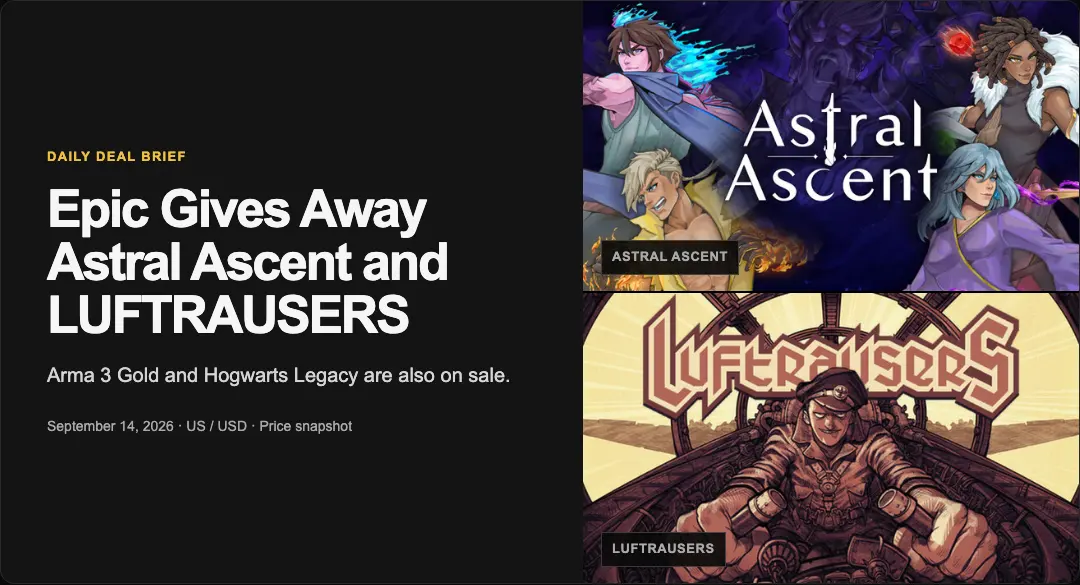
Grab two free PC games before Epic's clock runs out, while Undertale and Divinity: Original Sin 2 are 75% off
Astral Ascent and LUFTRAUSERS are free to keep today, while two of PC gaming's most celebrated RPGs cost less than $14 c













Chainsaw Princess of the Ruined City launched on Steam on May 5, and Rock Paper Shotgun quickly followed with a column highlighting the game’s mix of inspirations from Mirror’s Edge, NieR: Automata, Shadow of the Colossus, and Prince of Persia.
Developed by Regular Studio and published by Top Hat Studios, Inc., this indie action-parkour game makes its pitch immediately clear. Its biggest hook is the way it folds parkour, climbing, and combat into the same structure, and it is not subtle about where that approach comes from. In a Steam announcement posted on release day, the developer explicitly named Prince of Persia, Mirror’s Edge, Shadow of the Colossus, and the NieR series as key inspirations.

Rock Paper Shotgun framed that mix in a useful way: it argued that the game could potentially pick up the baton from Mirror’s Edge, NieR: Automata, and Shadow of the Colossus. The outlet also said the design pushes beyond Mirror’s Edge in a more brutalist direction, with enormous walls and clearly marked interactive spaces. That assessment fits the game’s visual language. Once those oversized structures and hulking industrial machines enter the frame, the identity is easy to read. Look a little closer and the climbable, blockable environmental structures make the comparisons to Shadow of the Colossus and the NieR series even more understandable.

Nostalgia is not the real risk for a game like this. The real risk is ending up as a stitched-together bundle of familiar references. Even the developer’s own announcement leaned into that with a joking line about the game being for players still waiting on a new Prince of Persia. It sounds like marketing, but it also shows the team knows exactly what it is selling: high-mobility parkour, mechanical enemies, giant structures, and a protagonist designed to grab attention. On paper, that is a strong hand. Whether it works depends on whether the feel can support the concept.
That is where expectations get complicated. Any indie game bold enough to put names like Mirror’s Edge, Prince of Persia, and NieR on the table invites scrutiny along with interest. The higher the expectation, the easier it is for the first hands-on impression to disappoint. Those games are remembered for more than just style. Their pacing, feedback, and level guidance are the hard part, and that is exactly where imitation tends to fall apart.

Even so, the fact that Rock Paper Shotgun singled out Chainsaw Princess of the Ruined City at all says something important: the game at least has a clear enough identity to stand out. In an increasingly crowded field of indie action games, it is not easy to make players instantly read the appeal as “parkour fused with colossal machinery.” That clarity matters.
The takeaway is fairly simple. If you love the movement-first thrill of Mirror’s Edge, or the aesthetic of NieR: Automata with a girl moving through mechanical ruins, this is worth putting on your watchlist. If you care more about the refinement and finish of the action system itself, it makes more sense to wait for further Steam player feedback before deciding whether to buy in.
At minimum, this feels like a very respectable first step. A game with this much personality and this clearly defined an aesthetic deserves some patience. But whether Chainsaw Princess of the Ruined City can truly inherit anything from those predecessors will depend on one thing: whether it can turn resemblance into achievement.


留言 0
歡迎發表遊戲評價
歡迎參與討論,分享對這款遊戲的評價。
暫無留言,歡迎發表評價。