資訊
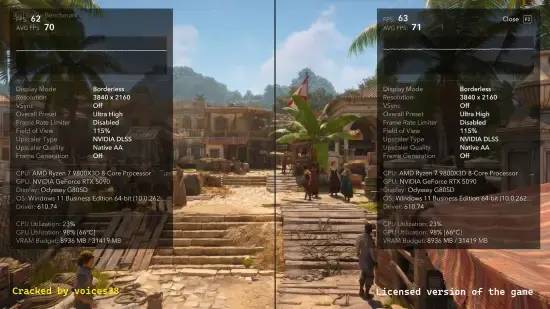
Assassin's Creed 4 Black Flag Memory Reset Removes Denuvo Without Improving Performance
After Denuvo's removal from Assassin's Creed 4: Black Flag Memory Reset, RTX 5090 performance was un
















Every time you start a new campaign, deciding whether to tweak graphics quality first or turn off effects first is, for strategy players, like choosing which key card to discard in the opening: every choice shapes the next dozens of turns of experience. As 3A games keep pushing material fidelity higher, 8GB VRAM cards frequently run out of memory at high texture settings and are forced to downgrade textures. It feels like you’ve carefully planned your tactics only for the system to flip the board over—this sense of wasted potential is incredibly frustrating.

From a systems design perspective, NVIDIA’s NTC Neural Texture Compression shown at GTC 2026 looks more like a rulebook rewrite than a simple balance hotfix. Traditional BCn-style 4×4 fixed-block texture compression is basically a rigid lookup rule that trades detail for space; NTC, on the other hand, hangs a tiny neural network behind each texture block for real-time decompression, handing the work off to matrix engines like Tensor Cores. In effect, the compress/decompress move is delegated to a dedicated “external helper” instead of fighting the base rendering pipeline for compute budget.
In terms of strategic depth, the key is that it changes our “resource curve.” In NVIDIA’s Tuscan villa demo, the same high-resolution material set that used to consume 6.5GB of VRAM with traditional block compression drops to just 970MB with NTC, with almost no visible difference. Another example is a flight helmet texture going from 272MB to 11.37MB, over 8× more efficient than the old method—nearly a 24× reduction from the original size. For players like us who run Total War with full battle replays or Civilization with ultra-heavy mod setups, this means that under the same VRAM budget, texture rendering resolution can be pushed to around four times what it used to be, with both image quality and capacity rising together, instead of the previous zero-sum choice between the two.

The catch is, what I care more about is whether this new board is just another way to force you into “whaling for a new GPU.” NTC relies on the matrix acceleration units found in modern GPUs—i.e., Tensor Cores on NVIDIA cards—and in theory doesn’t burden the main rendering pipeline. This is a very clever design choice, because it doesn’t directly demand higher raw shader throughput; instead, it turns AI accelerators from a side feature into a necessity. NVIDIA also stresses that this is not generative AI: the neural networks are trained offline during development for specific textures, and at runtime they only perform fixed mappings, so you don’t get any flashy AI hallucinations. At least in terms of determinism, that’s a plus for strategy players who demand predictable tactics.

Looking at industry trends, Intel and AMD are also pushing similar technologies, and PS6 is rumored to use something along these lines plus a 1TB SSD to control install sizes. This suggests it’s not just one vendor’s short-term gimmick, but a shared vision for the next-gen graphics pipeline. Neural materials announced at the same time take a similar approach by offloading complex BRDF lighting calculations to small networks. At 1080p, they can reportedly deliver up to a 7.7× speedup while maintaining image quality, like compressing a huge game tree into a strategy table and only doing lookups at runtime—turning real-time rendering from “deep search” into “table-driven decisions.”
From the player’s purchasing perspective, if you’re a strategy grinder like me, the value curve of 8GB cards does look likely to be extended. The meme that “an 8GB GPU can fight for another ten years” isn’t entirely detached from reality—but going all-in right now would definitely be wasteful. No released game supports NTC yet; in the short term this is more like a freshly laid-out opening book, still one meta-iteration away from real deployment. When DLSS 5, NTC, and neural materials land together in several flagship 3A titles, then we can compare them against AMD’s and Intel’s counterparts and see who leaves players more decision freedom at the systems level. That’s when those of us who care about systemic complexity should make our move.

For users with older 8GB cards, the advice is to keep your wallet in check and watch for one to two years, treating this rollout of neural textures as a midgame positional shift: it really is reshaping the trade-off between VRAM, storage, and image quality, giving large-map, high-fidelity, long-campaign strategy games a chance to return to a “compute tactics, not VRAM” trajectory. Once games with full NTC support actually launch, then we can do the real math—whether this wave is NVIDIA saving you an upgrade, or just using a more sophisticated method to push you toward the next hardware generation.

留言 0
期待聽到你的聲音
歡迎來到評論區!說說你對這款遊戲的看法,第一個發言說不定有驚喜~
還沒有留言,來搶頭香吧!