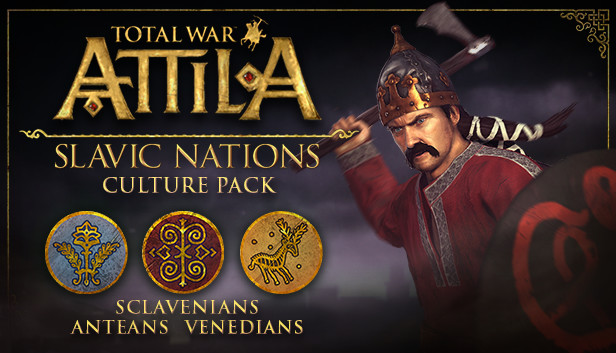
DLCTotal War: ATTILA - Slavic Nations Culture Pack~ €7.49~ €3.00-60%→über Kinguin
“A reverse campaign driven by climate collapse, asymmetric factions, and harsh strategic depth, built for patient hardcore history-strategy veterans.”
If you ask whether this game is worth fifty or sixty hours, I would answer with a question of my own: can you accept a grand-strategy game telling you, in all seriousness, to stop dreaming of conquering the world and start figuring out how to merely stay alive? If you can, it is very much worth it. If you cannot, it will hurt.
From a present-day player's vantage point, Total War: Attila occupies an interesting position. Its visuals are only upper-middle tier and its UI carries plenty of historical baggage. But in terms of systems design and content composition, it plainly reads like a work from its era that concentrated a whole set of new ideas into one experiment.
The nomadic horde mechanic, the reverse-campaign rhythm born from climate pressure, and the heavily asymmetric faction design still do not feel dated today; if anything, they remain rare. And yet this is not a game that flatters you. Its learning curve is steep, its difficulty is unfriendly to newcomers, and the campaign repeatedly forces you into decisions that are unpleasant but rational: dismantling your own city, giving up an entire stretch of border, signing an ugly truce with a power that had you on the ropes only a turn ago. If you are used to the crowd-pleasing arc of climbing from weak to strong, this will more often feel like starring in a heavy historical documentary where the protagonist is not you but an age destined to fall apart. The game asks you to sit with that discomfort rather than escape it, and that single demand is what separates the players who bounce off in the first few hours from the ones who quietly fall in love with it over the next forty.
For veteran strategy players, this is exactly where the magic lives. Every campaign is a long-distance run: you have to account for resources and terrain, but even more for your own state of mind, accepting an outlook where doing everything right still only postpones the loss. Players willing to chew on that oppressive mood as a deliberate part of the design will realize, dozens of hours later, that they have rewritten several different versions of the answer to "why did Rome fall," each through a different faction's eyes. Stacked against peers like a long historical strategy epic, Attila trades broad accessibility for a sharper, darker thesis, and it commits to that thesis without blinking. So it is not the kind of fast food everyone should take a bite of; it is a heavy dish that only yields its flavor with time and patience. Players who love strategy and are happy to wrestle with systems will find here a battlefield worth settling into for the long haul, and a score in the mid-eights reflects exactly that: a flawed, demanding, and genuinely distinctive grand-strategy game that knows precisely who it is for.
Kommentare 0
Wir freuen uns auf deine Meinung
Beteilige dich an der Diskussion und teile deine Bewertung des Spiels.
Noch keine Kommentare. Teile deine Bewertung.